


Shopping Cart
Remove All Your shopping cart is currently empty

Synonyms: 4-Oxo-tempo
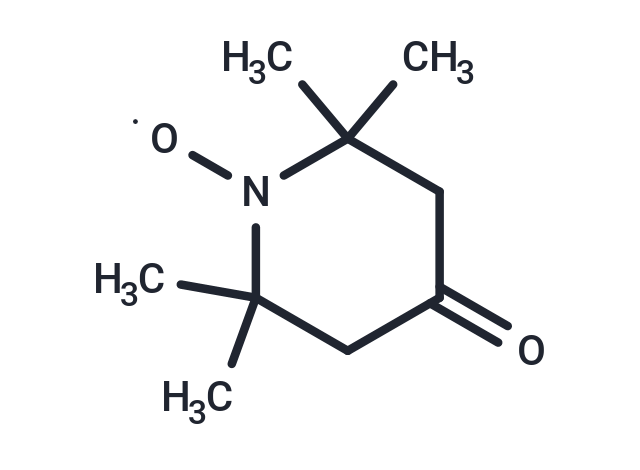
| Pack Size | Price | USA Stock | Global Stock | Quantity |
|---|---|---|---|---|
| 2 g | $29 | - | In Stock |
| Description | Tempone is an aminooxyalkane that acts as a free radical scavenger and reacts with reactive oxygen species (ROS). Intravenous Tempone reduces mean arterial pressure in spontaneously hypertensive rats. |
| In vivo | Tempone (100 mg/kg i.v. bolus followed by 30 mg/kg i.v. infusion; rats) significantly improved both glomerular and tubular function (serum urea, creatinine, creatinine clearance, and fractional excretion of Na(+)) in a dose-dependent manner and significantly attenuated the reperfusion-injury associated with I/R (urinary N-acetyl-beta-D-glucosaminidase, aspartate aminotransferase, assessment of renal histology). Tempone also markedly reduced the immunohistochemical evidence of the formation of nitrotyrosine and poly(ADP-ribose), indicating a reduction of nitrosative and oxidative stress, respectively. Importantly, in contrast to its in vivo metabolite TEMPOL (which also provided protective effects against renal I/R and oxidative stress of PT cells), Tempone reduced renal dysfunction and injury without causing a significant reduction in blood pressure upon administration. These results suggest, for the first time, that Tempone can reduce the renal dysfunction and injury caused by I/R and the injury caused to PT cells by oxidative stress without producing the adverse cardiovascular effects observed when using other nitroxyl radicals.[2] |
| Synonyms | 4-Oxo-tempo |
| Molecular Weight | 170.23 |
| Formula | C9H16NO2 |
| Cas No. | 2896-70-0 |
| Smiles | CC1(C)CC(=O)CC(C)(C)N1[O] |
| Relative Density. | 1.0710 g/cm3 (Estimated) |
| Storage | Powder: -20°C for 3 years | In solvent: -80°C for 1 year Shipping with blue ice/Shipping at ambient temperature. | ||||||||||||||||||||||||||||||||||||||||
| Solubility Information | DMSO: 45 mg/mL (264.35 mM), Sonication is recommended.  PBS (pH 7.2): 10 mg/mL (58.74 mM), Sonication is recommended. DMF: 30 mg/mL (176.23 mM), Sonication is recommended. Ethanol: 30 mg/mL (176.23 mM), Sonication is recommended. | ||||||||||||||||||||||||||||||||||||||||
Solution Preparation Table | |||||||||||||||||||||||||||||||||||||||||
PBS (pH 7.2)/DMF/Ethanol/DMSO
DMF/Ethanol/DMSO
Note : The dilution table applies only to solid products. For liquid products, please calculate the stock solution based on the stated concentration and/or density. | |||||||||||||||||||||||||||||||||||||||||
 For example, if the intended dosage is 10 mg/kg for animals weighing 20 g , with a dosing volume of 100 μL per animal, and a total of 10 animals are to be administered, using a formulation of
  10% DMSO+ 40% PEG300+ 5% Tween 80+ 45% Saline/PBS/ddH2O , the resulting working solution concentration would be 2 mg/mL.
Dissolve 2 mg of the compound in 100 μL DMSO to obtain a stock solution at a concentration of 20 mg/mL . If the required concentration exceeds the compound's known solubility, please contact us for technical support before proceeding.
1) Add 100 μL of the DMSO stock solution to 400 µL PEG300 and mix thoroughly until the solution becomes clear.
2) Add 50 µL Tween 80 and mix well until fully clarified.
3) Add 450 µL Saline,PBS or ddH2O and mix thoroughly until a homogeneous solution is obtained.
| Size | Quantity | Unit Price | Amount | Operation |
|---|
 Feedback
 Hello! How can I help you today?
Copyright © 2015-2026 TargetMol Chemicals Inc. All Rights Reserved.
