


Shopping Cart
Remove All Your shopping cart is currently empty


Synonyms: SR 151716A, SR 141716A
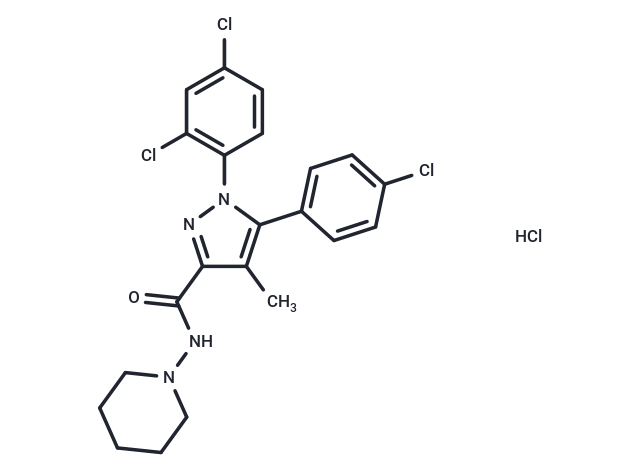
| Pack Size | Price | USA Stock | Global Stock | Quantity |
|---|---|---|---|---|
| 5 mg | $38 | In Stock | In Stock | |
| 10 mg | $61 | In Stock | In Stock | |
| 25 mg | $118 | In Stock | In Stock | |
| 50 mg | $217 | In Stock | In Stock | |
| 100 mg | $327 | In Stock | In Stock | |
| 500 mg | $783 | In Stock | In Stock | |
| 1 mL x 10 mM (in DMSO) | $43 | In Stock | In Stock |
| Description | Rimonabant hydrochloride (SR 141716A) is a cannabinoid receptor antagonist, binding selectively to central cannabinoid receptors (CB1) with high affinity. |
| Targets & IC50 | CB1 receptor:1.8 nM(ki) |
| In vitro | Rimonabant hydrochloride (SR 141716A) binds selectively to central cannabinoid receptors (CB1) with high affinity (Ki=2 nM), and blocks the inhibitory effects of cannabinoid receptor agonists in the mouse vas deferens, dopamine-stimulated adenylyl cyclase and WIN 55212-stimulated GTPγS binding[1]. Rimonabant dose-dependently inhibited CO synthesis in Raw 264.7 macrophages, with 1 μM producing a significant (~40%) decrease compared to untreated controls and concentrations ≥ 5 μM producing near complete inhibition. A small, but significant, reduction of TG and DG synthesis is also observed with Rimonabant at concentrations ≥ 10 μM. Inhibition of CO synthesis in Raw 264.7 macrophages by Rimonabant (IC50 value 2.9±0.38 μM) is very similar to that of AM251 and SR144528 (IC50 value 2.6±0.26 μM and 2.5±0.32 μM, respectively), two related compounds previously demonstrated to be potent ACAT inhibitors. Mouse peritoneal macrophages also displayed significantly reduced CO synthesis in response to Rimonabant treatment. Rimonabant at concentrations ≥ 1 μM significantly inhibits CO synthesis in CHO-ACAT1 and CHO-ACAT2 cells in a concentration-dependent manner with similar efficiency (IC50s of 1.5±1.2 μM and 2.2±1.1 μM, respectively)[2]. |
| In vivo | Pretreatment with Rimonabant hydrochloride (SR 141716A) blocks the antinociceptive, discriminative stimulus, memory impairing and hypolocomotor effects produced by Δ-9-THC. SR 141716A also precipitates a withdrawal syndrome in rats treated chronically with Δ-9-THC[1]. Pretreatment of mice with 0.1?mg/kg of WIN 55212-2 is effective in increasing the CPP induced by MDMA , while 1?mg/kg of Rimonabant specifically blocks CB1 receptors and does not act as an inverse agonist[3]. |
| Synonyms | SR 151716A, SR 141716A |
| Kinase Assay | Raw 264.7 cells (2×10⁶/well) in 12-well plates are rinsed with PBS and refed culture media supplemented with varying amounts of Rimonabant 1h prior to supplementation with 7-ketocholesterol (7KC). All wells are adjusted to receive equal amounts of vehicle. Following a 16 h incubation, caspase-3 and caspase 3-like activity is determined[2]. |
| Molecular Weight | 500.25 |
| Formula | C22H22Cl4N4O |
| Cas No. | 158681-13-1 |
| Smiles | n1(nc(c(c1c1ccc(cc1)Cl)C)C(=O)NN1CCCCC1)c1c(cc(cc1)Cl)Cl.Cl |
| Relative Density. | no data available |
| Storage | Powder: -20°C for 3 years | In solvent: -80°C for 1 year Shipping with blue ice/Shipping at ambient temperature. | |||||||||||||||||||||||||||||||||||
| Solubility Information | DMSO: 125 mg/mL (249.88 mM), Sonication is recommended.  | |||||||||||||||||||||||||||||||||||
| In Vivo Formulation | 10% DMSO+90% Saline: < 10 mg/mL (19.99 mM), Lower concentrations may be soluble, but exact solubility limit is unknown. 10% DMSO+90% Corn Oil: 2.5 mg/mL (5 mM), Sonication is recommended. 10% DMSO+40% PEG300+5% Tween 80+45% Saline: 10 mg/mL (19.99 mM), Solution. Please add the solvents sequentially, clarifying the solution as much as possible before adding the next one. Dissolve by heating and/or sonication if necessary. Working solution is recommended to be prepared and used immediately. The formulation provided above is for reference purposes only. In vivo formulations may vary and should be modified based on specific experimental conditions. | |||||||||||||||||||||||||||||||||||
Solution Preparation Table | ||||||||||||||||||||||||||||||||||||
DMSO
Note : The dilution table applies only to solid products. For liquid products, please calculate the stock solution based on the stated concentration and/or density. | ||||||||||||||||||||||||||||||||||||
 For example, if the intended dosage is 10 mg/kg for animals weighing 20 g , with a dosing volume of 100 μL per animal, and a total of 10 animals are to be administered, using a formulation of
  10% DMSO+ 40% PEG300+ 5% Tween 80+ 45% Saline/PBS/ddH2O , the resulting working solution concentration would be 2 mg/mL.
Dissolve 2 mg of the compound in 100 μL DMSO to obtain a stock solution at a concentration of 20 mg/mL . If the required concentration exceeds the compound's known solubility, please contact us for technical support before proceeding.
1) Add 100 μL of the DMSO stock solution to 400 µL PEG300 and mix thoroughly until the solution becomes clear.
2) Add 50 µL Tween 80 and mix well until fully clarified.
3) Add 450 µL Saline,PBS or ddH2O and mix thoroughly until a homogeneous solution is obtained.
| Size | Quantity | Unit Price | Amount | Operation |
|---|
 Feedback
 Hello! How can I help you today?
Copyright © 2015-2026 TargetMol Chemicals Inc. All Rights Reserved.
