


Shopping Cart
Remove All Your shopping cart is currently empty


Synonyms:
| Pack Size | Price | USA Stock | Global Stock | Quantity |
|---|---|---|---|---|
| 1 mg | $41 | In Stock | In Stock | |
| 5 mg | $113 | In Stock | In Stock | |
| 10 mg | $193 | In Stock | In Stock | |
| 25 mg | $317 | In Stock | In Stock | |
| 50 mg | $445 | In Stock | In Stock | |
| 100 mg | $601 | In Stock | In Stock | |
| 200 mg | $805 | In Stock | In Stock |
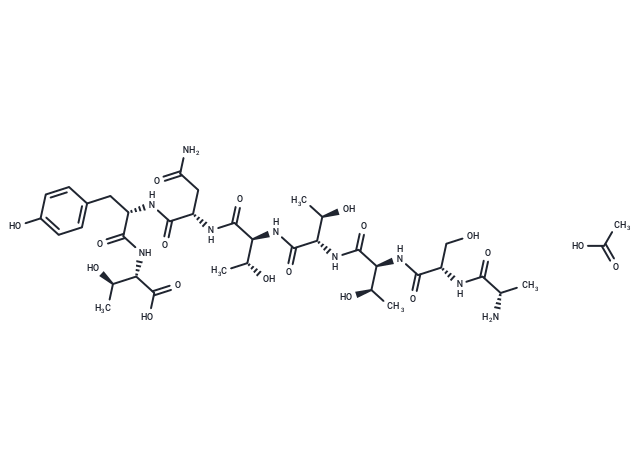
| Description | Peptide T acetate is an octapeptide from the V2 region of HIV-1 gp120. Peptide T is a synthetic octapeptide whose possible mechanism of action is the competitive inhibition of gp120 to the CD4 receptor as well as binding to vasointestinal peptide receptors and inhibiting cytokine action |
| In vitro | Peptide T acts to block viral entry as it inhibits in the MAGI cell assay and blocks infection in the luciferase reporter assay using HIV virions pseudotyped with ADA envelope. Peptide T selectively inhibits HIV replication using chemokine receptor CCR5 compared to CXC4[2]. Peptide T at 10-8 M induces IL-10 production by the human Th2 cell line and PBMC. Also peptide T at 10-9 M concentration significantly inhibits IFN-g production by PBMC[3]. |
| In vivo | Peptide T is administered subcutaneously at different doses and phases of the experimental autoimmune encephalomyelitis (EAE) disease, but Peptide T neither prevents nor ameliorates EAE[4]. |
| Molecular Weight | 917.91 |
| Formula | C37H59N9O18 |
| Smiles | C[C@H]([C@@H](C(=O)N[C@@H]([C@@H](C)O)C(=O)N[C@@H]([C@@H](C)O)C(=O)N[C@@H](CC(=O)N)C(=O)N[C@@H](CC1=CC=C(C=C1)O)C(=O)N[C@@H]([C@@H](C)O)C(=O)O)NC(=O)[C@H](CO)NC(=O)[C@H](C)N)O.CC(=O)O |
| Relative Density. | no data available |
| Sequence | H-Ala-Ser-Thr-Thr-Thr-Asn-Tyr-Thr-OH |
| Sequence Short | ASTTTNYT |
| Storage | Keep away from moisture Powder: -20°C for 3 years | In solvent: -80°C for 1 year Shipping with blue ice/Shipping at ambient temperature. | |||||||||||||||
| Solubility Information | H2O: 5 mM, Sonication is recommended. DMSO: Insoluble | |||||||||||||||
Solution Preparation Table | ||||||||||||||||
H2O
Note : The dilution table applies only to solid products. For liquid products, please calculate the stock solution based on the stated concentration and/or density. | ||||||||||||||||
 For example, if the intended dosage is 10 mg/kg for animals weighing 20 g , with a dosing volume of 100 μL per animal, and a total of 10 animals are to be administered, using a formulation of
  10% DMSO+ 40% PEG300+ 5% Tween 80+ 45% Saline/PBS/ddH2O , the resulting working solution concentration would be 2 mg/mL.
Dissolve 2 mg of the compound in 100 μL DMSO to obtain a stock solution at a concentration of 20 mg/mL . If the required concentration exceeds the compound's known solubility, please contact us for technical support before proceeding.
1) Add 100 μL of the DMSO stock solution to 400 µL PEG300 and mix thoroughly until the solution becomes clear.
2) Add 50 µL Tween 80 and mix well until fully clarified.
3) Add 450 µL Saline,PBS or ddH2O and mix thoroughly until a homogeneous solution is obtained.
| Size | Quantity | Unit Price | Amount | Operation |
|---|
 Feedback
 Hello! How can I help you today?
Copyright © 2015-2026 TargetMol Chemicals Inc. All Rights Reserved.
