


Shopping Cart
Remove All Your shopping cart is currently empty

Synonyms:

| Pack Size | Price | USA Stock | Global Stock | Quantity |
|---|---|---|---|---|
| 5 mg | $53 | In Stock | In Stock | |
| 10 mg | $77 | In Stock | In Stock | |
| 25 mg | $126 | In Stock | In Stock | |
| 50 mg | $207 | In Stock | In Stock | |
| 100 mg | $369 | - | In Stock | |
| 500 mg | $885 | - | In Stock | |
| 1 mL x 10 mM (in DMSO) | $57 | In Stock | In Stock |
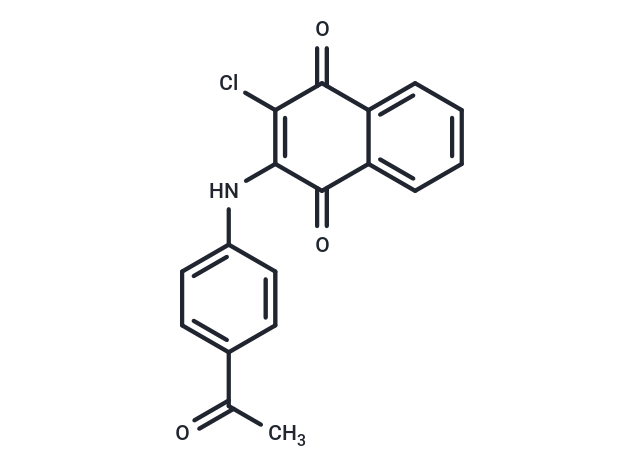
| Description | NQ301, an antithrombotic agent, inhibits collagen-challenged rabbit platelet aggregation (IC50: 10 mg/mL). |
| Targets & IC50 | Platelet aggregation (rabbit, collagen-challenged):10 mg/mL |
| In vitro | NQ301 dose-dependently inhibits collagen (10 mg/mL, IC50: 0.60±0.02 μM), U46619 (1 mg/mL, IC50: 0.58±0.04 μM) and arachidonic acid (100 mg/mL, IC50: 0.78±0.04 μM) challenged rabbit platelet aggregation. NQ301 potently suppresses thromboxane B2 formation by platelets that are exposed to arachidonic acid in a concentration-dependent manner, but had no effect on the production of prostaglandin D2, indicating an inhibitory effect on thromboxane A2 synthase. NQ301 markedly inhibits the increase of cytosolic Ca2+ concentration and ATP secretion, and also markedly increases platelet cAMP levels in the activated platelets. The antiplatelet activity of NQ301 may be mediated by inhibition of cytosolic Ca2+ mobilization, enhancement of cAMP production and inhibition of ATP secretion in activated platelets. |
| Kinase Assay | Compounds are dissolved in DMSO (5 mg/mL) and diluted with PBS/EtOH (70:30).Kinetic analyses are carried out for TB5 and TB8. A set of Lineweaver–Burk plots are constructed in the absence and presence of various concentrations of compounds TB5 and TC8. The set consists of five graphs, each constructed by measuring MAO-B and MAO-A catalytic rates at different substrate concentrations (0.1-1 μM). The first Lineweaver–Burk plot is constructed in the absence of inhibitor, while the remaining four graphs are constructed in the presence of different concentrations of TB5 and TB8[1]. |
| Cell Research | ished rabbit platelet suspension is challenged by addition of collagen (10 mg/mL), arachidonic acid (100 μM) or U46619 (1 μM). Concentration- response relationship is determined in the absence or presence of a range of concentrations of NQ301 (0, 0.25, 0.5, 0.75, 1 μM); aspirin-treated platelets (50 μM for 5 min) are used to prevent any possible contribution of endogenous arachidonic acid metabolites to platelet aggregation. The resulting aggregation, measured as the change in light transmission, is recorded for 5 min. The extent of platelet aggregation is expressed as % of the control[1]. |
| Molecular Weight | 325.75 |
| Formula | C18H12ClNO3 |
| Cas No. | 130089-98-4 |
| Smiles | CC(=O)c1ccc(NC2=C(Cl)C(=O)c3ccccc3C2=O)cc1 |
| Relative Density. | 1.40 g/cm3 (Predicted) |
| Storage | Powder: -20°C for 3 years | In solvent: -80°C for 1 year Shipping with blue ice/Shipping at ambient temperature. | |||||||||||||||||||||||||
| Solubility Information | DMSO: 6.88 mg/mL (21.12 mM), Sonication is recommended.  | |||||||||||||||||||||||||
Solution Preparation Table | ||||||||||||||||||||||||||
DMSO
Note : The dilution table applies only to solid products. For liquid products, please calculate the stock solution based on the stated concentration and/or density. | ||||||||||||||||||||||||||
 For example, if the intended dosage is 10 mg/kg for animals weighing 20 g , with a dosing volume of 100 μL per animal, and a total of 10 animals are to be administered, using a formulation of
  10% DMSO+ 40% PEG300+ 5% Tween 80+ 45% Saline/PBS/ddH2O , the resulting working solution concentration would be 2 mg/mL.
Dissolve 2 mg of the compound in 100 μL DMSO to obtain a stock solution at a concentration of 20 mg/mL . If the required concentration exceeds the compound's known solubility, please contact us for technical support before proceeding.
1) Add 100 μL of the DMSO stock solution to 400 µL PEG300 and mix thoroughly until the solution becomes clear.
2) Add 50 µL Tween 80 and mix well until fully clarified.
3) Add 450 µL Saline,PBS or ddH2O and mix thoroughly until a homogeneous solution is obtained.
| Size | Quantity | Unit Price | Amount | Operation |
|---|
 Feedback
 Hello! How can I help you today?
Copyright © 2015-2026 TargetMol Chemicals Inc. All Rights Reserved.
