


Shopping Cart
Remove All Your shopping cart is currently empty

Synonyms: NSC-92522, NSC92522, NSC 92522, L-Homocarnosine
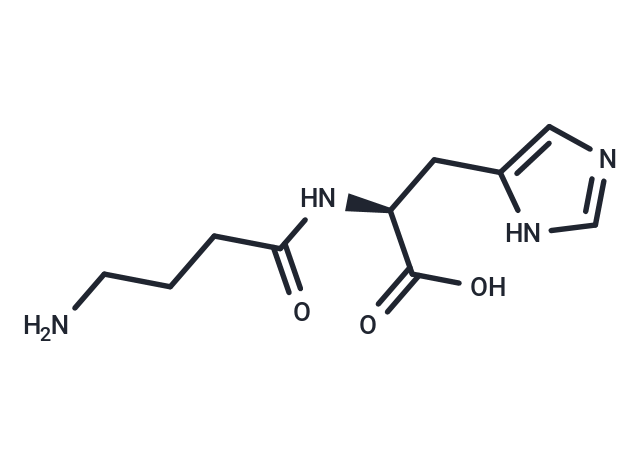
| Pack Size | Price | USA Stock | Global Stock | Quantity |
|---|---|---|---|---|
| 1 mg | $159 | 35 days | 35 days | |
| 5 mg | $686 | 35 days | 35 days | |
| 10 mg | $1,230 | 35 days | 35 days |
| Description | Homocarnosine is a brain-specific dipeptide composed of γ-aminobutyric acid (GABA) and histidine. As an inhibitory neurotransmitter, homocarnosine is synthesized from GABA within neurons and exerts anticonvulsant effects by enhancing GABA receptor signaling pathways. Homocarnosine also possesses antioxidant and anti-inflammatory properties; it scavenges peroxyl radicals, chelates transition metal ions such as copper, prevents oxidative damage to DNA, and inhibits the formation of advanced glycation end products (AGEs). |
| In vivo | Methods: To investigate the role of homocarnosine in osteomyelitis, male albino rats were used to establish a Staphylococcus aureus-induced osteomyelitis model. After successful model establishment, homocarnosine (25 mg/kg) was administered orally via gavage for 3 consecutive days. Results: Homocarnosine treatment significantly reduced MDA levels compared to the model group; furthermore, CAT, SOD, GPx, and GSH levels recovered to levels close to those of the control group. [1] Methods: To investigate the preventive effect of homocarnosine against Staphylococcus aureus infection, female Swiss mice were administered homocarnosine (5 mg/mouse) via subcutaneous injection in divided doses for 3 consecutive days. Bacterial challenge was performed within 1 hour after the final dose, and mortality rates were observed over 5 days. Results: Homocarnosine significantly reduced mouse mortality caused by Staphylococcus aureus infection; the average mortality rate in the homocarnosine-treated group was 20%, compared to 84% in the untreated control group.[2] |
| Synonyms | NSC-92522, NSC92522, NSC 92522, L-Homocarnosine |
| Molecular Weight | 240.26 |
| Formula | C10H16N4O3 |
| Cas No. | 3650-73-5 |
| Smiles | C([C@H](NC(CCCN)=O)C(O)=O)C1=CN=CN1 |
| Relative Density. | 1.327 g/cm3 (Predicted) |
| Sequence | His-{N-(4-aminobutyryl)} |
| Sequence Short | H-{N-(4-aminobutyryl)} |
| Storage | Powder: -20°C for 3 years | In solvent: -80°C for 1 year Shipping with blue ice/Shipping at ambient temperature. |
 For example, if the intended dosage is 10 mg/kg for animals weighing 20 g , with a dosing volume of 100 μL per animal, and a total of 10 animals are to be administered, using a formulation of
  10% DMSO+ 40% PEG300+ 5% Tween 80+ 45% Saline/PBS/ddH2O , the resulting working solution concentration would be 2 mg/mL.
Dissolve 2 mg of the compound in 100 μL DMSO to obtain a stock solution at a concentration of 20 mg/mL . If the required concentration exceeds the compound's known solubility, please contact us for technical support before proceeding.
1) Add 100 μL of the DMSO stock solution to 400 µL PEG300 and mix thoroughly until the solution becomes clear.
2) Add 50 µL Tween 80 and mix well until fully clarified.
3) Add 450 µL Saline,PBS or ddH2O and mix thoroughly until a homogeneous solution is obtained.
| Size | Quantity | Unit Price | Amount | Operation |
|---|
 Feedback
 Hello! How can I help you today?
Copyright © 2015-2026 TargetMol Chemicals Inc. All Rights Reserved.
