


Shopping Cart
Remove All Your shopping cart is currently empty

Synonyms: Aescin
| Pack Size | Price | USA Stock | Global Stock | Quantity |
|---|---|---|---|---|
| 50 mg | $30 | - | In Stock | |
| 100 mg | $39 | - | In Stock | |
| 500 mg | $89 | - | In Stock |
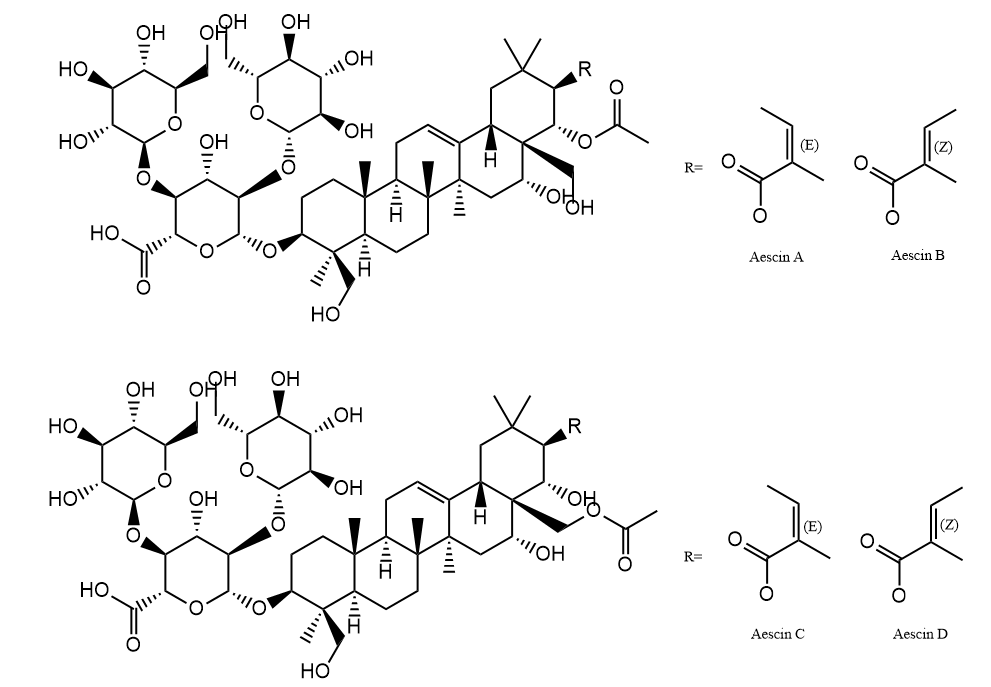
| Description | Escin (Aescin) is biosynthesized from protoaescigenin and barringtogenol, occurring in the seeds of Aesculus. |
| In vitro | Escin is effective to inhibit pancreatic cancer cell proliferation as a single agent. However, escin has minimal effect on normal rat skeletal muscle cells. Escin potentiates the proliferation-inhibiting and apoptosis-inducing effect of gemcitabine in both BxPC-3 and PANC-1 cell lines in vitro. It also down-regulates constitutive as well as gemcitabine-induced activation of NF-kB and its downstream gene products in pancreatic cancer cells in vitro[1]. |
| In vivo | Escin augments therapeutic effect of gemcitabine in BxPC-3 xenografts in nude mice. They have significant synergistic effects on suppressing the growth of pancreatic tumors, inhibiting the proliferation and inducing apoptosis of tumors. Escin potentiates the inhibiting effect of gemcitabine on NF-kB and NF-kB-regulated gene products in BxPC-3 xenografts in nude mice[1]. |
| Synonyms | Aescin |
| Cell Research | Cell cycle analysis: After treatment with escin (BxPC-3 (25 μM),PANC-1 (20 μM),respectively), gemcitabine (BxPC-3(100 nM), PANC-1(1 μM), respectively) or their combinations for 72 h, BxPC-3 and PANC-1 cells are collected by trypsinization, washed with ice-cold PBS and fixed overnight by the addition of 2 ml of ice-cold 70% ethanol/30% PBS at 4°C. The ethanol is subsequently removed after centrifugation, and about 1×10⁶ cells are resuspended in 800 μl of PBS, 100 μl of ribonuclease A (500 g/ml PBS) and 100 μl of PI (500 g/ml PBS) in the dark at room temperature for 30 min. Flow cytometric analysis is performed using FACScan for the detection of the percentage of cells in the diVerent phases of the cell cycle. Cells treated with DMSO alone are used as controls. (Only for Reference) |
| Molecular Weight | 1131.27 |
| Formula | C55H86O24 |
| Cas No. | 6805-41-0 |
| Relative Density. | 1.1200 g/cm3 (Estimated) |
| Storage | Powder: -20°C for 3 years | In solvent: -80°C for 1 year Shipping with blue ice/Shipping at ambient temperature. |
| Solubility Information | DMSO: < 1 mg/mL (insoluble), Sonication is recommended.  H2O: < 1 mg/mL (insoluble or slightly soluble) Ethanol: < 1 mg/mL (insoluble or slightly soluble) |
| In Vivo Formulation | 10% DMSO+40% PEG300+5% Tween 80+45% Saline: 1 mg/mL (0.88 mM), Sonication is recommended. Please add the solvents sequentially, clarifying the solution as much as possible before adding the next one. Dissolve by heating and/or sonication if necessary. Working solution is recommended to be prepared and used immediately. The formulation provided above is for reference purposes only. In vivo formulations may vary and should be modified based on specific experimental conditions. |
 For example, if the intended dosage is 10 mg/kg for animals weighing 20 g , with a dosing volume of 100 μL per animal, and a total of 10 animals are to be administered, using a formulation of
  10% DMSO+ 40% PEG300+ 5% Tween 80+ 45% Saline/PBS/ddH2O , the resulting working solution concentration would be 2 mg/mL.
Dissolve 2 mg of the compound in 100 μL DMSO to obtain a stock solution at a concentration of 20 mg/mL . If the required concentration exceeds the compound's known solubility, please contact us for technical support before proceeding.
1) Add 100 μL of the DMSO stock solution to 400 µL PEG300 and mix thoroughly until the solution becomes clear.
2) Add 50 µL Tween 80 and mix well until fully clarified.
3) Add 450 µL Saline,PBS or ddH2O and mix thoroughly until a homogeneous solution is obtained.
| Size | Quantity | Unit Price | Amount | Operation |
|---|
 Feedback
 Hello! How can I help you today?
Copyright © 2015-2026 TargetMol Chemicals Inc. All Rights Reserved.
