


Shopping Cart
Remove All Your shopping cart is currently empty

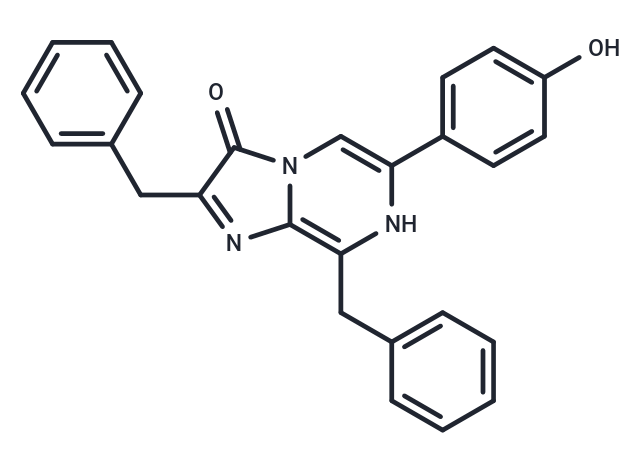
Synonyms: CLZN-h, 2-Deoxycoelenterazine
| Pack Size | Price | USA Stock | Global Stock | Quantity |
|---|---|---|---|---|
| 500 µg | $62 | In Stock | In Stock | |
| 1 mg | $89 | In Stock | In Stock | |
| 5 mg | $228 | In Stock | In Stock | |
| 10 mg | $372 | In Stock | In Stock | |
| 25 mg | $613 | In Stock | In Stock | |
| 50 mg | $869 | - | In Stock | |
| 100 mg | $1,170 | - | In Stock | |
| 200 mg | $1,570 | - | In Stock |
| Description | Coelenterazine h is a dehydroxy derivative of natural coelenterazine and serves as a luminescent substrate for RLuc8. Coelenterazine h is Ca²⁺-sensitive, making it an effective tool for measuring minute changes in Ca²⁺ concentration. Coelenterazine h is widely used in cell biology, molecular biology, drug discovery, and in vivo imaging. |
| Targets & IC50 | superoxide anion (Rat Hepatocyte cells):69 μM |
| In vitro | Methods: In BRET sensor (BRAC) studies, Coelenterazine-h (20 μM in vitro, 10 μM in cells) serves as the substrate for RLuc8, initiating the BRET signaling chain for real-time monitoring of Ca²⁺ binding kinetics. Changes in Venus (530 nm) emission were recorded at a high frequency of 1 kHz via stop-and-go spectroscopy. Results: The Ca²⁺ dissociation time constant τ_off = 0.21 s was successfully resolved, approximately 14 times faster than conventional FRET indicators. [1] Methods: C6 (rat glioma) cells were transfected with pCMV-Rluc plasmid. Cell lysates were obtained 48 hours post-transfection. Cell lysates were mixed with Coelenterazine h (0.1, 1, 10, 50, 100, 200 μg/mL) and measured for 10 seconds. A luminometer recorded RLU/mg protein. Results: Luminescence increased with Coelenterazine h concentration, peaking at 50 μg/mL, then decreased at higher doses. [2] Methods: Human breast cancer cells (MCF-7) were treated with Rluc8.6-KR-LP (10 μM) for 24 hours, followed by Coelenterazine h (150 μM) for an additional 24 hours. Analysis included fluorescence microscopy (DAPI staining for live cells, SYTOX Green for dead cells, KR red fluorescence tracing) and flow cytometry quantification. Results: The Rluc8.6-KR-LP + Coelenterazine H group exhibited substantial cell death, with KR red fluorescence localized to the cell membrane. [3] |
| In vivo | Methods: C6-Rluc cells (1×10⁶) were injected into the mouse tail vein (cells naturally homed to liver/lung). Coelenterazine h (2.8 mg/kg) was administered via tail vein injection 90 minutes after cell injection. Imaging was performed using a cooled CCD camera for 7-10 minutes. Following euthanasia, tissue homogenates were collected and verified using a luminometer. Results: Signals were detectable in the chest and upper abdomen (liver/lung regions), peaking at 5 minutes and decaying between 7–10 minutes. Tissue homogenate analysis confirmed signals primarily originated from the lungs. [2] Methods: NOD SCID-γ immunodeficient mice subcutaneously implanted with MDA-MB-231 human breast cancer cells. Three intra-tumoral injections of Rluc8.6-KR-LP (1 nmol) were administered via intratumoral injection. Coelenterazine h (5 μg) was injected subcutaneously on the second day after protein injection. Tumor volume was measured 2-3 times weekly. Results: Rluc8.6-KR-LP + Coelenterazine h significantly inhibited tumor growth, with an average volume of 127 mm³ on day 34.[3] |
| Synonyms | CLZN-h, 2-Deoxycoelenterazine |
| Molecular Weight | 407.46 |
| Formula | C26H21N3O2 |
| Cas No. | 50909-86-9 |
| Smiles | C(C1=C2N(C=C(N1)C3=CC=C(O)C=C3)C(=O)C(CC4=CC=CC=C4)=N2)C5=CC=CC=C5 |
| Relative Density. | 1.26 g/cm3 |
| Storage | Powder: -20°C for 3 years Shipping with blue ice/Shipping at ambient temperature. | |||||||||||||||||||||||||||||||||||
| Solubility Information | DMSO: 237.5 mg/mL (582.88 mM), Sonication is recommended.  | |||||||||||||||||||||||||||||||||||
Solution Preparation Table | ||||||||||||||||||||||||||||||||||||
DMSO
Note : The dilution table applies only to solid products. For liquid products, please calculate the stock solution based on the stated concentration and/or density. | ||||||||||||||||||||||||||||||||||||
 For example, if the intended dosage is 10 mg/kg for animals weighing 20 g , with a dosing volume of 100 μL per animal, and a total of 10 animals are to be administered, using a formulation of
  10% DMSO+ 40% PEG300+ 5% Tween 80+ 45% Saline/PBS/ddH2O , the resulting working solution concentration would be 2 mg/mL.
Dissolve 2 mg of the compound in 100 μL DMSO to obtain a stock solution at a concentration of 20 mg/mL . If the required concentration exceeds the compound's known solubility, please contact us for technical support before proceeding.
1) Add 100 μL of the DMSO stock solution to 400 µL PEG300 and mix thoroughly until the solution becomes clear.
2) Add 50 µL Tween 80 and mix well until fully clarified.
3) Add 450 µL Saline,PBS or ddH2O and mix thoroughly until a homogeneous solution is obtained.
| Size | Quantity | Unit Price | Amount | Operation |
|---|
 Feedback
 Hello! How can I help you today?
Copyright © 2015-2026 TargetMol Chemicals Inc. All Rights Reserved.
