


Shopping Cart
Remove All Your shopping cart is currently empty

Synonyms: KP-363 HCl, KP363 (Hydrochloride), Butenafine HCl
| Pack Size | Price | USA Stock | Global Stock | Quantity |
|---|---|---|---|---|
| 200 mg | $31 | In Stock | In Stock | |
| 500 mg | $53 | - | In Stock | |
| 1 g | $81 | - | In Stock | |
| 1 mL x 10 mM (in DMSO) | $57 | In Stock | In Stock |
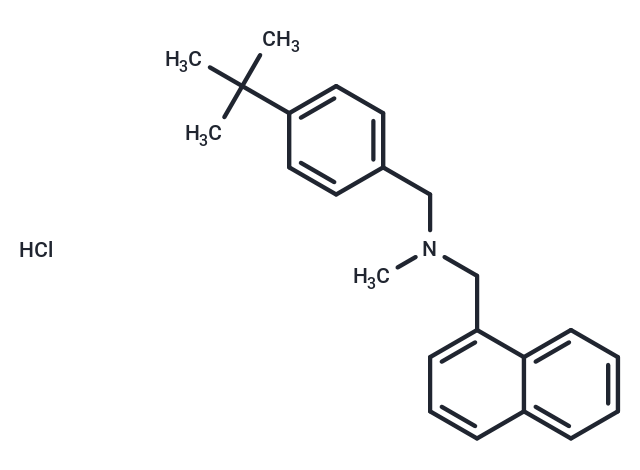
| Description | Butenafine hydrochloride (KP363 Hydrochloride) is a synthetic benzylamine antifungal, inhibiting the synthesis of sterols by inhibiting squalene epoxidase. |
| In vitro | Butenafine HCl shows minimum inhibitory concentrations ranging from 0.03–1.0 μg/mL against 30 isolates representing different dermatophyte species. Butenafine shows limited activity against C. albicans and no activity against M. furfur against 10 isolates of two species of yeasts. Butenafine HCl shows activity against β-hemolytic Streptococcus Group A and Corynebacterium but failed to inhibit S. aureus against 25 isolates representing different Gram-positive bacteria species. Butenafine fails to show activity against any of the Gram-negative strains tested. [1] Butenafine interferes with fungal ergosterol biosynthesis by inhibiting the conversion of squalene into squalene epoxide which is catalyzed by squalene epoxidase. Butenafine shows activity against KD-04 and KD-305 with minimum inhibitory concentrations of 12 ng/mL. [2] |
| In vivo | Butenafine (1%, once daily) shows excellent efficacy against dermatophytosis in male hartley strain guinea pigs, and the effect is superior to those of naftifine, tolnaftate, clotrimazole, and bifonazole. Butenafine (1%) exhibits excellent prophylactic efficacy against experimental T. mentagrophytes infection when apply once at 24 or 48 h before infection. [2] After 16 weeks, 80% of patients using medicated cream incorporating 2% butenafine HCl are cured, as opposed to none in the placebo group. Four patients in the active treatment group experience subjective mild inflammation without discontinuing treatment. During follow-up, no relapse occurres in cured patients and no improvement is seen in medication-resistant and placebo participants. [3] Butenafine (1% cream) applied once daily for 4 weeks results in an effective clinical response and mycologic cure of tinea pedis during treatment in patients with positive fungal cultures. [4] Butenafine hydrochloride (1% cream) alone is extremely effective for the treatment of hyperkeratotic-type tinea pedis patients. [5] |
| Synonyms | KP-363 HCl, KP363 (Hydrochloride), Butenafine HCl |
| Molecular Weight | 353.93 |
| Formula | C23H27N·HCl |
| Cas No. | 101827-46-7 |
| Smiles | Cl.C(c1ccc(cc1)CN(C)Cc1cccc2c1cccc2)(C)(C)C |
| Relative Density. | 1.032g/cm3 |
| Storage | Powder: -20°C for 3 years | In solvent: -80°C for 1 year Shipping with blue ice/Shipping at ambient temperature. | |||||||||||||||||||||||||||||||||||
| Solubility Information | DMSO: 71.43 mg/mL (201.82 mM), Sonication is recommended.  Ethanol: 65 mg/mL (183.65 mM), Sonication is recommended. H2O: < 1 mg/mL (insoluble or slightly soluble) | |||||||||||||||||||||||||||||||||||
| In Vivo Formulation | 10% DMSO+40% PEG300+5% Tween 80+45% Saline: 2 mg/mL (5.65 mM), Sonication is recommended. 10% DMSO+90% Saline: 7.14 mg/mL (20.17 mM), Solution. Please add the solvents sequentially, clarifying the solution as much as possible before adding the next one. Dissolve by heating and/or sonication if necessary. Working solution is recommended to be prepared and used immediately. The formulation provided above is for reference purposes only. In vivo formulations may vary and should be modified based on specific experimental conditions. | |||||||||||||||||||||||||||||||||||
Solution Preparation Table | ||||||||||||||||||||||||||||||||||||
Ethanol/DMSO
Note : The dilution table applies only to solid products. For liquid products, please calculate the stock solution based on the stated concentration and/or density. | ||||||||||||||||||||||||||||||||||||
 For example, if the intended dosage is 10 mg/kg for animals weighing 20 g , with a dosing volume of 100 μL per animal, and a total of 10 animals are to be administered, using a formulation of
  10% DMSO+ 40% PEG300+ 5% Tween 80+ 45% Saline/PBS/ddH2O , the resulting working solution concentration would be 2 mg/mL.
Dissolve 2 mg of the compound in 100 μL DMSO to obtain a stock solution at a concentration of 20 mg/mL . If the required concentration exceeds the compound's known solubility, please contact us for technical support before proceeding.
1) Add 100 μL of the DMSO stock solution to 400 µL PEG300 and mix thoroughly until the solution becomes clear.
2) Add 50 µL Tween 80 and mix well until fully clarified.
3) Add 450 µL Saline,PBS or ddH2O and mix thoroughly until a homogeneous solution is obtained.
| Size | Quantity | Unit Price | Amount | Operation |
|---|
 Feedback
 Hello! How can I help you today?
Copyright © 2015-2026 TargetMol Chemicals Inc. All Rights Reserved.
