


Shopping Cart
Remove All Your shopping cart is currently empty


Synonyms: BEC HCl
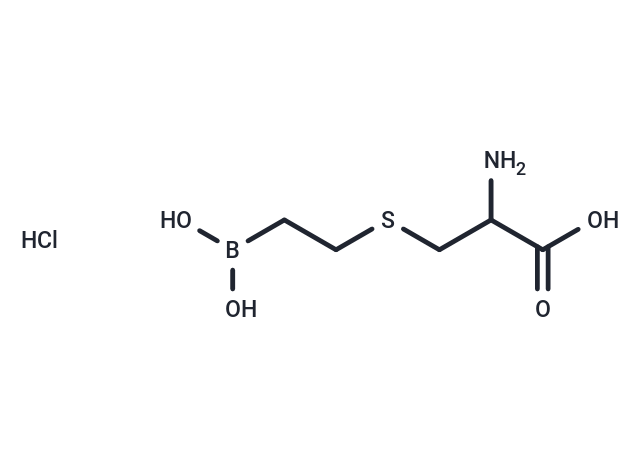

| Pack Size | Price | USA Stock | Global Stock | Quantity |
|---|---|---|---|---|
| 1 mg | $33 | In Stock | In Stock | |
| 5 mg | $81 | In Stock | In Stock | |
| 10 mg | $155 | In Stock | In Stock | |
| 25 mg | $297 | In Stock | In Stock | |
| 50 mg | $488 | In Stock | In Stock | |
| 100 mg | $698 | In Stock | - | |
| 200 mg | $967 | In Stock | - | |
| 1 mL x 10 mM (in DMSO) | $81 | In Stock | In Stock |
| Description | BEC hydrochloride (BEC HCl) is a competitive arginase inhibitor, which bind slowly. Ki of BEC HCl is 0.31 μM (pH7.5) for Arginase II, and is 0.4-0.6 μM for rat Arginase I. |
| Targets & IC50 | Arginase II:0.31 μM(Ki) |
| In vitro | BEC causes significant enhancement of NO-dependent smooth muscle relaxation. [2] In myocytes, BEC augments Ca(2+)-dependent NOS activity and NO production, and increases basal contractility. [3] BEC also inhibits the proliferation of human pulmonary artery smooth muscle cells by decreasing the expression levels of cyclin D1 and CDK4, increasing the expression of p27, and partly reducing the phosphorylation of Akt and ERK. [5] |
| In vivo | In mice with allergic inflammation (OVA/OVA), BEC enhances peribronchiolar and perivascular inflammation, leads to enhanced NF-κB DNA binding and NF-κB-dependent inflammatory gene expression, and causes an increase in the content of NOx. [4] In rats with pulmonary arterial hypertension, BEC reduces the right ventricle systolic pressure. [5] |
| Synonyms | BEC HCl |
| Kinase Assay | PI3Kα, PI3Kβ, PI3Kγ and PI3Kδ enzyme assays: The inhibition of PI3Kα, PI3Kβ, PI3Kγ and PI3Kδ human recombinant PI3K isoforms is evaluated using a Kinase-Glo Plus Assay Kit. 12 point half-log concentration-response curves with a top concentration of 100 μM are constructed by dispensing DMSO solubilised compounds into white 384-well medium-binding microplates using an Echo 555. 3 μL of the appropriate PI3K? in Tris buffer (50 mM Tris pH7.4, 0.05% CHAPS, 2.1 mM DTT, and 10 mM MgCl2) is added. The plate is covered and allowed to pre-incubate with compound for 20 minutes prior to addition of 3 μL of substrate solution containing PIP2 and ATP. The enzyme reaction is stopped after 80 minutes by the addition of Kinase Glo detection solution. Plates are covered and incubated for 30 minutes at room temperature before the luminescence signal is read using a PHERAstar plate reader. The final concentrations of DMSO, ATP and PIP2 in the assay are 2%, 8 μM, and 80 μM respectively. The final concentrations of PI3Kα, PI3Kβ, PI3Kγ and PI3Kδ are respectively 20 nM, 20 nM, 45 nM and 30 nM. For PI3Kα, PI3Kβ and PI3Kδ the concentration of active enzyme is determined as outlined in the enzyme assay tight binding limit determination section. For PI3Kγ the concentration of enzyme is determined by Bradford assay. IC50 values are calculated using Genedata Screener. |
| Molecular Weight | 229.49 |
| Formula | C5H12BNO4S·ClH |
| Cas No. | 222638-67-7 |
| Smiles | Cl.NC(CSCCB(O)O)C(O)=O |
| Relative Density. | no data available |
| Storage | Powder: -20°C for 3 years | In solvent: -80°C for 1 year Shipping with blue ice/Shipping at ambient temperature. | |||||||||||||||||||||||||||||||||||
| Solubility Information | DMSO: 31.25 mg/mL (136.17 mM), Sonication is recommended.  Ethanol: 42 mg/mL (183.01 mM), Sonication is recommended. H2O: 41 mg/mL (178.66 mM), Sonication is recommended. | |||||||||||||||||||||||||||||||||||
| In Vivo Formulation | 10% DMSO+90% Saline: 3.13 mg/mL (13.64 mM), Suspension. 10% DMSO+40% PEG300+5% Tween 80+45% Saline: 2 mg/mL (8.71 mM), Sonication is recommended. Please add the solvents sequentially, clarifying the solution as much as possible before adding the next one. Dissolve by heating and/or sonication if necessary. Working solution is recommended to be prepared and used immediately. The formulation provided above is for reference purposes only. In vivo formulations may vary and should be modified based on specific experimental conditions. | |||||||||||||||||||||||||||||||||||
Solution Preparation Table | ||||||||||||||||||||||||||||||||||||
DMSO/H2O/Ethanol
Note : The dilution table applies only to solid products. For liquid products, please calculate the stock solution based on the stated concentration and/or density. | ||||||||||||||||||||||||||||||||||||
 For example, if the intended dosage is 10 mg/kg for animals weighing 20 g , with a dosing volume of 100 μL per animal, and a total of 10 animals are to be administered, using a formulation of
  10% DMSO+ 40% PEG300+ 5% Tween 80+ 45% Saline/PBS/ddH2O , the resulting working solution concentration would be 2 mg/mL.
Dissolve 2 mg of the compound in 100 μL DMSO to obtain a stock solution at a concentration of 20 mg/mL . If the required concentration exceeds the compound's known solubility, please contact us for technical support before proceeding.
1) Add 100 μL of the DMSO stock solution to 400 µL PEG300 and mix thoroughly until the solution becomes clear.
2) Add 50 µL Tween 80 and mix well until fully clarified.
3) Add 450 µL Saline,PBS or ddH2O and mix thoroughly until a homogeneous solution is obtained.
| Size | Quantity | Unit Price | Amount | Operation |
|---|
 Feedback
 Hello! How can I help you today?
Copyright © 2015-2026 TargetMol Chemicals Inc. All Rights Reserved.
