


Shopping Cart
Remove All Your shopping cart is currently empty

Synonyms:

| Pack Size | Price | USA Stock | Global Stock | Quantity |
|---|---|---|---|---|
| 1 mg | $30 | In Stock | In Stock | |
| 2 mg | $42 | In Stock | In Stock | |
| 5 mg | $68 | In Stock | In Stock | |
| 10 mg | $108 | In Stock | In Stock | |
| 25 mg | $196 | In Stock | In Stock | |
| 50 mg | $293 | In Stock | In Stock | |
| 100 mg | $448 | - | In Stock | |
| 200 mg | $648 | - | In Stock | |
| 1 mL x 10 mM (in DMSO) | $76 | In Stock | In Stock |
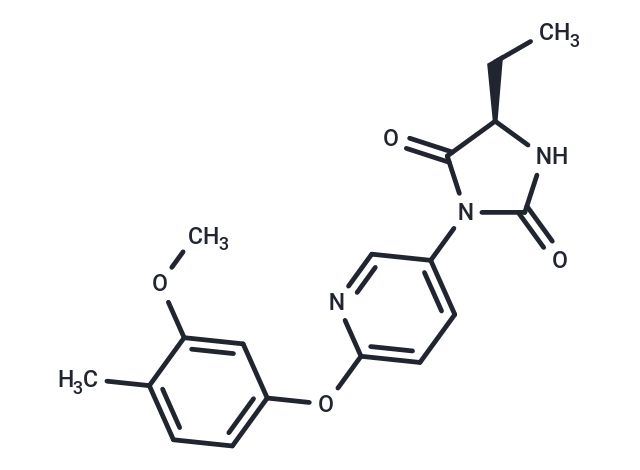
| Description | AUT1 (AUT-1) is a novel specific modulator of Kv3 channels (EC50: 4.7 and 4.9 uM for Kv3.1b and Kv3.2a). |
| Targets & IC50 | Kv3.2a channel:4.9 μM, Kv3.1b channel:4.7 μM |
| In vitro | AUT1 increased the current mediated by human recombinant Kv3.1b and Kv3.2a channels. pEC50 values for AUT1 were 5.33 (4.7 μM) and 5.31 (4.9 μM) for Kv3.1b and Kv3.2a, respectively [1]. Using Chinese hamster ovary cells stably expressing rat Kv3.1 channels, lower concentrations of AUT1 shift the voltage of activation of Kv3.1 currents toward negative potentials, increasing currents evoked by depolarization from typical neuronal resting potentials [2]. |
| Cell Research | The population patch-clamp mode of an automated voltage clamp recording with IonWorks Quattro was used. Briefly, the effects on these channels were tested using 384-well population patch-clamp plates. Seal resistance was measured for each well, and cells were perforated by incubation with 100 mg/ml amphotericin B. Cells were held at 270 mV and stepped to 215 mV for 100 milliseconds (partial channel activation), and after 100 milliseconds at 270 mV, a second pulse to 140 mV was applied for 50 milliseconds (full channel activation). In all of the experiments, this voltage protocol was applied to cells before and following a 3-minute incubation with AUT1. 1-Cyclohexyl-1-[(7,8-dimethyl-2-oxo-1H-quinolin-3-yl)methyl]-3-phenylurea (10 mM), which we had previously found to be a potent and full activator of human Kv3.1 and Kv3.2 channels, was included in all assays as a standard. An external buffer with the addition of dimethyl sulfoxide (DMSO) was also tested to provide a vehicle baseline. Recordings were performed in the following buffers: Dulbecco's phosphate-buffered saline (PBS) with MgCl2 and CaCl2 as an extracellular solution and 50 mM KCl, 100 mM K-gluconate, 3.2 mM MgCl2, and 5 mM HEPES, pH 7.3 adjusted with KOH, as an intracellular solution. An online correction of 115–20 mV was applied to correct for junction potentials. The current signal was sampled at 10 kHz [1]. |
| Molecular Weight | 341.36 |
| Formula | C18H19N3O4 |
| Cas No. | 1311136-84-1 |
| Smiles | CC[C@H]1NC(=O)N(C1=O)c1ccc(Oc2ccc(C)c(OC)c2)nc1 |
| Relative Density. | no data available |
| Storage | Keep away from moisture Powder: -20°C for 3 years | In solvent: -80°C for 1 year Shipping with blue ice/Shipping at ambient temperature. | |||||||||||||||||||||||||||||||||||
| Solubility Information | DMSO: 250 mg/mL (732.36 mM), Sonication is recommended. | |||||||||||||||||||||||||||||||||||
| In Vivo Formulation | 10% DMSO+40% PEG300+5% Tween 80+45% Saline: 5 mg/mL (14.65 mM), Sonication is recommended. Please add the solvents sequentially, clarifying the solution as much as possible before adding the next one. Dissolve by heating and/or sonication if necessary. Working solution is recommended to be prepared and used immediately. The formulation provided above is for reference purposes only. In vivo formulations may vary and should be modified based on specific experimental conditions. | |||||||||||||||||||||||||||||||||||
Solution Preparation Table | ||||||||||||||||||||||||||||||||||||
DMSO
Note : The dilution table applies only to solid products. For liquid products, please calculate the stock solution based on the stated concentration and/or density. | ||||||||||||||||||||||||||||||||||||
 For example, if the intended dosage is 10 mg/kg for animals weighing 20 g , with a dosing volume of 100 μL per animal, and a total of 10 animals are to be administered, using a formulation of
  10% DMSO+ 40% PEG300+ 5% Tween 80+ 45% Saline/PBS/ddH2O , the resulting working solution concentration would be 2 mg/mL.
Dissolve 2 mg of the compound in 100 μL DMSO to obtain a stock solution at a concentration of 20 mg/mL . If the required concentration exceeds the compound's known solubility, please contact us for technical support before proceeding.
1) Add 100 μL of the DMSO stock solution to 400 µL PEG300 and mix thoroughly until the solution becomes clear.
2) Add 50 µL Tween 80 and mix well until fully clarified.
3) Add 450 µL Saline,PBS or ddH2O and mix thoroughly until a homogeneous solution is obtained.
| Size | Quantity | Unit Price | Amount | Operation |
|---|
 Feedback
 Hello! How can I help you today?
Copyright © 2015-2026 TargetMol Chemicals Inc. All Rights Reserved.
