


Shopping Cart
Remove All Your shopping cart is currently empty


Synonyms:
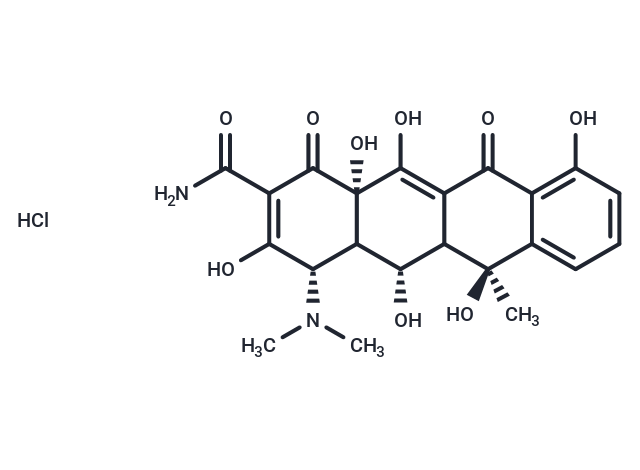

| Pack Size | Price | USA Stock | Global Stock | Quantity |
|---|---|---|---|---|
| 5 mg | $30 | In Stock | In Stock | |
| 10 mg | $45 | In Stock | In Stock | |
| 25 mg | $77 | In Stock | In Stock | |
| 50 mg | $115 | In Stock | In Stock | |
| 100 mg | $172 | In Stock | In Stock | |
| 1 mL x 10 mM (in DMSO) | $47 | In Stock | In Stock |
| Description | Oxytetracycline (OTC) is a broad-spectrum antibiotic that acts by inhibiting protein synthesis in bacteria. Oxytetracycline prevents the binding from aminoacil-tRNA to the complex m-ribosomal RNA. Oxytetracycline also possesses anti-HSV-1 activity[1][2][3]. |
| In vitro | Oxytetracycline is an important member of the bacterial aromatic polyketide family, which is a structurally diverse class of natural products. Oxytetracycline is synthesized by a type II polyketide synthase that generates the poly-beta-ketone backbone through successive decarboxylative condensation of malonyl-CoA extender units, followed by modifications by cyclases, oxygenases, transferases, and additional tailoring enzymes[2]. |
| In vivo | For Oxytetracycline, the limits are 100 μg/kg in muscle and milk, 200 μg/kg in egg, 300 μg/kg in liver and 600 μg/kg in kidney. Oxytetracycline (OTC) is administered to fish as medicated feed at concentrations ranging from 35 to 75 mg a.i kg-1 biomass day-1 for 7-14 days[1]. The effects of administration a therapeutic dose of Oxytetracycline (82.8 mg/kg of bw to 1 % bw/day) for 10 days are species specific. Oxytetracycline increases the relative liver weight in Morone chrysops x M. saxatilis, the enzymatic activity of CYP3A4 in Ictalurus punctatus, protein expression of CYP3A4 in Oreochromis niloticus and depleted the hepatic CYP3A4 in the latter[1]. |
| Molecular Weight | 496.895 |
| Formula | C22H25ClN2O9 |
| Cas No. | 423769-22-6 |
| Smiles | Cl.CN(C)[C@H]1C2[C@@H](O)C3C(C(=O)c4c(O)cccc4[C@@]3(C)O)=C(O)[C@]2(O)C(=O)C(C(N)=O)=C1O |
| Relative Density. | no data available |
| Storage | Powder: -20°C for 3 years | In solvent: -80°C for 1 year Shipping with blue ice/Shipping at ambient temperature. | |||||||||||||||||||||||||||||||||||
| Solubility Information | DMSO: 55 mg/mL (110.69 mM), Sonication is recommended.  | |||||||||||||||||||||||||||||||||||
Solution Preparation Table | ||||||||||||||||||||||||||||||||||||
DMSO
Note : The dilution table applies only to solid products. For liquid products, please calculate the stock solution based on the stated concentration and/or density. | ||||||||||||||||||||||||||||||||||||
 For example, if the intended dosage is 10 mg/kg for animals weighing 20 g , with a dosing volume of 100 μL per animal, and a total of 10 animals are to be administered, using a formulation of
  10% DMSO+ 40% PEG300+ 5% Tween 80+ 45% Saline/PBS/ddH2O , the resulting working solution concentration would be 2 mg/mL.
Dissolve 2 mg of the compound in 100 μL DMSO to obtain a stock solution at a concentration of 20 mg/mL . If the required concentration exceeds the compound's known solubility, please contact us for technical support before proceeding.
1) Add 100 μL of the DMSO stock solution to 400 µL PEG300 and mix thoroughly until the solution becomes clear.
2) Add 50 µL Tween 80 and mix well until fully clarified.
3) Add 450 µL Saline,PBS or ddH2O and mix thoroughly until a homogeneous solution is obtained.
| Size | Quantity | Unit Price | Amount | Operation |
|---|
 Feedback
 Hello! How can I help you today?
Copyright © 2015-2026 TargetMol Chemicals Inc. All Rights Reserved.
