


Shopping Cart
Remove All Your shopping cart is currently empty


Synonyms: WNT974, NVP-LGK974, LGK-974, LGK 974
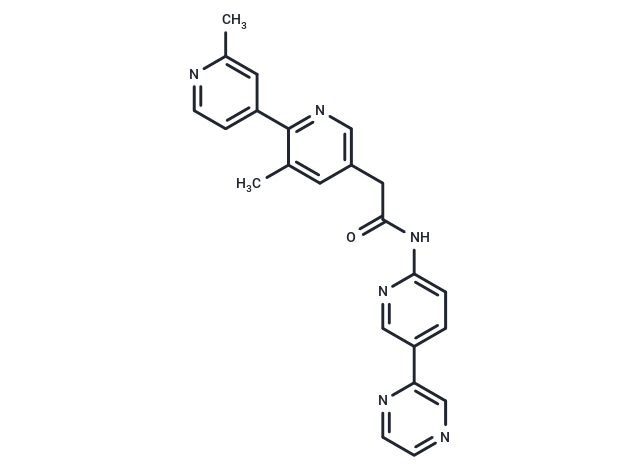

| Pack Size | Price | USA Stock | Global Stock | Quantity |
|---|---|---|---|---|
| 1 mg | $41 | In Stock | In Stock | |
| 2 mg | $59 | In Stock | In Stock | |
| 5 mg | $97 | In Stock | In Stock | |
| 10 mg | $167 | In Stock | In Stock | |
| 25 mg | $319 | In Stock | In Stock | |
| 50 mg | $573 | In Stock | In Stock | |
| 100 mg | $819 | In Stock | In Stock | |
| 1 mL x 10 mM (in DMSO) | $97 | In Stock | In Stock |
| Description | LGK974 (NVP-LGK974) is an effective and selective PORCN inhibitor and inhibits Wnt signaling (IC50: 0.4 nM) in TM3 cells. It has been used in trials studying the treatment of Metastatic Colorectal Cancer and Squamous Cell Carcinoma, Head And Neck. |
| Targets & IC50 | Porcn:0.4 nM |
| In vitro | In both the MMTV-WNT1 mouse model of breast carcinoma and the human head and neck squamous cell carcinoma model (hn30), LGK-974 (3 mg/kg) inhibits the Wnt signaling pathway, leading to tumor regression without affecting mouse body weight. Additionally, LGK-974 (5 mg/kg, twice daily, orally) also suppresses the growth of RNF43-mutant pancreatic tumors (HPAF-II and Capan-2). |
| In vivo | LGK-974 inhibits a range of tested Wnts, with IC50 values between 0.05 to 2.4 nM. In the PORCN radioligand binding assay, LGK-974 effectively displaces [3H]GNF-1331 with an IC50 of 1 nM and exhibits minimal cytotoxicity at 20 μM. It specifically inhibits the growth of RNF43 mutant cell lines HPAF-II, PaTu 8988S, and Capan-2. |
| Synonyms | WNT974, NVP-LGK974, LGK-974, LGK 974 |
| Kinase Assay | Radioligand binding assay: using the aforementioned membrane preps, filtration binding assays are performed. To reduce nonspecific binding, 96-well filtration plates are precoated as suggested by the manufacturer with 0.1% BSA and then washed four times with 0.1% BSA. Membrane preps (50 μg total protein) are incubated in polypropylene 96-well plates with 6.6 nM 3H-GNF-1331 in the presence or absence of a testing compound in binding buffer (50 mM Tris, pH 7.5, 5 mM MgCl2, 1 mM EDTA, 0.1% BSA) plus EDTA-free protease inhibitor mixture in a final volume of 150 μL for 3 h at room temperature. Binding reaction mixtures are then transferred to the precoated 96-well filtration plates, filtered, and washed using a 96-pin FilterMate Harvester. Radioactive signals are obtained using a Microplate Scintillation Counter TopCount. Curve fitting is performed using Prism[1]. |
| Cell Research | Cells are plated in growth medium in a 96-well plate at a density of 6,000–12,000 cells per well and treated with DMSO or 1 μM LGK974. After 3 d, the cells are treated with fresh growth medium containing 20 μM EdU, which is included in the Click-iT EdU Alexa Fluor 488 HCS assay kit, and the plate was incubated for 2 h at 37 °C in a humidi?ed atmosphere containing 5% CO2. Cells are ?xed with ?nal 4% (mass/vol) paraformaldehyde for 30 min, washed with PBS, permeabilized, and stained with 50 μg/mL Hoechst in PBS for 30 min. After wash, the cells are proceeded to EdU detection according to the instruction of Click-iT EdU assay kit. Triplet wells are performed for each condition. (Only for Reference) |
| Molecular Weight | 396.44 |
| Formula | C23H20N6O |
| Cas No. | 1243244-14-5 |
| Smiles | Cc1cc(ccn1)-c1ncc(CC(=O)Nc2ccc(cn2)-c2cnccn2)cc1C |
| Relative Density. | 1.268 g/cm3 (Predicted) |
| Storage | Powder: -20°C for 3 years | In solvent: -80°C for 1 year Shipping with blue ice/Shipping at ambient temperature. | |||||||||||||||||||||||||
| Solubility Information | DMSO: 16.96 mg/mL (42.78 mM), Sonication is recommended.  Ethanol: < 1 mg/mL (insoluble or slightly soluble) | |||||||||||||||||||||||||
| In Vivo Formulation | 10% DMSO+90% Corn Oil: 3.3 mg/mL (8.32 mM), Sonication is recommended. Please add the solvents sequentially, clarifying the solution as much as possible before adding the next one. Dissolve by heating and/or sonication if necessary. Working solution is recommended to be prepared and used immediately. The formulation provided above is for reference purposes only. In vivo formulations may vary and should be modified based on specific experimental conditions. | |||||||||||||||||||||||||
Solution Preparation Table | ||||||||||||||||||||||||||
DMSO
Note : The dilution table applies only to solid products. For liquid products, please calculate the stock solution based on the stated concentration and/or density. | ||||||||||||||||||||||||||
 For example, if the intended dosage is 10 mg/kg for animals weighing 20 g , with a dosing volume of 100 μL per animal, and a total of 10 animals are to be administered, using a formulation of
  10% DMSO+ 40% PEG300+ 5% Tween 80+ 45% Saline/PBS/ddH2O , the resulting working solution concentration would be 2 mg/mL.
Dissolve 2 mg of the compound in 100 μL DMSO to obtain a stock solution at a concentration of 20 mg/mL . If the required concentration exceeds the compound's known solubility, please contact us for technical support before proceeding.
1) Add 100 μL of the DMSO stock solution to 400 µL PEG300 and mix thoroughly until the solution becomes clear.
2) Add 50 µL Tween 80 and mix well until fully clarified.
3) Add 450 µL Saline,PBS or ddH2O and mix thoroughly until a homogeneous solution is obtained.
| Size | Quantity | Unit Price | Amount | Operation |
|---|
 Feedback
 Hello! How can I help you today?
Copyright © 2015-2026 TargetMol Chemicals Inc. All Rights Reserved.
