


Shopping Cart
Remove All Your shopping cart is currently empty

Synonyms: Oplophorus luciferin, CTZ, Coelenteramine

| Pack Size | Price | USA Stock | Global Stock | Quantity |
|---|---|---|---|---|
| 500 µg | $55 | In Stock | In Stock | |
| 1 mg | $90 | In Stock | In Stock | |
| 2 mg | $148 | In Stock | In Stock | |
| 5 mg | $319 | In Stock | In Stock | |
| 10 mg | $490 | In Stock | In Stock | |
| 25 mg | $721 | In Stock | In Stock | |
| 50 mg | $987 | In Stock | In Stock | |
| 100 mg | $1,370 | In Stock | In Stock | |
| 200 mg | $1,830 | - | In Stock |
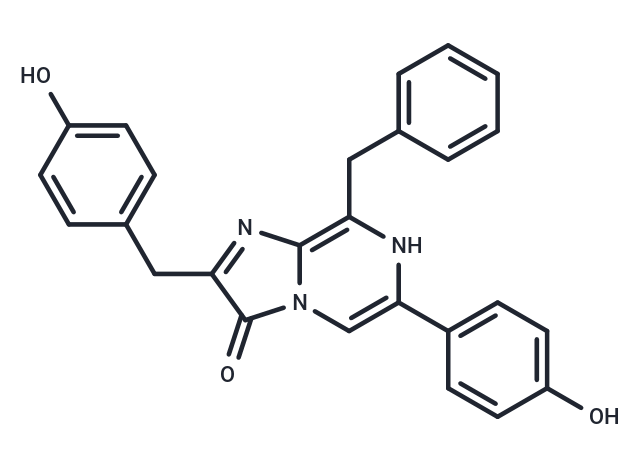
| Description | Coelenterazine is a superoxide anion-sensitive chemiluminescent probe that can be used to detect the chemiluminescence of peroxynitrite and can serve as a luminescent enzyme substrate for apoaequorin and Renilla luciferase. |
| Targets & IC50 | breast cancer cell:21.56 μM, superoxide anion:69 μM, prostate cancer cell:24.28 μM |
| In vitro | When monitoring various biological processes, coelenterazine (CTZ) can be catalyzed by luciferases, such as the sea pansy Renilla reniformis (Rluc) and the marine copepod Gaussia princeps (Gluc), which results in emission of blue light. In Gli36-Gluc- or Gli36-Rluc-expressing Gli36 cells, coelenterazine (8 礸/ml) shows a bioluminescence signal. [1] In RIN-5F, 4T1, HCT 116, HEK 293, 293FT, HeLa and INS-1 cells, coelenterazine can be used to assay superoxide anion concentrations. [2] |
| In vivo | METHODS: Gli36-Gluc and Gli36-Rluc cells were injected into the leg muscles of nude mice. Mice were injected intravenously with 100 μg (4 mg/kg body weight) of coelenterazine and immediately imaged using a cooled charge-coupled device (CCD) camera. The mice were injected with 500 μg (20 mg/kg) of water-soluble coelenterazine and imaged using a CCD camera. RESULTS Water-soluble coelenterazine produced 10-fold higher photon counts for Gluc and 4-fold higher photon counts for Rluc, indicating that s-coelenterazine is more sensitive for detecting coelenteric acid luciferase in vivo. [1] |
| Synonyms | Oplophorus luciferin, CTZ, Coelenteramine |
| Cell Research | Cells are plated at a density of 5×10^4?cells per well into 24-well plates and grown to 80-100% confluency. Just before imaging, media are changed to a colorless solution containing (in mM): 2.7 KCl, 139 NaCl, 8.1 Na2HPO4, 0.7 H2O, 1.5 KH2PO4, 1.8 CaCl2, 1 MgCl2?and 5.5 d-glucose. Cells are preincubated for 15 min in the absence or presence of Pgp modulator, after which Coelenterazine (final concentration of 470 nM) is added directly to the cells. They are for reference only. |
| Animal Research | Mice are anesthetized with metofane or isoflurane before tail vein injection of Coelenterazine (4 μg/g) formulated from an ethanol stock diluted in sodium phosphate buffer (50 mM). Bioluminescence imaging is performed on the in vivo imaging system at 2, 6, 8, and 11 min after injection. Anesthesia is maintained during imaging by nose cone delivery of 2.5% isoflurane. After imaging, animals are killed by cervical dislocation; tumors are then harvested and weighed. They are for reference only. |
| Molecular Weight | 423.46 |
| Formula | C26H21N3O3 |
| Cas No. | 55779-48-1 |
| Smiles | Oc1ccc(Cc2nc3c(Cc4ccccc4)[nH]c(cn3c2=O)-c2ccc(O)cc2)cc1 |
| Relative Density. | 1.32 g/cm3 (Predicted) |
| Storage | Keep away from direct sunlight,Store at low temperature,The compound is unstable in solution. Please use soon Powder: -20°C for 3 years Shipping with blue ice/Shipping at ambient temperature. | ||||||||||
| Solubility Information | Ethanol: 1 mg/mL (2.36 mM), It is not recommended to dissolve in DMSO.The compound is unstable in solution, please use soon. H2O: < 1 mg/mL (insoluble or slightly soluble) | ||||||||||
Solution Preparation Table | |||||||||||
Ethanol
Note : The dilution table applies only to solid products. For liquid products, please calculate the stock solution based on the stated concentration and/or density. | |||||||||||
 For example, if the intended dosage is 10 mg/kg for animals weighing 20 g , with a dosing volume of 100 μL per animal, and a total of 10 animals are to be administered, using a formulation of
  10% DMSO+ 40% PEG300+ 5% Tween 80+ 45% Saline/PBS/ddH2O , the resulting working solution concentration would be 2 mg/mL.
Dissolve 2 mg of the compound in 100 μL DMSO to obtain a stock solution at a concentration of 20 mg/mL . If the required concentration exceeds the compound's known solubility, please contact us for technical support before proceeding.
1) Add 100 μL of the DMSO stock solution to 400 µL PEG300 and mix thoroughly until the solution becomes clear.
2) Add 50 µL Tween 80 and mix well until fully clarified.
3) Add 450 µL Saline,PBS or ddH2O and mix thoroughly until a homogeneous solution is obtained.
| Size | Quantity | Unit Price | Amount | Operation |
|---|
 Feedback
 Hello! How can I help you today?
Copyright © 2015-2026 TargetMol Chemicals Inc. All Rights Reserved.
