


Shopping Cart
Remove All Your shopping cart is currently empty


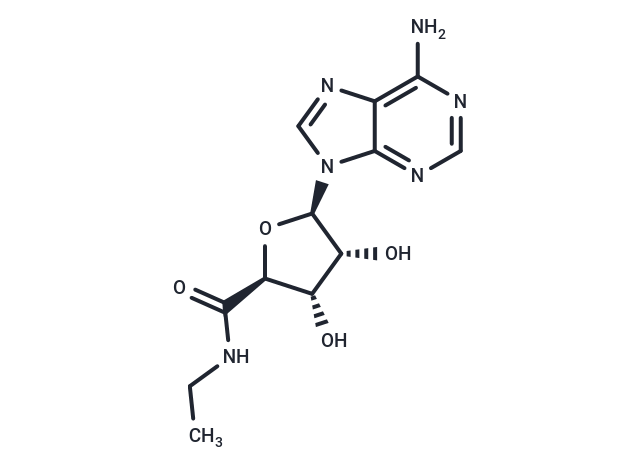
Synonyms: NECA

| Pack Size | Price | USA Stock | Global Stock | Quantity |
|---|---|---|---|---|
| 5 mg | $41 | In Stock | In Stock | |
| 10 mg | $51 | In Stock | In Stock | |
| 25 mg | $97 | In Stock | In Stock | |
| 50 mg | $146 | In Stock | In Stock | |
| 100 mg | $217 | In Stock | In Stock | |
| 1 mL x 10 mM (in DMSO) | $44 | In Stock | In Stock |
| Description | 5'-N-Ethylcarboxamidoadenosine (NECA), an agonist of the Adenosine receptor, increases cerebral extravasation of fluorescein and low molecular weight dextran independent of blood-brain barrier modulation. |
| In vitro | In vitro cultures of an Epo producing hepatocellular carcinoma (Hep3B) cell line with 5'-N-Ethylcarboxamidoadenosine (> or = 10(-6) M) for 20 hours under hypoxic conditions (1% O2) produced significant increases in medium levels of Epo when compared with hypoxia controls. Hepatocellular carcinoma cells treated with 5'-N-Ethylcarboxamidoadenosine at a concentration range of 10(-7) M to 5 x 10(-5) M for one hour in a hypoxic atmosphere also had significantly higher cAMP levels than that of hypoxia controls. Scatchard analyses of [3H]5'-N-Ethylcarboxamidoadenosine binding to membrane preparations of hepatocellular carcinoma cells showed low affinity binding sites with a dissociation-constant (Kd) of 0.44 microM and a binding capacity of 863 fmol/mg protein. Suggest that the increase in Epo production in response to 5'-N-Ethylcarboxamidoadenosine under hypoxic conditions can be attributed, at least in part, to stimulation of adenosine A2 receptors which is coupled to adenylyl cyclase activation[1]. |
| In vivo | 5'-N-Ethylcarboxamidoadenosine, an adenosine analogue, on erythropoietin (Epo) production. 5'-N-Ethylcarboxamidoadenosine (0.05 and 0.1 mumol/kg i.v.) produced significant increases in serum Epo levels (368.8 +/- 56.1 and 384.6 +/- 45.9 mU/ml, respectively) in exhypoxic polycythemic mice after a four hour exposure to hypoxia when compared with hypoxia controls (133.2 +/- 18.2 mU/ml). The hypoxic kidney Epo levels were 46.4 +/- 13.4 mU/kg kidney which were significantly higher than normoxic kidney Ep levels (< 1.24 mU/kg kidney). Theophylline (20 mg/kg i.p.), an adenosine receptor antagonist, significantly inhibited the stimulatory effects of 5'-N-Ethylcarboxamidoadenosine on serum Epo levels[1]. |
| Synonyms | NECA |
| Cell Research | A human hepatocellular carcinoma cell line (Hep3B) was employed to determine the in vitro effects of NECA on Epo production and cAMP accumulation. Hep3B cells were carried in a monolayer cell culture and maintained in 75 cm^2 Corning culture flasks containing Eagle's minimal essential medium (MEM) supplemented with 10% fetal bovine serum (PBS), 0.1 m nonessential amino acids, 1 m sodium pyruvate, 100 U/ml penicillin G, and 100 μg/ml streptomycin in a humidified atmosphere of 5% C02/95% air at 37℃. The culture medium was replaced every two days. Cells were detached with trypsin and aliquots of 2.5 x 10^5 viable cells (determined by trypan blue dye exclusion) were transferred to 24 multi-well plates. Each experiment was carried out with low density cells before they reached confluency. The cells were incubated with NECA in concentrations of 1O^9 M to 5 x l0^-5 M in the presence of 1 U/ml adenosine deaminase (ADA) under hypoxic conditions (1% 02, 5% C02, and 94% N2) for 20 hours following 24 hour preincubation in a normoxic atmosphere. At the end of the incubation period, the supernatant was harvested and frozen at -70℃ prior to Epo RIA. The multiple-range test of Duncan was used for the comparison of the several in vitro treatment groups compared with controls[1]. |
| Molecular Weight | 308.29 |
| Formula | C12H16N6O4 |
| Cas No. | 35920-39-9 |
| Smiles | CCNC(=O)[C@H]1O[C@H]([C@H](O)[C@@H]1O)n1cnc2c(N)ncnc12 |
| Relative Density. | 1.87 g/cm3 (Predicted) |
| Storage | Store at low temperature Powder: -20°C for 3 years | In solvent: -80°C for 1 year Shipping with blue ice/Shipping at ambient temperature. | |||||||||||||||||||||||||||||||||||
| Solubility Information | DMSO: 150 mg/mL (486.55 mM), Sonication is recommended. | |||||||||||||||||||||||||||||||||||
| In Vivo Formulation | 10% DMSO+40% PEG300+5% Tween 80+45% Saline: 4 mg/mL (12.97 mM), Sonication is recommended. Please add the solvents sequentially, clarifying the solution as much as possible before adding the next one. Dissolve by heating and/or sonication if necessary. Working solution is recommended to be prepared and used immediately. The formulation provided above is for reference purposes only. In vivo formulations may vary and should be modified based on specific experimental conditions. | |||||||||||||||||||||||||||||||||||
Solution Preparation Table | ||||||||||||||||||||||||||||||||||||
DMSO
Note : The dilution table applies only to solid products. For liquid products, please calculate the stock solution based on the stated concentration and/or density. | ||||||||||||||||||||||||||||||||||||
 For example, if the intended dosage is 10 mg/kg for animals weighing 20 g , with a dosing volume of 100 μL per animal, and a total of 10 animals are to be administered, using a formulation of
  10% DMSO+ 40% PEG300+ 5% Tween 80+ 45% Saline/PBS/ddH2O , the resulting working solution concentration would be 2 mg/mL.
Dissolve 2 mg of the compound in 100 μL DMSO to obtain a stock solution at a concentration of 20 mg/mL . If the required concentration exceeds the compound's known solubility, please contact us for technical support before proceeding.
1) Add 100 μL of the DMSO stock solution to 400 µL PEG300 and mix thoroughly until the solution becomes clear.
2) Add 50 µL Tween 80 and mix well until fully clarified.
3) Add 450 µL Saline,PBS or ddH2O and mix thoroughly until a homogeneous solution is obtained.
| Size | Quantity | Unit Price | Amount | Operation |
|---|
 Feedback
 Hello! How can I help you today?
Copyright © 2015-2026 TargetMol Chemicals Inc. All Rights Reserved.
