


Shopping Cart
Remove All Your shopping cart is currently empty

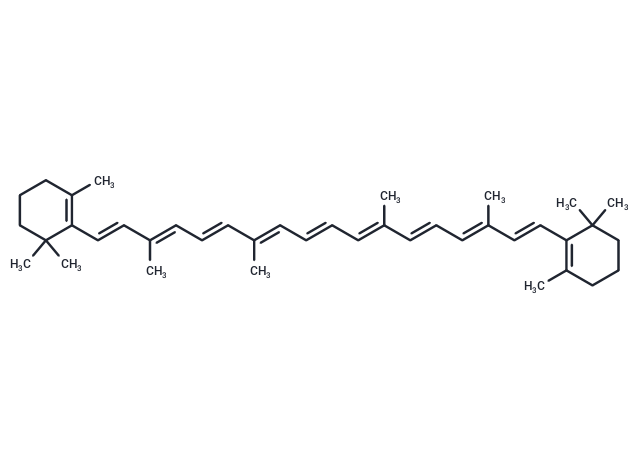
Synonyms: Provitamin A (Standard), beta-Carotene (Standard)
| Pack Size | Price | USA Stock | Global Stock | Quantity |
|---|---|---|---|---|
| 25 mg | $43 | 7-10 days | 7-10 days |
| Description | β-Carotene (Standard) is the reference standard of β-carotene, applicable to quantitative analysis, quality control, biochemical experiments, and related research. As a carotenoid, β-carotene is a natural precursor of vitamin A and acts as a reactive oxygen species modulator with both antioxidant and anti-inflammatory effects. Its antioxidant or pro-oxidant effects depend on its intrinsic properties and the redox status of the biological microenvironment. In addition, β-carotene can induce apoptosis in breast cancer cells and shows certain antitumor activity. |
| In vitro | Methods: MCF‑7 breast cancer cells were used as the research object and treated with β‑carotene.Results: β‑carotene upregulated PPAR‑γ expression and ROS production in MCF‑7 cells. Methods: MCF‑7 cells were treated with various concentrations of β‑carotene (1–100 μM) for 72 h. Results: β‑carotene significantly reduced the viability of MCF‑7 cells in a dose‑dependent manner. Methods: MCF‑7 cells were treated with 50 μM β‑carotene for 24–72 h. Results: β‑carotene significantly increased the mRNA and protein expression levels of PPAR‑γ in a time‑dependent manner. Methods: MCF‑7 cells were cultured in vitro and treated with β‑carotene. Results: β‑carotene downregulated COX‑2 and upregulated the mRNA and protein expression of p21 in a time‑dependent manner. Methods: The effect of β‑carotene on apoptosis in MCF‑7 cells was detected in vitro, with pre‑incubation using GW9662 or GSH. Results: β‑carotene significantly increased the proportion of early apoptotic cells, and this effect could be partially attenuated by GW9662 or GSH. Methods: The effect of β‑carotene on mitochondria‑related proteins in MCF‑7 cells was investigated in vitro. Results: β‑carotene induced the release of cytochrome c [3]. |
| Synonyms | Provitamin A (Standard), beta-Carotene (Standard) |
| Molecular Weight | 536.87 |
| Formula | C40H56 |
| Cas No. | 7235-40-7 |
| Smiles | C(=C/C(=C/C=C/C(=C/C=C/C=C(/C=C/C=C(/C=C/C=1C(C)(C)CCCC1C)\C)\C)/C)/C)\C=2C(C)(C)CCCC2C |
| Relative Density. | 0.941g/cm3 |
| Storage | Keep away from direct sunlight Powder: -20°C for 3 years | In solvent: -80°C for 1 year Shipping with blue ice/Shipping at ambient temperature. |
 For example, if the intended dosage is 10 mg/kg for animals weighing 20 g , with a dosing volume of 100 μL per animal, and a total of 10 animals are to be administered, using a formulation of
  10% DMSO+ 40% PEG300+ 5% Tween 80+ 45% Saline/PBS/ddH2O , the resulting working solution concentration would be 2 mg/mL.
Dissolve 2 mg of the compound in 100 μL DMSO to obtain a stock solution at a concentration of 20 mg/mL . If the required concentration exceeds the compound's known solubility, please contact us for technical support before proceeding.
1) Add 100 μL of the DMSO stock solution to 400 µL PEG300 and mix thoroughly until the solution becomes clear.
2) Add 50 µL Tween 80 and mix well until fully clarified.
3) Add 450 µL Saline,PBS or ddH2O and mix thoroughly until a homogeneous solution is obtained.
| Size | Quantity | Unit Price | Amount | Operation |
|---|
 Feedback
 Hello! How can I help you today?
Copyright © 2015-2026 TargetMol Chemicals Inc. All Rights Reserved.
