


Shopping Cart
Remove All Your shopping cart is currently empty


Synonyms: WCK-5107
| Pack Size | Price | USA Stock | Global Stock | Quantity |
|---|---|---|---|---|
| 1 mg | $88 | In Stock | In Stock | |
| 5 mg | $189 | In Stock | In Stock | |
| 10 mg | $313 | In Stock | In Stock | |
| 25 mg | $533 | In Stock | In Stock | |
| 50 mg | $768 | In Stock | In Stock | |
| 100 mg | $1,080 | In Stock | In Stock |
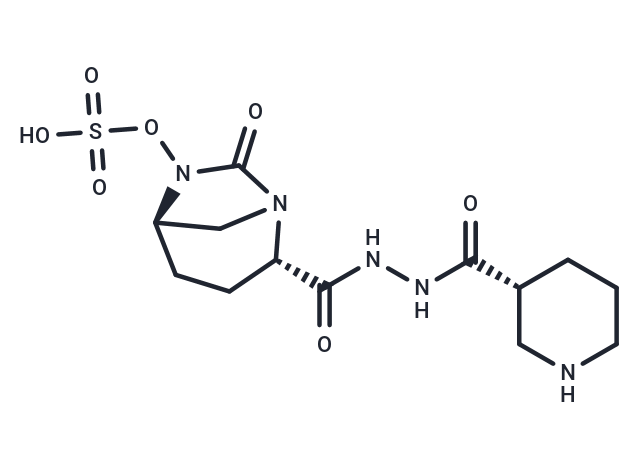
| Description | Zidebactam (WCK-5107) is a β-lactamase inhibitor and a penicillin-binding protein 2 (PBP2) inhibitor (IC50 = 0.26 μg/ml), with enzymatic inhibitory activity, and can be used for antibacterial research. |
| Targets & IC50 | Enterobacter spp:0.12 mg/L (MIC50), PBP2:0.26 μg/ml (P. aeruginosa PAO1 PBP2), E. coli:0.12 mg/L (MIC50), Enterobacteriaceae (WT):0.25 mg/L (MIC50) |
| In vitro | Methods:Acinetobacter baumannii ATCC 19606 and OXA-23-producing clinical ST2 isolates were used to evaluate Zidebactam in vitro activity through MIC determination, PBP binding affinity determination (IC₅₀), and time-kill kinetics assays. Results: Zidebactam monotherapy showed MIC >1024 μg/mL, but exhibited high affinity for PBP2 (IC₅₀ 0.01 μg/mL); when combined with 8 μg/mL cefepime or sulbactam, MIC decreased by 4-8 fold, with complete bacterial clearance achieved within 24 hours.[1] Methods: Ninety-three carbapenemase-producing Klebsiella species and other isolates were used to determine the minimum inhibitory concentration (MIC) of Zidebactam alone and in combination with cefepime or ertapenem (1:1) by BSAC agar dilution method, with inoculum ranging from 3-6×10³ to 3-6×10⁵ CFU/spot. Results: For metallo-β-lactamase-producing strains, the MIC of Zidebactam combinations increased significantly (≥32-fold) with increasing inoculum, while the effect on non-MBL-producing strains was minimal.[2] |
| In vivo | Methods: A neutropenic mouse pneumonia model was established by intranasal inoculation with Pseudomonas aeruginosa. Zidebactam was administered subcutaneously at doses simulating human alveolar epithelial lining fluid exposure (3.8, 4.15 mg/kg) every 8 hours for 24 hours, with normal saline as the vehicle. Results: Zidebactam monotherapy reduced bacterial load by 0.99 log₁₀ CFU/lung, while combination with cefepime (WCK 5222) increased the reduction to 2.21 log₁₀ CFU/lung, demonstrating synergistic enhancement.[3] Methods: A neutropenic mouse pneumonia model was established by intranasal inoculation with Acinetobacter baumannii. Zidebactam was administered subcutaneously at doses of 12.5 and 37.5 mg/kg every 2 hours for 24 hours, with normal saline as the vehicle. Results: Zidebactam monotherapy was ineffective, but when combined with cefepime, it reduced the percentage of time that free drug concentrations exceeded the MIC required for 1-log₁₀ bactericidal activity from 38.9% to 15.5%.[4] |
| Synonyms | WCK-5107 |
| Molecular Weight | 391.4 |
| Formula | C13H21N5O7S |
| Cas No. | 1436861-97-0 |
| Smiles | OS(=O)(=O)ON1[C@H]2CN([C@@H](CC2)C(=O)NNC(=O)[C@@H]2CCCNC2)C1=O |
| Relative Density. | no data available |
| Storage | Store at low temperature,Keep away from moisture Powder: -20°C for 3 years | In solvent: -80°C for 1 year Shipping with blue ice/Shipping at ambient temperature. | |||||||||||||||||||||||||||||||||||
| Solubility Information | DMSO: 250 mg/mL (638.73 mM), Sonication is recommended.  H2O: 50 mg/mL (127.75 mM), Sonication is recommended. | |||||||||||||||||||||||||||||||||||
| In Vivo Formulation | 10% DMSO+40% PEG300+5% Tween 80+45% Saline: 5 mg/mL (12.77 mM), Sonication is recommended. Please add the solvents sequentially, clarifying the solution as much as possible before adding the next one. Dissolve by heating and/or sonication if necessary. Working solution is recommended to be prepared and used immediately. The formulation provided above is for reference purposes only. In vivo formulations may vary and should be modified based on specific experimental conditions. | |||||||||||||||||||||||||||||||||||
Solution Preparation Table | ||||||||||||||||||||||||||||||||||||
H2O/DMSO
Note : The dilution table applies only to solid products. For liquid products, please calculate the stock solution based on the stated concentration and/or density. | ||||||||||||||||||||||||||||||||||||
 For example, if the intended dosage is 10 mg/kg for animals weighing 20 g , with a dosing volume of 100 μL per animal, and a total of 10 animals are to be administered, using a formulation of
  10% DMSO+ 40% PEG300+ 5% Tween 80+ 45% Saline/PBS/ddH2O , the resulting working solution concentration would be 2 mg/mL.
Dissolve 2 mg of the compound in 100 μL DMSO to obtain a stock solution at a concentration of 20 mg/mL . If the required concentration exceeds the compound's known solubility, please contact us for technical support before proceeding.
1) Add 100 μL of the DMSO stock solution to 400 µL PEG300 and mix thoroughly until the solution becomes clear.
2) Add 50 µL Tween 80 and mix well until fully clarified.
3) Add 450 µL Saline,PBS or ddH2O and mix thoroughly until a homogeneous solution is obtained.
| Size | Quantity | Unit Price | Amount | Operation |
|---|
 Feedback
 Hello! How can I help you today?
Copyright © 2015-2026 TargetMol Chemicals Inc. All Rights Reserved.
