


Shopping Cart
Remove All Your shopping cart is currently empty

Synonyms: Tetracyclinum, Tetracyclin, Deschlorobiomycin
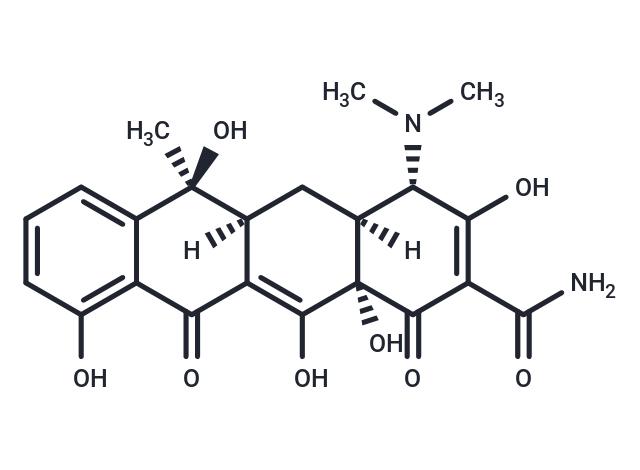
| Pack Size | Price | USA Stock | Global Stock | Quantity |
|---|---|---|---|---|
| 1 g | $29 | In Stock | In Stock | |
| 5 g | $44 | - | In Stock |

| Description | Tetracycline is an orally active broad-spectrum antibiotic that exhibits inhibitory activity against various Gram-positive and Gram-negative bacteria, as well as Chlamydia, Mycoplasma, and Rickettsia. It is commonly used in anti-infection research and can also be used to induce tumor regression based on BCR-ABL gene silencing. |
| Targets & IC50 | Osteoblast:180 μg/mL, MG-63 cells:180 μg/mL, HeLa cells:> 400 μg/mL, HaCaT cells:8 μM, CCRF-CEM cells:40.5 μM (CC50), MCF-7 cells:41.6 μM |
| In vitro | METHODS: Neuroblastoma cells were treated with Binimetinib (0-2 µM) for 24-120 h. Cell viability was measured by MTT assay. RESULTS: Four cell lines, CHP-212, SK-N-BE, SK-N-AS and SJ-NB-10, were sensitive to Binimetinib, achieving <50% survival after 24-120 h of treatment, while five cell lines were resistant to the drug. [1] METHODS: NSCLC cells A549, H157 and H522 were treated with Binimetinib (0.5-1 µM) for 48 h. Cell cycle was measured by flow cytometry. RESULTS: Binimetinib induced G1 phase block in three sensitive NSCLC cell lines at relatively low concentration ranges, e.g. 0.5 and 1 µM. [2] |
| In vivo | METHODS: To detect in vivo antitumor activity, Binimetinib (5 mg/kg) and BMK120 (7.5 mg/kg) were administered by gavage to athymic (nu/nu) mice bearing A549 xenografts once daily for 21 days. RESULTS: Binimetinib and BKM120 alone at the doses tested only weakly inhibited the growth of A549 xenografts, but the combination of Binimetinib and BKM120 significantly inhibited the growth of A549 xenografts. [2] |
| Synonyms | Tetracyclinum, Tetracyclin, Deschlorobiomycin |
| Disease Modeling Protocol | Male reproductive system transgenerational injury model
*Precautions: A full-sibling family split design was adopted (F0 generation offspring were randomly assigned to the control group and the treatment group) to reduce genetic background interference. |
| Molecular Weight | 444.43 |
| Formula | C22H24N2O8 |
| Cas No. | 60-54-8 |
| Smiles | [H][C@@]12C[C@@]3([H])C(=C(O)[C@]1(O)C(=O)C(C(N)=O)=C(O)[C@H]2N(C)C)C(=O)c1c(O)cccc1[C@@]3(C)O |
| Relative Density. | 1.644g/cm3 |
| Storage | Powder: -20°C for 3 years Shipping with blue ice/Shipping at ambient temperature. | |||||||||||||||||||||||||||||||||||
| Solubility Information | DMSO: 262.5 mg/mL (590.64 mM), Sonication is recommended.  | |||||||||||||||||||||||||||||||||||
| In Vivo Formulation | 10% DMSO+40% PEG300+5% Tween 80+45% Saline: 15 mg/mL (33.75 mM), Solution. Please add the solvents sequentially, clarifying the solution as much as possible before adding the next one. Dissolve by heating and/or sonication if necessary. Working solution is recommended to be prepared and used immediately. The formulation provided above is for reference purposes only. In vivo formulations may vary and should be modified based on specific experimental conditions. | |||||||||||||||||||||||||||||||||||
Solution Preparation Table | ||||||||||||||||||||||||||||||||||||
DMSO
Note : The dilution table applies only to solid products. For liquid products, please calculate the stock solution based on the stated concentration and/or density. | ||||||||||||||||||||||||||||||||||||
 For example, if the intended dosage is 10 mg/kg for animals weighing 20 g , with a dosing volume of 100 μL per animal, and a total of 10 animals are to be administered, using a formulation of
  10% DMSO+ 40% PEG300+ 5% Tween 80+ 45% Saline/PBS/ddH2O , the resulting working solution concentration would be 2 mg/mL.
Dissolve 2 mg of the compound in 100 μL DMSO to obtain a stock solution at a concentration of 20 mg/mL . If the required concentration exceeds the compound's known solubility, please contact us for technical support before proceeding.
1) Add 100 μL of the DMSO stock solution to 400 µL PEG300 and mix thoroughly until the solution becomes clear.
2) Add 50 µL Tween 80 and mix well until fully clarified.
3) Add 450 µL Saline,PBS or ddH2O and mix thoroughly until a homogeneous solution is obtained.
| Size | Quantity | Unit Price | Amount | Operation |
|---|
 Feedback
 Hello! How can I help you today?
Copyright © 2015-2026 TargetMol Chemicals Inc. All Rights Reserved.
