


Shopping Cart
Remove All Your shopping cart is currently empty


Synonyms: ZK 62711, (R,S)-Rolipram
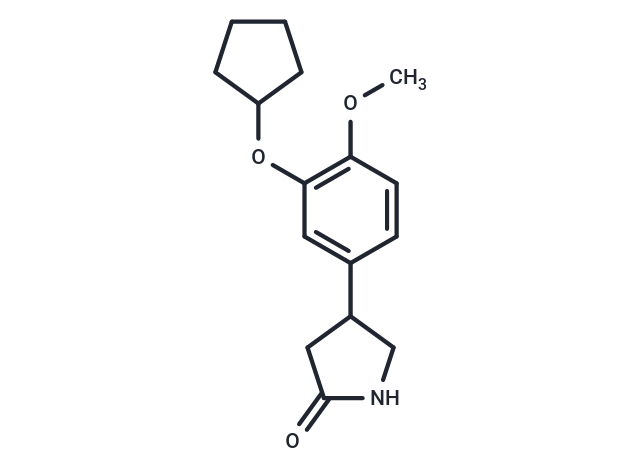
| Pack Size | Price | USA Stock | Global Stock | Quantity |
|---|---|---|---|---|
| 10 mg | $44 | In Stock | In Stock | |
| 25 mg | $53 | In Stock | In Stock | |
| 50 mg | $62 | In Stock | In Stock | |
| 100 mg | $88 | In Stock | In Stock | |
| 500 mg | $215 | In Stock | In Stock | |
| 1 mL x 10 mM (in DMSO) | $30 | In Stock | In Stock |
| Description | Rolipram (SB 95952) is a phosphodiesterase 4 inhibitor with antidepressant properties. |
| Targets & IC50 | PDE4B:130 nM, PDE4D:240 nM |
| In vitro | The PDE4 selective inhibitor, Rolipram, inhibits immunopurified PDE4B and PDE4D activities similarly, with IC50s of approx. 130 nM and 240 nM respectively. In contrast, Rolipram inhibits immunopurified PDE4A activity with a dramatically lower IC50 of around 3 nM. Rolipram increases phosphorylation of cAMP-response-element-binding protein (CREB) in U937 cells in a dose-dependent fashion, which means that both high affinity (IC50 approx. 1 nM) and low affinity (IC50 approx. 120 nM) components are presented. Rolipram dose-dependently inhibits the IFN-gamma-stimulated phosphorylation of p38 MAPK in a simple monotonic fashion with an IC50 of approx. 290 nM[1]. Rolipram is a selective PDE4 inhibitor that inhibits all PDE4 isoforms A, B, C and D. Rolipram inhibits LPS-induced TNF production in a dose-dependent manner (IC50 25.9 nM), and maximal/submaximal inhibition is observed with 2 μM drug concentration in J774 cells[2]. |
| In vivo | In peritoneal macrophages (PM) from wild-type (WT) mice, lipopolysaccharide (LPS) induces TNF mRNA and protein expression, which is significantly reduced by Rolipram (by 74% and 63% for TNF mRNA and protein, respectively). However, LPS-induced TNF production is elevated in PM from MKP-1(-/-) mice compared to WT mice, aligning with existing research. Notably, Rolipram's ability to suppress TNF mRNA and protein levels in PM from MKP-1(-/-) mice is considerably weakened and lacks statistical significance. Furthermore, repeated Rolipram administration (1.25 mg/kg, i.p.) diminishes the incidence of escape failures in rats with learned helplessness, suggesting its potential therapeutic effect. |
| Synonyms | ZK 62711, (R,S)-Rolipram |
| Cell Research | Rolipram is dissolved in DMSO and stored, and then diluted with appropriate medium before use[2]. J774 murine macrophages (ATCC) are cultured at 37°C in 5% CO2 atmosphere in DMEM supplemented with glutamax-1 containing 10% heat-inactivated FBS, 100 U/mL penicillin, 100 μg/mL streptomycin and 250 ng/mL amphotericin B. For experiments, cells are seeded on 24-well plates at a density of 2×10⁵ cells per well. Cell monolayers are grown for 72 h before the experiments are started. Rolipram, IBMX and BIRB 796 are dissolved in DMSO, and 8-Br-cAMP in HBSS. LPS (10 ng/mL) or the compounds of interest at concentrations indicated or the solvent (DMSO, 0.1% v/v) are added to the cells in fresh culture medium containing 10% FBS and the supplements. Cells are further incubated for the time indicated. The effect of LPS and the tested chemicals on cell viability is evaluated by Cell Proliferation Kit II (XTT)[2]. |
| Molecular Weight | 275.34 |
| Formula | C16H21NO3 |
| Cas No. | 61413-54-5 |
| Smiles | O(C1=C(OC)C=CC(=C1)C2CNC(=O)C2)C3CCCC3 |
| Relative Density. | 1.0677 g/cm3 (Estimated) |
| Storage | Store at low temperature,Keep away from moisture Powder: -20°C for 3 years | In solvent: -80°C for 1 year Shipping with blue ice/Shipping at ambient temperature. | ||||||||||||||||||||||||||||||||||||||||
| Solubility Information | Ethanol: 20.7 mg/mL (75.18 mM), Sonication is recommended. DMSO: 41.67 mg/mL (151.34 mM), Sonication is recommended.  | ||||||||||||||||||||||||||||||||||||||||
| In Vivo Formulation | 10% DMSO+40% PEG300+5% Tween 80+45% Saline: 4.17 mg/mL (15.14 mM), Suspension. 10% DMSO+90% Saline: < 4.17 mg/mL (15.14 mM), Lower concentrations may be soluble, but exact solubility limit is unknown. Please add the solvents sequentially, clarifying the solution as much as possible before adding the next one. Dissolve by heating and/or sonication if necessary. Working solution is recommended to be prepared and used immediately. The formulation provided above is for reference purposes only. In vivo formulations may vary and should be modified based on specific experimental conditions. | ||||||||||||||||||||||||||||||||||||||||
Solution Preparation Table | |||||||||||||||||||||||||||||||||||||||||
Ethanol/DMSO
DMSO
Note : The dilution table applies only to solid products. For liquid products, please calculate the stock solution based on the stated concentration and/or density. | |||||||||||||||||||||||||||||||||||||||||
 For example, if the intended dosage is 10 mg/kg for animals weighing 20 g , with a dosing volume of 100 μL per animal, and a total of 10 animals are to be administered, using a formulation of
  10% DMSO+ 40% PEG300+ 5% Tween 80+ 45% Saline/PBS/ddH2O , the resulting working solution concentration would be 2 mg/mL.
Dissolve 2 mg of the compound in 100 μL DMSO to obtain a stock solution at a concentration of 20 mg/mL . If the required concentration exceeds the compound's known solubility, please contact us for technical support before proceeding.
1) Add 100 μL of the DMSO stock solution to 400 µL PEG300 and mix thoroughly until the solution becomes clear.
2) Add 50 µL Tween 80 and mix well until fully clarified.
3) Add 450 µL Saline,PBS or ddH2O and mix thoroughly until a homogeneous solution is obtained.
| Size | Quantity | Unit Price | Amount | Operation |
|---|
 Feedback
 Hello! How can I help you today?
Copyright © 2015-2026 TargetMol Chemicals Inc. All Rights Reserved.
