


Shopping Cart
Remove All Your shopping cart is currently empty


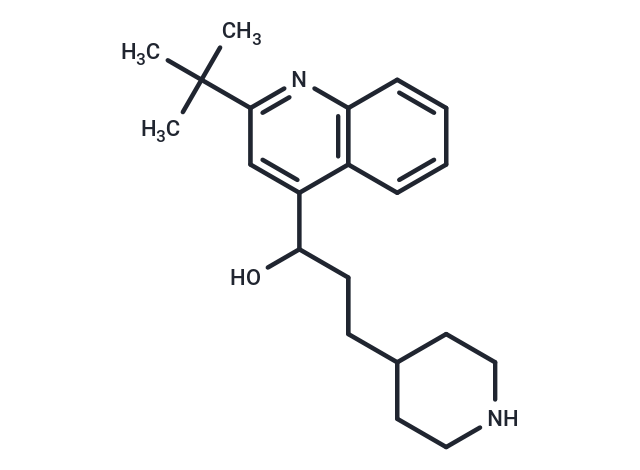
Synonyms: RP-54272, RP 54272, PK-10139, PK10139, PK 10139
| Pack Size | Price | USA Stock | Global Stock | Quantity |
|---|---|---|---|---|
| 1 mg | $86 | In Stock | In Stock | |
| 5 mg | $216 | In Stock | In Stock | |
| 10 mg | $318 | In Stock | In Stock | |
| 25 mg | $515 | In Stock | In Stock | |
| 50 mg | $747 | In Stock | In Stock |
| Description | Quinacainol (RP 54272) is a new antiarrhythmic compound with class I antiarrhythmic effects in rats. |
| In vitro | Quinacainol blocked sodium currents in a concentration-dependent manner and with a potency similar to that of quinidine (mean (+/-SEM) EC50 50+/-12 vs 95+/-25 micromol/L for quinidine and quinacainol, respectively). Quinacainol, a quinidine analog, blocks sodium currents in cardiac myocytes with little effect on I (to) or iKsus potassium currents, which suggests that quinacainol may be exerting class 1c anti-arrhythmic actions.[1] |
| In vivo | Evaluation of antiarrhythmic effects using Quinacainol in conscious rats with LAD coronary artery occlusion. Antiarrhythmic actions occurred with 2.0 and 4.0 mg/kg, whereas 8.0 mg/kg was pro-arrhythmic. At doses of 0.5 mg/kg and above, quinacainol increased threshold currents for capture and for ventricular fibrillation. Doses of 2.0 mg/kg and above increased ventricular refractoriness. From 1.0 to 8.0 mg/kg, quinacainol reduced dV/dtmax of phase 0 of epicardial action potentials but only 8.0 mg/kg increased action potential duration. The Q-T interval was also increased with the highest dose. Quinacainol dose-relatedly increased P-R interval whereas QRS did not change. Thus the Class I electrophysiological properties of quinacainol over the dose range tested did not fit accurately into a single subclass of the various subclasses of Class I. However, the Class Ic actions seen with 2.0 and 4.0 mg/kg were associated with antiarrhythmic actions.[2] |
| Synonyms | RP-54272, RP 54272, PK-10139, PK10139, PK 10139 |
| Molecular Weight | 326.48 |
| Formula | C21H30N2O |
| Cas No. | 86073-85-0 |
| Smiles | C(CCC1CCNCC1)(O)C=2C3=C(N=C(C(C)(C)C)C2)C=CC=C3 |
| Relative Density. | no data available |
| Storage | Powder: -20°C for 3 years | In solvent: -80°C for 1 year Shipping with blue ice/Shipping at ambient temperature. | |||||||||||||||||||||||||||||||||||
| Solubility Information | DMSO: 50 mg/mL (153.15 mM), Sonication is recommended.  | |||||||||||||||||||||||||||||||||||
Solution Preparation Table | ||||||||||||||||||||||||||||||||||||
DMSO
Note : The dilution table applies only to solid products. For liquid products, please calculate the stock solution based on the stated concentration and/or density. | ||||||||||||||||||||||||||||||||||||
 For example, if the intended dosage is 10 mg/kg for animals weighing 20 g , with a dosing volume of 100 μL per animal, and a total of 10 animals are to be administered, using a formulation of
  10% DMSO+ 40% PEG300+ 5% Tween 80+ 45% Saline/PBS/ddH2O , the resulting working solution concentration would be 2 mg/mL.
Dissolve 2 mg of the compound in 100 μL DMSO to obtain a stock solution at a concentration of 20 mg/mL . If the required concentration exceeds the compound's known solubility, please contact us for technical support before proceeding.
1) Add 100 μL of the DMSO stock solution to 400 µL PEG300 and mix thoroughly until the solution becomes clear.
2) Add 50 µL Tween 80 and mix well until fully clarified.
3) Add 450 µL Saline,PBS or ddH2O and mix thoroughly until a homogeneous solution is obtained.
| Size | Quantity | Unit Price | Amount | Operation |
|---|
 Feedback
 Hello! How can I help you today?
Copyright © 2015-2026 TargetMol Chemicals Inc. All Rights Reserved.
