


Shopping Cart
Remove All Your shopping cart is currently empty

Synonyms:
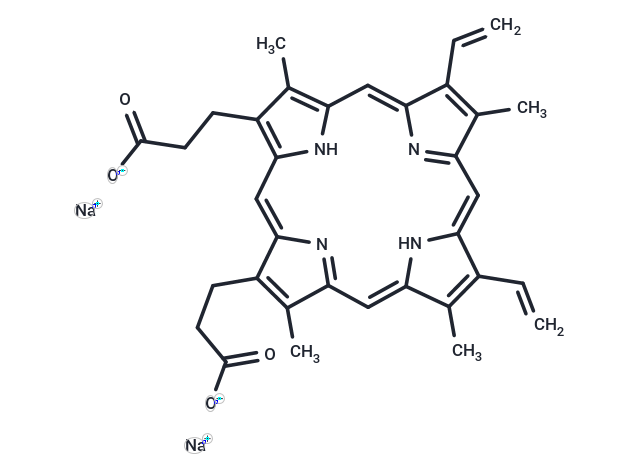
| Pack Size | Price | USA Stock | Global Stock | Quantity |
|---|---|---|---|---|
| 10 mg | Inquiry | 7-10 days | 7-10 days | |
| 50 mg | Inquiry | 7-10 days | 7-10 days |
| Description | Protoporphyrin IX disodium, as a radiation sensitizer, enhances the production of ROS and induces DNA damage even under hypoxic conditions. It also acts as a photosensitizer, undergoing direct degradation through photobleaching upon light exposure. This compound accumulates in rat tumor cells following administration of 5-aminolevulinic acid (5-ALA). When activated with a peak wavelength of 405 nm, Protoporphyrin IX disodium selectively improves basal cell carcinoma. It shows promise in pharmacological research of sonodynamic and photodynamic therapy for cancers such as bladder cancer and nodular basal cell carcinoma. |
| In vitro | Protoporphyrin IX disodium, when administered at a dosage of 3.6 nmol/g to tissue, causes necrosis of the normal rat colonic mucosa upon exposure to light. At a concentration of 6.6 nmol/g in rat tumors, it delays tumor growth following irradiation. Additionally, a rapid increase in nuclear G4 levels in Hela cells is observed with Protoporphyrin IX disodium at concentrations ranging from 0 to 25 μM, when applied for 2 hours. |
| In vivo | Following a single intravenous injection of aminolevulinic acid at a dosage of 300 mg/kg, the highest concentrations of Protoporphyrin IX disodium were observed in the liver and intestines of rats, approximately 3 hours post-administration, reaching about 6.3 nmol/g of tissue. This was followed by the aorta, which showed a concentration of 4.3 nmol/g of tissue, and the esophagus, which had around 2.1 nmol/g of tissue. |
| Molecular Weight | 606.62 |
| Formula | C34H32N4Na2O4 |
| Cas No. | 50865-01-5 |
| Smiles | O=C(CCC1=C(C)C2=NC1=CC3=C(CCC([O-])=O)C(C)=C(N3)C=C(C(C=C)=C4C)N=C4C=C(C(C=C)=C5C)NC5=C2)[O-].[Na+].[Na+] |
| Storage | Powder: -20°C for 3 years | In solvent: -80°C for 1 year Shipping with blue ice/Shipping at ambient temperature. |
 For example, if the intended dosage is 10 mg/kg for animals weighing 20 g , with a dosing volume of 100 μL per animal, and a total of 10 animals are to be administered, using a formulation of
  10% DMSO+ 40% PEG300+ 5% Tween 80+ 45% Saline/PBS/ddH2O , the resulting working solution concentration would be 2 mg/mL.
Dissolve 2 mg of the compound in 100 μL DMSO to obtain a stock solution at a concentration of 20 mg/mL . If the required concentration exceeds the compound's known solubility, please contact us for technical support before proceeding.
1) Add 100 μL of the DMSO stock solution to 400 µL PEG300 and mix thoroughly until the solution becomes clear.
2) Add 50 µL Tween 80 and mix well until fully clarified.
3) Add 450 µL Saline,PBS or ddH2O and mix thoroughly until a homogeneous solution is obtained.
| Size | Quantity | Unit Price | Amount | Operation |
|---|
 Feedback
 Hello! How can I help you today?
Copyright © 2015-2026 TargetMol Chemicals Inc. All Rights Reserved.
