


Shopping Cart
Remove All Your shopping cart is currently empty


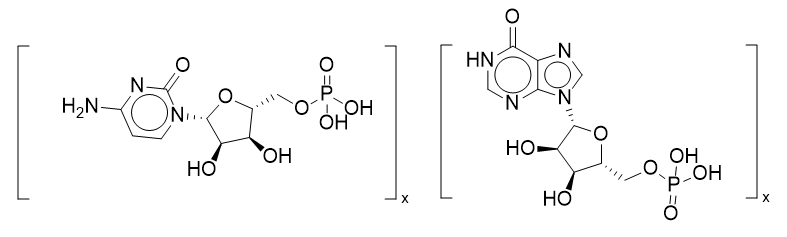
Synonyms: Poly(I:C)
| Pack Size | Price | USA Stock | Global Stock | Quantity |
|---|---|---|---|---|
| 5 mg | $45 | In Stock | - | |
| 10 mg | $72 | In Stock | - | |
| 25 mg | $148 | In Stock | - | |
| 50 mg | Inquiry | In Stock | - |
| Description | Polyinosinic-polycytidylic acid (Poly(I:C)) is a synthetic double-stranded RNA (dsRNA) analog and an agonist of TLR3 as well as retinoic acid-inducible gene I (RIG-I) and melanoma differentiation-associated protein 5 (MDA5). It can induce innate immune responses in mammals and serve as a vaccine adjuvant to enhance both innate and adaptive immunity, while modulating the tumor microenvironment and directly inducing apoptosis in cancer cells. Poly(I:C) is commonly used to establish acute respiratory distress syndrome (ARDS) animal models for studying immune responses and disease mechanisms. |
| In vitro | METHODS: Cervical cancer cells HeLa, SiHa, C33A and lung cancer cells A549 were treated with polyinosinic-polycytidylic acid (0.1-1 μg/mL) for 24 h, and cell death was detected using PI Staining. RESULTS: Polyinosinic-polycytidylic acid effectively induced tumor cell death in a dose-dependent pattern. [1] METHODS: Rat astrocytes were pretreated with polyinosinic-polycytidylic acid (10-20 μg/mL) for 12 h, and then exposed to oxygen-glucose deprivation (OGD) for 12 h. The morphology of the cells was examined by microscopy. RESULTS: OGD induced significant cellular damage, and the cells appeared to be healthier in the group pretreated with polyinosinic-polycytidylic acid.Polyinosinic-polycytidylic acid exerted a certain degree of protective effect against OGD-induced damage in cultured astrocytes. [2] |
| In vivo | METHODS: To investigate the neuroprotective effects in an acute ischemia model, Polyinosinic-polycytidylic acid (0.3 mg/kg) was administered as a single intramuscular injection to Kun-Ming strain mice, and a model of arterial occlusion (MCAO) was constructed 2 h later. RESULTS: Administration of polyinosinic-polycytidylic acid significantly attenuated neurological deficits in the ischemic striatum and cortex, reduced infarct volume, and suppressed the elevation of TNFα and IL-6 levels. [2] METHODS: To test the antitumor activity in vivo, Polyinosinic-polycytidylic acid (1-100 μg/mouse) was intraperitoneally injected into a mouse model of metastatic tumors C57BL/6J induced by cutaneous melanoma B16-F10. RESULTS: Lung tumor growth stopped after a single dose of Polyinosinic-polycytidylic acid. Polyinosinic-polycytidylic acid has potential antitumor activity in an established mouse model of lung metastasis. [3] |
| Synonyms | Poly(I:C) |
| Disease Modeling Protocol | Acute Respiratory Distress Syndrome (ARDS) Model
*Precautions: The animal should be euthanized immediately after ventilation to avoid delays that could lead to the degradation of inflammatory factors. |
| Molecular Weight | 671.406 |
| Formula | (C10H13N4O8P)x.(C9H14N3O8P)x |
| Cas No. | 24939-03-5 |
| Relative Density. | no data available |
| Storage | Store at low temperature,Store under nitrogen Powder: -20°C for 3 years | In solvent: -80°C for 1 year Shipping with blue ice/Shipping at ambient temperature. | |||||||||||||||||||||||||||||||||||
| Solubility Information | H2O: 128.80 mg/mL (191.84 mM), Sonication is recommended.  DMSO: < 1 mg/mL (insoluble or slightly soluble) | |||||||||||||||||||||||||||||||||||
Solution Preparation Table | ||||||||||||||||||||||||||||||||||||
H2O
Note : The dilution table applies only to solid products. For liquid products, please calculate the stock solution based on the stated concentration and/or density. | ||||||||||||||||||||||||||||||||||||
 For example, if the intended dosage is 10 mg/kg for animals weighing 20 g , with a dosing volume of 100 μL per animal, and a total of 10 animals are to be administered, using a formulation of
  10% DMSO+ 40% PEG300+ 5% Tween 80+ 45% Saline/PBS/ddH2O , the resulting working solution concentration would be 2 mg/mL.
Dissolve 2 mg of the compound in 100 μL DMSO to obtain a stock solution at a concentration of 20 mg/mL . If the required concentration exceeds the compound's known solubility, please contact us for technical support before proceeding.
1) Add 100 μL of the DMSO stock solution to 400 µL PEG300 and mix thoroughly until the solution becomes clear.
2) Add 50 µL Tween 80 and mix well until fully clarified.
3) Add 450 µL Saline,PBS or ddH2O and mix thoroughly until a homogeneous solution is obtained.
| Size | Quantity | Unit Price | Amount | Operation |
|---|
 Feedback
 Hello! How can I help you today?
Copyright © 2015-2026 TargetMol Chemicals Inc. All Rights Reserved.
