


Shopping Cart
Remove All Your shopping cart is currently empty

Synonyms:
| Pack Size | Price | USA Stock | Global Stock | Quantity |
|---|---|---|---|---|
| 10 mg | Inquiry | 10-14 weeks | 10-14 weeks | |
| 50 mg | Inquiry | 10-14 weeks | 10-14 weeks |
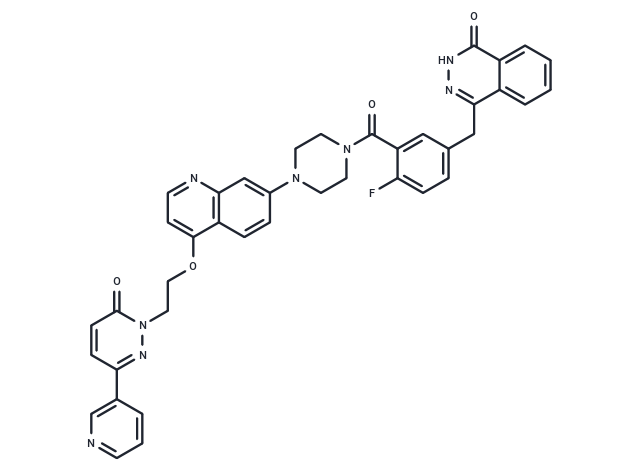
| Description | PARP1/c-Met-IN-1 (Compound 16) serves as a selective dual inhibitor targeting both PARP1 and c-Met, demonstrating IC50 values of 3.3 nM and 32.2 nM, respectively. This compound effectively induces apoptosis and causes cell cycle arrest at the G2/M phase in MDA-MB-231 cells. Furthermore, PARP1/c-Met-IN-1 displays notable antitumor activity in mouse models [1]. |
| Targets & IC50 | PARP1:3.3 nM, c-Met:32.2 nM |
| In vitro | PARP1/c-Met-IN-1 at a concentration of 1 μM enhances the thermal stability of PARP1 and c-Met, and inhibits the expression of associated proteins PAR, p-c-Met, and p-AKT, thereby affecting the interaction between PARP1 and c-Met, which leads to DNA damage [1]. In the concentration range of 0.5-1 μM, it reduces homologous recombination (HR) function in MDA-MB-231 cells by downregulating BRCA1 and Rad51 expression [1]. According to Western Blot analysis on MDA-MB-231 cells incubated for 72 hours at 1 μM, the compound increased protein stability in the temperature range of 43–55 °C and decreased BRCA1 and Rad51 expressions [1]. |
| In vivo | In a study involving BALB/c nude mice with xenografts of MDA-MB-231 and HCT116OR tumors, the chemical compound PARP1/c-Met-IN-1 administered intraperitoneally at doses of 12.5-100 mg/kg for 28 days demonstrated tumor growth inhibition rates of 49-77% for MDA-MB-231 and 62-70% for HCT116OR tumors [1]. Pharmacokinetic analysis in BALB/c mice revealed that PARP1/c-Met-IN-1 exhibited a half-life of 1.42 hours at a 10 mg/kg dose, with peak plasma concentration (T max) at 0.25 hours and a maximum concentration (C max) of 152.47 ng/mL. The area under the curve (AUC 0-t) was 95.42 ng·h/mL and AUC 0-inf was 96.70 ng·h/mL, while the mean residence time (MRT 0-t) was 1.67 hours and MRT 0-inf was 1.77 hours. The clearance rate was calculated at 121232 mL/h/kg. For these animal models, the MDA-MB-231 and HCT116OR xenografts in BALB/c nude mice received varying dosages, with MDA-MB-231 xenograft mice treated with 12.5-50 mg/kg and HCT116OR xenograft mice with 20-100 mg/kg over 21 and 28 days respectively. These treatments resulted in tumor growth inhibition (TGI) of 49-77% in MDA-MB-231 and 62-70% in HCT116OR xenograft mice. |
| Molecular Weight | 708.74 |
| Formula | C40H33FN8O4 |
| Cas No. | 2944101-99-7 |
| Smiles | O(CCN1N=C(C=CC1=O)C=2C=CC=NC2)C=3C4=C(C=C(C=C4)N5CCN(C(=O)C6=CC(CC=7C=8C(C(=O)NN7)=CC=CC8)=CC=C6F)CC5)N=CC3 |
| Storage | Powder: -20°C for 3 years | In solvent: -80°C for 1 year Shipping with blue ice/Shipping at ambient temperature. |
 For example, if the intended dosage is 10 mg/kg for animals weighing 20 g , with a dosing volume of 100 μL per animal, and a total of 10 animals are to be administered, using a formulation of
  10% DMSO+ 40% PEG300+ 5% Tween 80+ 45% Saline/PBS/ddH2O , the resulting working solution concentration would be 2 mg/mL.
Dissolve 2 mg of the compound in 100 μL DMSO to obtain a stock solution at a concentration of 20 mg/mL . If the required concentration exceeds the compound's known solubility, please contact us for technical support before proceeding.
1) Add 100 μL of the DMSO stock solution to 400 µL PEG300 and mix thoroughly until the solution becomes clear.
2) Add 50 µL Tween 80 and mix well until fully clarified.
3) Add 450 µL Saline,PBS or ddH2O and mix thoroughly until a homogeneous solution is obtained.
| Size | Quantity | Unit Price | Amount | Operation |
|---|
 Feedback
 Hello! How can I help you today?
Copyright © 2015-2026 TargetMol Chemicals Inc. All Rights Reserved.
