


Shopping Cart
Remove All Your shopping cart is currently empty

Synonyms: Pituitary Adenylate Cyclase Activating Polypeptide 38 TFA, Pituitary Adenylate Cyclase Activating Polypeptide 38 (TFA)
| Pack Size | Price | USA Stock | Global Stock | Quantity |
|---|---|---|---|---|
| 1 mg | $130 | Inquiry | Inquiry | |
| 5 mg | $396 | Inquiry | Inquiry |
| Description | PACAP (1-38), human, ovine, rat TFA is an endogenous neuropeptide and a high-affinity agonist for the PAC1 receptor. This 38-amino acid peptide binds to the PAC1 receptor to activate adenylate cyclase, inducing an increase in intracellular cAMP levels and triggering downstream signaling. Research demonstrates that C-terminal amidation of PACAP (1-38), human, ovine, rat TFA is dispensable for its biological activity at the PAC1 receptor, with the non-amidated form retaining full agonistic potency. It plays crucial roles in neuroprotection, regulation of insulin secretion, and vasodilation. |
| In vitro | In human PAC1-expressing HEK293 cells, PACAP (1-38), human, ovine, rat TFA potently induces cAMP production, with amidated and non-amidated forms showing similar potency [1]. In neuronal cultures, the peptide promotes neurite outgrowth and enhances neuronal survival via the activation of PAC1-mediated signaling [1]。 |
| Synonyms | Pituitary Adenylate Cyclase Activating Polypeptide 38 TFA, Pituitary Adenylate Cyclase Activating Polypeptide 38 (TFA) |
| Molecular Weight | 4648.28 |
| Formula | C203H331N63O53S.C2HF3O2 |
| Smiles | [H]N[C@@H](CC1=CN=CN1)C(N[C@H](C(N[C@@H](CC(O)=O)C(NCC(N[C@]([H])(C(N[C@@H](CC2=CC=CC=C2)C(N[C@]([H])(C(N[C@@H](CC(O)=O)C(N[C@H](C(N[C@@H](CC3=CC=C(C=C3)O)C(N[C@H](C(N[C@H](C(N[C@@H](CC4=CC=C(C=C4)O)C(N[C@H](C(N[C@H](C(N[C@H](C(N[C@@H](CCSC)C(N[C@@H](C)C(N[C@H](C(N[C@H](C(N[C@H](C(N[C@@H](CC5=CC=C(C=C5)O)C(N[C@H](C(N[C@@H](C)C(N[C@@H](C)C(N[C@H](C(N[C@H](C(NCC(N[C@H](C(N[C@H](C(N[C@@H](CC6=CC=C(C=C6)O)C(N[C@H](C(N[C@H](C(N[C@H](C(N[C@H](C(N[C@H](C(N[C@H](C(N[C@H](C(N)=O)CCCCN)=O)CC(N)=O)=O)CCCCN)=O)C(C)C)=O)CCCNC(N)=N)=O)CCC(N)=O)=O)CCCCN)=O)=O)CCCNC(N)=N)=O)CCCCN)=O)=O)CC(C)C)=O)C(C)C)=O)=O)=O)CC(C)C)=O)=O)CCCCN)=O)CCCCN)=O)C(C)C)=O)=O)=O)CCC(N)=O)=O)CCCCN)=O)CCCNC(N)=N)=O)=O)CCCNC(N)=N)=O)CO)=O)=O)CO)=O)=O)[C@H](O)C)=O)=O)[C@@H](C)CC)=O)=O)=O)CO)=O |
| Relative Density. | no data available |
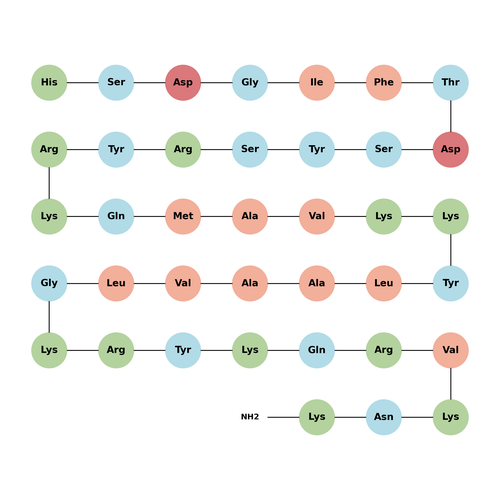
| Sequence | His-Ser-Asp-Gly-Ile-Phe-Thr-Asp-Ser-Tyr-Ser-Arg-Tyr-Arg-Lys-Gln-Met-Ala-Val-Lys-Lys-Tyr-Leu-Ala-Ala-Val-Leu-Gly-Lys-Arg-Tyr-Lys-Gln-Arg-Val-Lys-Asn-Lys-NH₂ |
| Sequence Short | HSDGIFTDSYSRYRKQMAVKKYLAAVLGKRYKQRVKNK |
| Storage | Keep away from moisture Powder: -20°C for 3 years | In solvent: -80°C for 1 year Shipping with blue ice/Shipping at ambient temperature. |
| Solubility Information | H2O: Soluble, Sonication is recommended. |
 For example, if the intended dosage is 10 mg/kg for animals weighing 20 g , with a dosing volume of 100 μL per animal, and a total of 10 animals are to be administered, using a formulation of
  10% DMSO+ 40% PEG300+ 5% Tween 80+ 45% Saline/PBS/ddH2O , the resulting working solution concentration would be 2 mg/mL.
Dissolve 2 mg of the compound in 100 μL DMSO to obtain a stock solution at a concentration of 20 mg/mL . If the required concentration exceeds the compound's known solubility, please contact us for technical support before proceeding.
1) Add 100 μL of the DMSO stock solution to 400 µL PEG300 and mix thoroughly until the solution becomes clear.
2) Add 50 µL Tween 80 and mix well until fully clarified.
3) Add 450 µL Saline,PBS or ddH2O and mix thoroughly until a homogeneous solution is obtained.
| Size | Quantity | Unit Price | Amount | Operation |
|---|
 Feedback
 Hello! How can I help you today?
Copyright © 2015-2026 TargetMol Chemicals Inc. All Rights Reserved.
