


Shopping Cart
Remove All Your shopping cart is currently empty


Synonyms: PACAP 1-27 acetate, PACAP (1-27), human, ovine, rat acetate(127317-03-7 free base)
| Pack Size | Price | USA Stock | Global Stock | Quantity |
|---|---|---|---|---|
| 1 mg | $153 | In Stock | In Stock | |
| 5 mg | $450 | In Stock | In Stock | |
| 10 mg | $663 | In Stock | In Stock | |
| 25 mg | $987 | In Stock | In Stock | |
| 50 mg | $1,390 | In Stock | In Stock | |
| 100 mg | $1,880 | In Stock | In Stock |
| Description | PACAP (1-27), human, ovine, rat acetate (PACAP 1-27 acetate) is a novel neuropeptides originally isolated from bovine hypothalamus, also found in humans and rats. |
| In vitro | Radioligand receptor binding assays with I-monoiodinated PACAP (1-27), human, ovine, rat confirms the presence of PAC -receptors on AR4-2J cells, since PACAP (1-27), human, ovine, rat and PACAP(1–38) equipotently displaces radioligand binding with a Kd of 1-2 nM, whereas vasoactive intestinal peptide (VIP) is 1000-fold less potent. PACAP (1-27), human, ovine, rat exhibits a distinct and much higher susceptibility to VIP-amino acid substitutions. PACAP (1-27), human, ovine, rat has potency and binding affinity to stimulate IP3 and cAMP formation in AR4-2J cells[2]. |
| In vivo | The inhibitory effect of pituitary adenylate cyclase activating polypeptide (PACAP (1-27), human, ovine, rat) on the increase in total pulmonary resistance (RL) causes either by allergen or histamine in anaesthetized, ventilated guinea-pigs is studied. PACAP (1-27), human, ovine, rat given via i.v. infusion (0.045-4.5 nmol/kg/min) dose-dependently reduces the increase in RL caused by inhaled ovalbumin and histamine. At the highest dose, PACAP (1-27), human, ovine, rat prevented the increase in RL caused by ovalbumin and histamine completely. Infusion of PACAP (1-27), human, ovine, rat and the β2-adrenoceptor agonist, salbutamol (0.045-4.5 nmol/kg/min) inhibit the increase in RL similarly, but salbutamol increases the heart rate more than PACAP (1-27), human, ovine, rat[3]. |
| Synonyms | PACAP 1-27 acetate, PACAP (1-27), human, ovine, rat acetate(127317-03-7 free base) |
| Molecular Weight | 3207.71 |
| Formula | C144H228N40O41S |
| Smiles | O=C(N[C@@H](CCCNC(N)=N)C(N[C@@H](CCCCN)C(N[C@@H](CCC(N)=O)C(N[C@@H](CCSC)C(N[C@@H](C)C(N[C@@H](C(C)C)C(N[C@@H](CCCCN)C(N[C@@H](CCCCN)C(N[C@H](C(N[C@@H](CC(C)C)C(N[C@@H](C)C(N[C@@H](C)C(N[C@@H](C(C)C)C(N[C@H](C(N)=O)CC(C)C)=O)=O)=O)=O)=O)CC1=CC=C(O)C=C1)=O)=O)=O)=O)=O)=O)=O)=O)[C@@H](NC([C@H](CCCNC(N)=N)NC([C@H](CO)NC([C@@H](NC([C@H](CO)NC([C@H](CC(O)=O)NC([C@@]([C@H](O)C)([H])NC([C@@H](NC([C@@]([C@@H](C)CC)([H])NC(CNC([C@H](CC(O)=O)NC([C@H](CO)NC([C@@H](N)CC2=CNC=N2)=O)=O)=O)=O)=O)CC3=CC=CC=C3)=O)=O)=O)=O)CC4=CC=C(O)C=C4)=O)=O)=O)CC5=CC=C(O)C=C5.CC(O)=O |
| Relative Density. | 1.31g/cm3 |
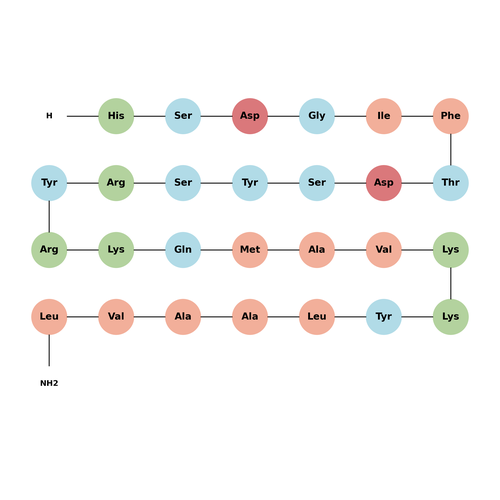
| Sequence | H-His-Ser-Asp-Gly-Ile-Phe-Thr-Asp-Ser-Tyr-Ser-Arg-Tyr-Arg-Lys-Gln-Met-Ala-Val-Lys-Lys-Tyr-Leu-Ala-Ala-Val-Leu-NH₂ |
| Sequence Short | HSDGIFTDSYSRYRKQMAVKKYLAAVL |
| Storage | Keep away from moisture Powder: -20°C for 3 years | In solvent: -80°C for 1 year Shipping with blue ice/Shipping at ambient temperature. | |||||||||||||||
| Solubility Information | DMSO: 5 mM, Sonication is recommended. | |||||||||||||||
Solution Preparation Table | ||||||||||||||||
DMSO
Note : The dilution table applies only to solid products. For liquid products, please calculate the stock solution based on the stated concentration and/or density. | ||||||||||||||||
 For example, if the intended dosage is 10 mg/kg for animals weighing 20 g , with a dosing volume of 100 μL per animal, and a total of 10 animals are to be administered, using a formulation of
  10% DMSO+ 40% PEG300+ 5% Tween 80+ 45% Saline/PBS/ddH2O , the resulting working solution concentration would be 2 mg/mL.
Dissolve 2 mg of the compound in 100 μL DMSO to obtain a stock solution at a concentration of 20 mg/mL . If the required concentration exceeds the compound's known solubility, please contact us for technical support before proceeding.
1) Add 100 μL of the DMSO stock solution to 400 µL PEG300 and mix thoroughly until the solution becomes clear.
2) Add 50 µL Tween 80 and mix well until fully clarified.
3) Add 450 µL Saline,PBS or ddH2O and mix thoroughly until a homogeneous solution is obtained.
| Size | Quantity | Unit Price | Amount | Operation |
|---|
 Feedback
 Hello! How can I help you today?
Copyright © 2015-2026 TargetMol Chemicals Inc. All Rights Reserved.
