


Shopping Cart
Remove All Your shopping cart is currently empty

Synonyms:
| Pack Size | Price | USA Stock | Global Stock | Quantity |
|---|---|---|---|---|
| 500 µg | $180 | 35 days | 35 days | |
| 1 mg | $342 | 35 days | 35 days | |
| 5 mg | $1,430 | 35 days | 35 days | |
| 10 mg | $2,520 | 35 days | 35 days |
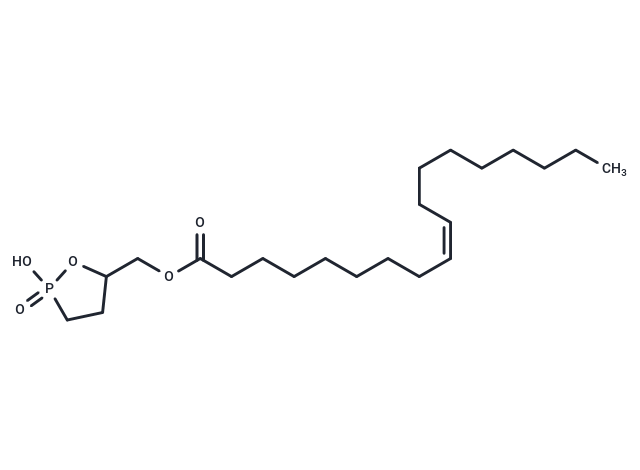
| Description | Oleoyl 3-carbacyclic Phosphatidic Acid are naturally occurring lysophosphatidic acid (LPA) analogs characterized by a five-membered ring formed between the sn-2 hydroxy group and the sn-3 phosphate moiety. Oleoyl 3-Carbacyclic Phosphatidic Acid (3-ccPA 18:1) contains the 18:1 fatty acid oleate at the sn-1 position of the glycerol backbone and functions as a cyclic lysophosphatidic acid analog. At a concentration of 25 μM, Oleoyl 3-Carbacyclic Phosphatidic Acid (3-ccPA 18:1) inhibits MM1 cell transcellular migration through mesothelial cell monolayers induced by fetal bovine serum by 90.1% and by lysophosphatidic acid by 99.9%, without affecting cell proliferation. Furthermore, Oleoyl 3-Carbacyclic Phosphatidic Acid (3-ccPA 18:1), at concentrations ranging from 0.1 to 1.0 μM, markedly suppresses autotaxin, a key regulator of cancer cell survival, growth, migration, invasion, and metastasis. These findings support the application of Oleoyl 3-Carbacyclic Phosphatidic Acid (3-ccPA 18:1) in studies of lysophospholipid signaling, cancer cell biology, cell migration, and autotaxin-mediated molecular mechanisms. |
| In vitro | Method: Oleoyl-containing 3-carbacyclic phosphatidic acid was assessed in autotaxin lysophospholipase-D assays, LPA-receptor-response assays and A2058 melanoma-cell invasion assays. Rresult: The carba analogue showed little LPA-receptor agonism, inhibited autotaxin activity and reduced melanoma-cell invasion. [1] |
| In vivo | Method: Carba analogues of cyclic phosphatidic acid, including the oleoyl 3-ccPA species, were evaluated in a murine B16-F10 melanoma experimental pulmonary-metastasis model.[1] Rresult: Treatment reduced experimental melanoma metastasis, consistent with inhibition of autotaxin-dependent invasion and metastatic dissemination.[1] |
| Molecular Weight | 416.53 |
| Formula | C22H41O5P |
| Cas No. | 779333-58-3 |
| Smiles | C(OC(CCCCCCC/C=C\CCCCCCCC)=O)C1CCP(=O)(O)O1 |
| Storage | Store at low temperature Powder: -20°C for 3 years | In solvent: -80°C for 1 year Shipping with blue ice/Shipping at ambient temperature. |
 For example, if the intended dosage is 10 mg/kg for animals weighing 20 g , with a dosing volume of 100 μL per animal, and a total of 10 animals are to be administered, using a formulation of
  10% DMSO+ 40% PEG300+ 5% Tween 80+ 45% Saline/PBS/ddH2O , the resulting working solution concentration would be 2 mg/mL.
Dissolve 2 mg of the compound in 100 μL DMSO to obtain a stock solution at a concentration of 20 mg/mL . If the required concentration exceeds the compound's known solubility, please contact us for technical support before proceeding.
1) Add 100 μL of the DMSO stock solution to 400 µL PEG300 and mix thoroughly until the solution becomes clear.
2) Add 50 µL Tween 80 and mix well until fully clarified.
3) Add 450 µL Saline,PBS or ddH2O and mix thoroughly until a homogeneous solution is obtained.
| Size | Quantity | Unit Price | Amount | Operation |
|---|
 Feedback
 Hello! How can I help you today?
Copyright © 2015-2026 TargetMol Chemicals Inc. All Rights Reserved.
