


Shopping Cart
Remove All Your shopping cart is currently empty


Synonyms: Mildronate, Meldonium
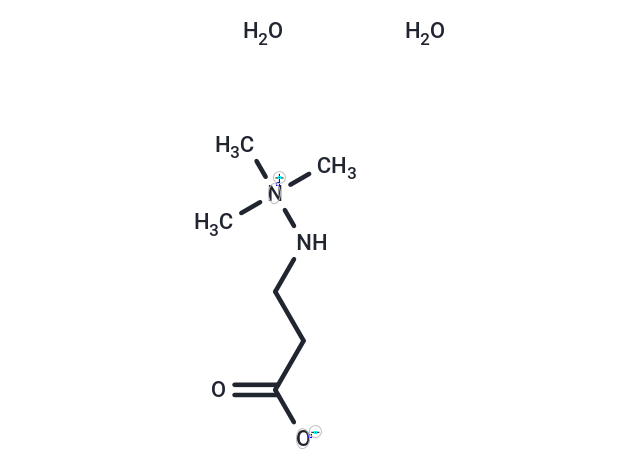
| Pack Size | Price | USA Stock | Global Stock | Quantity |
|---|---|---|---|---|
| 25 mg | $38 | In Stock | In Stock | |
| 50 mg | $56 | In Stock | In Stock | |
| 100 mg | $81 | In Stock | In Stock | |
| 500 mg | $197 | In Stock | In Stock | |
| 1 mL x 10 mM (in H2O) | $29 | In Stock | In Stock |
| Description | Mildronate dihydrate is an inhibitor of biosynthesis of L-carnitine by gamma-butyrobetaine (GBB) hydroxylase and as a competitive inhibitor of renal carnitine reabsorption. |
| Targets & IC50 | BBOX (human recombinant):34-62 μM (IC50), OCTN2 (human):21 μM (EC50) |
| In vitro | Mildronate (40 μM) inhibits the reaction of γ-butyrobetaine hydroxylase with γ-butyrobetaine with Km and Vmax of 36.8 μM and 0.08 nmol/min/mg protein, respectively. [1] |
| In vivo | Mildronate administered orally to rats for 10 days (150 mg/kg) elicits a reduction in myocardial free camitine and long-chain acyl carnitine content by 63.7 and 74.3%, respectively. Mildronate treatment (100 mg/kg, orally) subsequent administration of isoproterenol results in a reduction in free camitine concentration by 48.7% in comparison with the rats receiving isoproterenol. A prior administration of Mildronate effectively protects the myocardium from isoproterenol-induced variations in the content of ATP and myocardial energy charge, as well as preventing a rise in creatine phosphokinase and lactic dehydrogenase activity. [1] Mildronate (200 mg/kg) long-term treatment significantly increases the rate of insulin-stimulated glucose uptake by 35% and the expression of glucose transporter 4 (1.7-fold increase), hexokinase II (2.1-fold increase), insulin receptor proteins (2.5-fold increase) and carnitine palmitoyltransferases IA (2.2-fold increase) in mouse hearts. Mildronate long-term treatment statistically significantly decreases fed state blood glucose from 6 to 5 mM. [2] Mildronate reduces the azidothymidine-induced alterations in mouse brain tissue. Mildronate (50 mg/kg) normalizes the increase in caspase-3, cellular apoptosis susceptibility protein (CAS) and iNOS expression. Mildronate also normalizes the changes in cytochromec oxidase (COX) expression, reduces the expression of glial fibrillary acidic protein (GFAP) and cellular infiltration. [3] |
| Synonyms | Mildronate, Meldonium |
| Molecular Weight | 182.22 |
| Formula | C6H18N2O4 |
| Cas No. | 86426-17-7 |
| Smiles | O.O.C[N+](C)(C)NCCC([O-])=O |
| Relative Density. | no data available |
| Storage | Powder: -20°C for 3 years | In solvent: -80°C for 1 year Shipping with blue ice/Shipping at ambient temperature. | ||||||||||||||||||||
| Solubility Information | DMSO: Insoluble H2O: 10 mM, Sonication is recommended. | ||||||||||||||||||||
Solution Preparation Table | |||||||||||||||||||||
H2O
Note : The dilution table applies only to solid products. For liquid products, please calculate the stock solution based on the stated concentration and/or density. | |||||||||||||||||||||
 For example, if the intended dosage is 10 mg/kg for animals weighing 20 g , with a dosing volume of 100 μL per animal, and a total of 10 animals are to be administered, using a formulation of
  10% DMSO+ 40% PEG300+ 5% Tween 80+ 45% Saline/PBS/ddH2O , the resulting working solution concentration would be 2 mg/mL.
Dissolve 2 mg of the compound in 100 μL DMSO to obtain a stock solution at a concentration of 20 mg/mL . If the required concentration exceeds the compound's known solubility, please contact us for technical support before proceeding.
1) Add 100 μL of the DMSO stock solution to 400 µL PEG300 and mix thoroughly until the solution becomes clear.
2) Add 50 µL Tween 80 and mix well until fully clarified.
3) Add 450 µL Saline,PBS or ddH2O and mix thoroughly until a homogeneous solution is obtained.
| Size | Quantity | Unit Price | Amount | Operation |
|---|
 Feedback
 Hello! How can I help you today?
Copyright © 2015-2026 TargetMol Chemicals Inc. All Rights Reserved.
