


Shopping Cart
Remove All Your shopping cart is currently empty


Synonyms:

| Pack Size | Price | USA Stock | Global Stock | Quantity |
|---|---|---|---|---|
| 5 mg | $32 | In Stock | In Stock | |
| 10 mg | $52 | In Stock | In Stock | |
| 25 mg | $94 | In Stock | In Stock | |
| 50 mg | $145 | In Stock | In Stock | |
| 100 mg | $262 | In Stock | - | |
| 200 mg | $455 | In Stock | - | |
| 1 mL x 10 mM (in DMSO) | $36 | In Stock | In Stock |
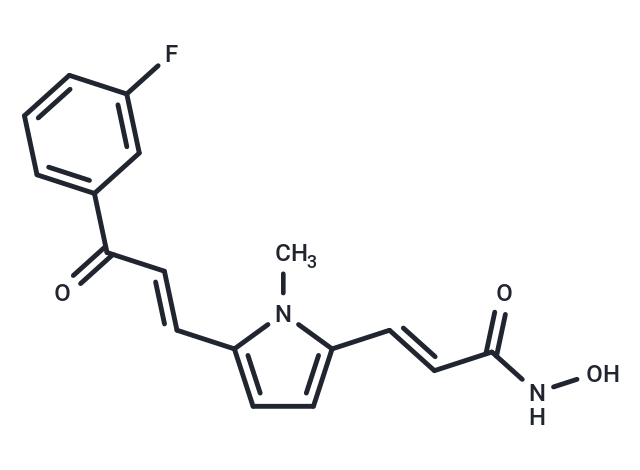
| Description | MC1568 is a specific HDAC inhibitor for maize HD1-A (IC50: 100 nM, in a cell-free assay). It is 34-fold more selective for HD1-A than HD1-B. |
| Targets & IC50 | HD1-A (Maize):100 nM |
| In vitro | In pancreatic transplantation research, MC1568 significantly enhances endocrine β and δ-cells and increases the expression of Pax4. In vivo in mice, MC1568 (50 mg/kg) selectively and markedly inhibits HDAC. Within PPRE-Luc mice, MC1568 (50 mg/kg) specifically disrupts PPARγ signaling in the heart and adipose tissues. When acting on skeletal muscle and heart, MC1568 inhibits the activity of HDAC4/5 without affecting HDAC3 activity, leaving the MEF2-HDAC complex in an inactive state. |
| In vivo | MC1568 selectively inhibits HDAC class II with an IC50 of 220 nM, showing 176 times greater selectivity compared to class I HDACs. In C2C12 cells, MC1568 (5 μM) stabilizes the HDAC4-HDAC3-MEF2 (Myocyte Enhancer Factor 2D) complex by reducing MEF2D expression, blocking myogenic differentiation through inhibition of MEF2D acetylation. Additionally, MC1568 at 5 or 10 μM disrupts the RAR (Retinoic Acid Receptor) and PPARγ (Peroxisome Proliferator-Activated Receptor Gamma)-mediated differentiation signaling pathways. In MCF-7 cells, a concentration of 20 μM MC1568 enhances the accumulation of acetylated H3 and H4 histones and acetylated tubulin levels, indicating inhibition of HDAC6. Experiments with human breast cancer ZR-75.1 cell lysates show that MC1568 does not inhibit HDAC1 but does inhibit HDAC4. In F9 cells, MC1568 selectively inhibits endodermal differentiation without affecting VA (Vitamin A)-induced maturation in early promyelocytic NB4 cells. Furthermore, in 3T3-L1 cells, MC1568 reduces PPARγ-induced adipogenesis. |
| Kinase Assay | Maize HD2, HD1-B, and HD1-A Enzyme Inhibition.: The enzyme liberats tritiated acetic acid from the substrate, which is quantified by scintillation counting. IC50 values are results of triple determinations. A 50 μL sample of maize enzyme (at 30 °C) is incubated (30 min) with 10 μL of total [3H]acetate-prelabeled chicken reticulocyte histones (2 mg/mL). Reaction is stopped by addition of 50 μL of 1 M HCl/0.4 M acetate and 800 μL of ethyl acetate. After centrifugation (1×10⁴ g, 5 min), an aliquot of 600 μL of the upper phase is counted for radioactivity in 3 mL of liquid scintillation cocktail. MC1568 is tested at a starting concentration of 40 μM, and active substances are diluted further. NaB, VPA, TSA, SAHA, 85 TPX, HC-toxin, and tubacin are used as the reference compounds, and blank solvents are used as negative controls. |
| Cell Research | The 3T3-L1 cells are propagated and differentiated using a cocktail of isobutylmethylxanthine, dexamethasone, and insulin. From the second day post-confluence and throughout the differentiation period of 8 days, the 3T3-L1 cells are induced by: (1) no induction: at post-confluence and throughout the differentiation period of 8 days, the cells are incubated with DMSO or MC1568. (2) troglitazone: at post-confluence and throughout the differentiation period of 8 days, the cells are induced with 5 μM troglitazone, MC1568, or both. (3) rosiglitazone: at post-confluence and throughout the differentiation period of 8 days, the cells are incubated with 1?μM rosiglitazone and either DMSO or MC1568. (4) rosiglitazone and dexamethasone: at post-confluence, the cells received 1?μM of rosiglitazone and 390?ng/mL dexamethasone. Throughout the differentiation period of 8 days, the cells are induced with 1?μM of rosiglitazone and either DMSO or MC1568. All medium is renewed every second day.(Only for Reference) |
| Molecular Weight | 314.31 |
| Formula | C17H15FN2O3 |
| Cas No. | 852475-26-4 |
| Smiles | Cn1c(\C=C\C(=O)NO)ccc1\C=C\C(=O)c1cccc(F)c1 |
| Relative Density. | 1.21 g/cm3 (Predicted) |
| Storage | Powder: -20°C for 3 years | In solvent: -80°C for 1 year Shipping with blue ice/Shipping at ambient temperature. | |||||||||||||||||||||||||
| Solubility Information | H2O: < 1 mg/mL (insoluble or slightly soluble) Ethanol: < 1 mg/mL (insoluble or slightly soluble) DMSO: 11 mg/mL (35 mM), Sonication is recommended. | |||||||||||||||||||||||||
Solution Preparation Table | ||||||||||||||||||||||||||
DMSO
Note : The dilution table applies only to solid products. For liquid products, please calculate the stock solution based on the stated concentration and/or density. | ||||||||||||||||||||||||||
 For example, if the intended dosage is 10 mg/kg for animals weighing 20 g , with a dosing volume of 100 μL per animal, and a total of 10 animals are to be administered, using a formulation of
  10% DMSO+ 40% PEG300+ 5% Tween 80+ 45% Saline/PBS/ddH2O , the resulting working solution concentration would be 2 mg/mL.
Dissolve 2 mg of the compound in 100 μL DMSO to obtain a stock solution at a concentration of 20 mg/mL . If the required concentration exceeds the compound's known solubility, please contact us for technical support before proceeding.
1) Add 100 μL of the DMSO stock solution to 400 µL PEG300 and mix thoroughly until the solution becomes clear.
2) Add 50 µL Tween 80 and mix well until fully clarified.
3) Add 450 µL Saline,PBS or ddH2O and mix thoroughly until a homogeneous solution is obtained.
| Size | Quantity | Unit Price | Amount | Operation |
|---|
 Feedback
 Hello! How can I help you today?
Copyright © 2015-2026 TargetMol Chemicals Inc. All Rights Reserved.
