


Shopping Cart
Remove All Your shopping cart is currently empty

Synonyms:
| Pack Size | Price | USA Stock | Global Stock | Quantity |
|---|---|---|---|---|
| 1 mg | $29 | - | In Stock |
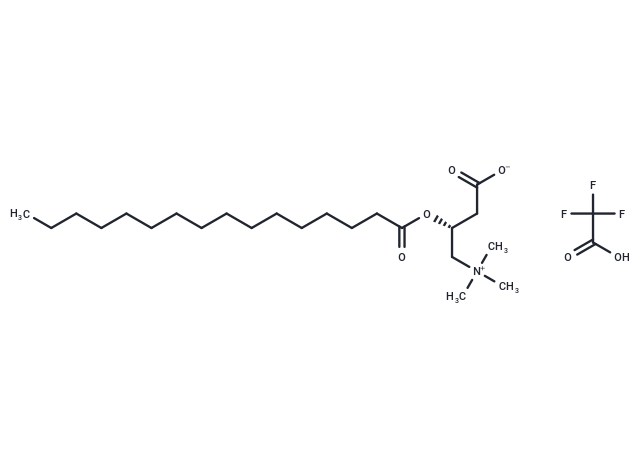
| Description | L-Palmitoylcarnitine TFA is a long-chain acylcarnitine and fatty acid metabolite that accumulates in the sarcolemma during ischemia and disrupts the membrane lipid environment. L-Palmitoylcarnitine TFA inhibits KATP channel activity through interaction with Kir6.2, without affecting single-channel conductance. |
| In vitro | Method: L-Palmitoylcarnitine TFA (the study used palmitoylcarnitine) was applied at approximately 0.3–10 μM to rabbit aortic endothelial cells and membrane currents were measured electrophysiologically. Result: Palmitoylcarnitine produced a slowly activating outward current; the response was inhibited by 4-aminopyridine and was nearly abolished by removal of extracellular Ca2+.[1] Method: L-Palmitoylcarnitine TFA (the study used L-palmitoylcarnitine) was applied at 1 μM to inside-out membrane patches from guinea-pig ventricular myocytes to examine ATP-sensitive K+ channel activity. Result: L-Palmitoylcarnitine inhibited KATP-channel activity without changing unitary conductance and increased channel sensitivity to ATP; the ATP IC50 shifted from approximately 62.0±2.7 to 30.3±5.5 μM.[2] Method: L-Palmitoylcarnitine TFA (the study used palmitoylcarnitine) was applied to PC3 prostate cancer cells at concentrations up to approximately 100 μM, including 50 μM treatment for inflammatory-endpoint measurements. Result: Palmitoylcarnitine increased intracellular Ca2+ influx and significantly enhanced IL-6 secretion in PC3 cells.[3] |
| Molecular Weight | 513.63 |
| Formula | C25H46F3NO6 |
| Smiles | CCCCCCCCCCCCCCCC(O[C@H](CC([O-])=O)C[N+](C)(C)C)=O.O=C(O)C(F)(F)F |
| Storage | Keep away from moisture,,Store under nitrogen Powder: -20°C for 3 years | In solvent: -80°C for 1 year Shipping with blue ice/Shipping at ambient temperature. | |||||||||||||||||||||||||||||||||||
| Solubility Information | DMSO: 80 mg/mL (155.75 mM), Sonication is recommended. | |||||||||||||||||||||||||||||||||||
| In Vivo Formulation | 10% DMSO+40% PEG300+5% Tween-80+45% Saline: 3.3 mg/mL (6.42 mM), Sonication is recommended. Please add the solvents sequentially, clarifying the solution as much as possible before adding the next one. Dissolve by heating and/or sonication if necessary. Working solution is recommended to be prepared and used immediately. The formulation provided above is for reference purposes only. In vivo formulations may vary and should be modified based on specific experimental conditions. | |||||||||||||||||||||||||||||||||||
Solution Preparation Table | ||||||||||||||||||||||||||||||||||||
DMSO
Note : The dilution table applies only to solid products. For liquid products, please calculate the stock solution based on the stated concentration and/or density. | ||||||||||||||||||||||||||||||||||||
 For example, if the intended dosage is 10 mg/kg for animals weighing 20 g , with a dosing volume of 100 μL per animal, and a total of 10 animals are to be administered, using a formulation of
 10% DMSO+ 40% PEG300+ 5% Tween 80+ 45% Saline/PBS/ddH2O , the resulting working solution concentration would be 2 mg/mL.
Dissolve 2 mg of the compound in 100 μL DMSO to obtain a stock solution at a concentration of 20 mg/mL . If the required concentration exceeds the compound's known solubility, please contact us for technical support before proceeding.
1) Add 100 μL of the DMSO stock solution to 400 µL PEG300 and mix thoroughly until the solution becomes clear.
2) Add 50 µL Tween 80 and mix well until fully clarified.
3) Add 450 µL Saline,PBS or ddH2O and mix thoroughly until a homogeneous solution is obtained.
| Size | Quantity | Unit Price | Amount | Operation |
|---|
 Feedback
 Hello! How can I help you today?

Copyright © 2015-2026 TargetMol Chemicals Inc. All Rights Reserved.
