


Shopping Cart
Remove All Your shopping cart is currently empty

Synonyms: IPA3, IPA 3
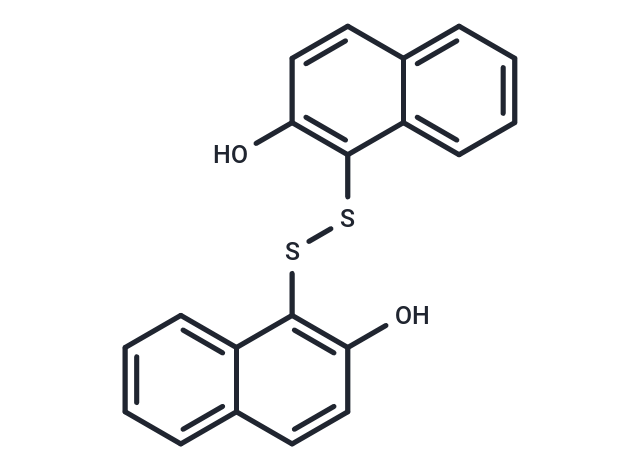

| Pack Size | Price | USA Stock | Global Stock | Quantity |
|---|---|---|---|---|
| 5 mg | $39 | In Stock | In Stock | |
| 10 mg | $61 | In Stock | In Stock | |
| 25 mg | $118 | In Stock | In Stock | |
| 50 mg | $215 | In Stock | In Stock | |
| 100 mg | $379 | - | In Stock | |
| 1 mL x 10 mM (in DMSO) | $43 | In Stock | In Stock |
| Description | IPA-3 is a selective, non-ATP competitive Pak1 inhibitor with an IC50 of 2.5 μM, and it does not inhibit group II PAKs (PAKs 4-6). |
| Targets & IC50 | PAK1:2.5 μM |
| In vitro | IPA-3 is a non-ATP-competitive, allosteric inhibitor of p21-activated kinase 1 (Pak1), with PIR3.5 serving as its control compound. It effectively blocks Cdc42-stimulated and sphingosine-dependent autophosphorylation of Pak1 on Thr423, without targeting the protein's exposed cysteine residues. The efficacy of IPA-3 is dependent on its disulfide bond; reduction by dithiothreitol (DTT) nullifies its inhibitory action on Pak1. Notably, IPA-3 obstructs Pak1 activation by various activators but does not affect already preactivated Pak1; it also impedes PDGF-induced Pak activation in mouse embryonic fibroblasts. This inhibition is partially achieved through covalent binding to Pak1's regulatory domain, an interaction that is both time- and temperature-sensitive, and prevents Cdc42 engagement. Additionally, IPA-3 demonstrates a direct bond to the Pak1 autoregulatory domain and offers reversible inhibition of PMA-induced membrane ruffling in cells. |
| Synonyms | IPA3, IPA 3 |
| Kinase Assay | Pak1 (150 nM final) is pre-incubated with MBP (8.3 μM), indicated proteins, and IPA-3 or DMSO in Kinase buffer for 20 minutes at 4°C. Cdc42-GTPγS (3.2 μM) is then added and the reaction is pre-equilibrated 10 minutes at 30°C. Kinase reactions are started by the addition of ATP (to 30 μM) containing [32P]ATP and are incubated 10 min and analyzed by SDS-PAGE and autoradiography. |
| Cell Research | Human primary schwannoma cells are grown on 96 well plates for 2 days. Cells are left untreated or treated with 5 μM IPA-3, 20 μM IPA-3 or 20 μM PIR-3.5 for 24 hours. The MTS-solution is left on the cells for 3 hours, before the absorbance at 490 nm is measured. The experiments are conducted three times and mean and standard error of the mean is calculated with Excel. |
| Molecular Weight | 350.45 |
| Formula | C20H14O2S2 |
| Cas No. | 42521-82-4 |
| Smiles | Oc1ccc2ccccc2c1SSc1c(O)ccc2ccccc12 |
| Relative Density. | 1.46 g/cm3 (Predicted) |
| Storage | Powder: -20°C for 3 years | In solvent: -80°C for 1 year Shipping with blue ice/Shipping at ambient temperature. | ||||||||||||||||||||||||||||||||||||||||
| Solubility Information | H2O: < 1 mg/mL (insoluble or slightly soluble) Ethanol: 7 mg/mL (19.97 mM), Sonication is recommended. DMSO: 250 mg/mL (713.37 mM), Sonication is recommended.  | ||||||||||||||||||||||||||||||||||||||||
| In Vivo Formulation | 10% DMSO+90% Corn oil: 10 mg/mL (28.53 mM), Solution. 10% DMSO+40% PEG300+5% Tween 80+45% Saline: < 10 mg/mL (28.53 mM), Lower concentrations may be soluble, but exact solubility limit is unknown. 10% DMSO+90% Saline: < 10 mg/mL (28.53 mM), Lower concentrations may be soluble, but exact solubility limit is unknown. 10% DMSO+90% (20% SBE-β-CD in Saline): < 10 mg/mL (28.53 mM), Lower concentrations may be soluble, but exact solubility limit is unknown. Please add the solvents sequentially, clarifying the solution as much as possible before adding the next one. Dissolve by heating and/or sonication if necessary. Working solution is recommended to be prepared and used immediately. The formulation provided above is for reference purposes only. In vivo formulations may vary and should be modified based on specific experimental conditions. | ||||||||||||||||||||||||||||||||||||||||
Solution Preparation Table | |||||||||||||||||||||||||||||||||||||||||
Ethanol/DMSO
DMSO
Note : The dilution table applies only to solid products. For liquid products, please calculate the stock solution based on the stated concentration and/or density. | |||||||||||||||||||||||||||||||||||||||||
 For example, if the intended dosage is 10 mg/kg for animals weighing 20 g , with a dosing volume of 100 μL per animal, and a total of 10 animals are to be administered, using a formulation of
  10% DMSO+ 40% PEG300+ 5% Tween 80+ 45% Saline/PBS/ddH2O , the resulting working solution concentration would be 2 mg/mL.
Dissolve 2 mg of the compound in 100 μL DMSO to obtain a stock solution at a concentration of 20 mg/mL . If the required concentration exceeds the compound's known solubility, please contact us for technical support before proceeding.
1) Add 100 μL of the DMSO stock solution to 400 µL PEG300 and mix thoroughly until the solution becomes clear.
2) Add 50 µL Tween 80 and mix well until fully clarified.
3) Add 450 µL Saline,PBS or ddH2O and mix thoroughly until a homogeneous solution is obtained.
| Size | Quantity | Unit Price | Amount | Operation |
|---|
 Feedback
 Hello! How can I help you today?
Copyright © 2015-2026 TargetMol Chemicals Inc. All Rights Reserved.
