


Shopping Cart
Remove All Your shopping cart is currently empty

Synonyms:
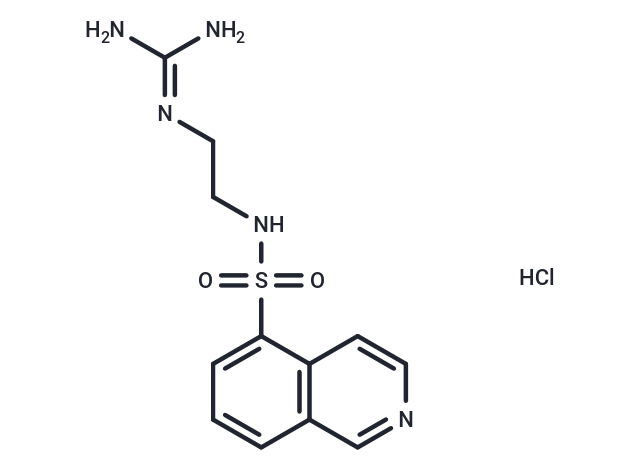
| Pack Size | Price | USA Stock | Global Stock | Quantity |
|---|---|---|---|---|
| 1 mg | $370 | 6-8 weeks | 6-8 weeks |
| Description | HA-1004 dihydrochloride is an inhibitor of PKA, PKC, cGKI, MYLK, and calcium channel protein |
| In vivo | HA-1004, was shown to be a potent inhibitor of two cyclic nucleotide-dependent protein kinases, cyclic GMP-dependent protein kinase and cyclic AMP-dependent protein kinase and the Ki values were 1.4 and 2.3 microM, respectively.?HA-1004 relaxed rabbit aortic strips contracted by various agonists and with similar ED50 values.?Phenotolamine, propranolol and atropine did not affect this HA-1004-induced relaxation, thereby suggesting that this compound does not act through these membrane receptor associated mechanisms.?HA-1004 shifted the dose-response curve for CaCl2 to the right in a competitive manner in depolarized rabbit renal arterial strips.?This compound also relaxed the A-23187 and phenylephrine-induced contractions elicited in Ca++-free solution.?HA-1004 exerts its action at the intracellular or submembranal level.?This vasodilator has little effect on actomyosin adenosine triphosphatase and Ca++-calmodulin-dependent myosin light chain kinase.?Studies using its derivatives with various lengths of alkyl chain (C0-C6) indicated that the potencies of these compounds, as vasorelaxants, correlated well with their potential to inhibit cyclic nucleotide-dependent protein kinase.?HA-1004 should be a useful tool for investigating in smooth muscle, regulatory mechanism(s) by second messengers, cyclic AMP and cyclic GMP[1]. |
| Molecular Weight | 329.81 |
| Formula | C12H16ClN5O2S |
| Cas No. | 92564-34-6 |
| Smiles | C1=CC2=C(C=CN=C2)C(=C1)S(=O)(=O)NCCN=C(N)N.Cl |
| Relative Density. | no data available |
| Storage | Powder: -20°C for 3 years | In solvent: -80°C for 1 year Shipping with blue ice/Shipping at ambient temperature. |
 For example, if the intended dosage is 10 mg/kg for animals weighing 20 g , with a dosing volume of 100 μL per animal, and a total of 10 animals are to be administered, using a formulation of
  10% DMSO+ 40% PEG300+ 5% Tween 80+ 45% Saline/PBS/ddH2O , the resulting working solution concentration would be 2 mg/mL.
Dissolve 2 mg of the compound in 100 μL DMSO to obtain a stock solution at a concentration of 20 mg/mL . If the required concentration exceeds the compound's known solubility, please contact us for technical support before proceeding.
1) Add 100 μL of the DMSO stock solution to 400 µL PEG300 and mix thoroughly until the solution becomes clear.
2) Add 50 µL Tween 80 and mix well until fully clarified.
3) Add 450 µL Saline,PBS or ddH2O and mix thoroughly until a homogeneous solution is obtained.
| Size | Quantity | Unit Price | Amount | Operation |
|---|
 Feedback
 Hello! How can I help you today?
Copyright © 2015-2026 TargetMol Chemicals Inc. All Rights Reserved.
