


Shopping Cart
Remove All Your shopping cart is currently empty

Synonyms:
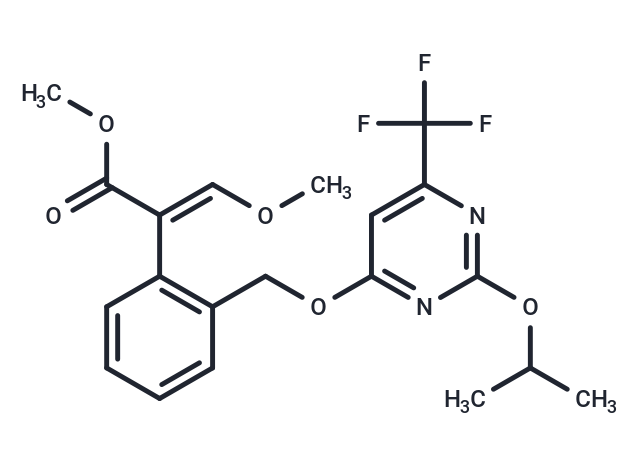
| Pack Size | Price | USA Stock | Global Stock | Quantity |
|---|---|---|---|---|
| 10 mg | Inquiry | 10-14 weeks | 10-14 weeks | |
| 50 mg | Inquiry | 10-14 weeks | 10-14 weeks |
| Description | Fluacrypyrim is an ester-based acaricide and functions as a STAT3 inhibitor. It significantly enhances the activity of protein tyrosine phosphatases (PTPs) and suppresses leukemia cell growth by inducing substantial G1 phase arrest and significantly reducing the levels of cyclin D1 protein and mRNA. Fluacrypyrim selectively inhibits the STAT3 signaling pathway, leading to growth arrest and apoptosis in STAT3-dependent cancer cells. It mainly alleviates radiation-induced hematopoietic system damage by preventing apoptosis in hematopoietic stem cells (HSCs). Additionally, fluacrypyrim exhibits notable analgesic and anti-inflammatory effects by inhibiting uterine smooth muscle contraction and inflammatory responses. |
| In vitro | Fluacrypyrim decreases the apoptosis rate of bone marrow nucleated cells (BMNCs) and their subpopulations (Lin⁻ cells, Lin⁻c-Kit⁺ cells, LK cells, and LSK cells) following 6.5 Gy irradiation when applied for 3-12 hours. At a concentration of 5 μM for 4-10 hours, fluacrypyrim reduces BMNCs apoptosis through modulating the p53-PUMA pathway. The compound exhibits strong concentration and time-dependent inhibitory effects on HL-60 cell growth, with an IC50 of 3.8 μM, when applied in the range of 0.1-12 μM for 0-72 hours. Fluacrypyrim induces G1 phase arrest in HL-60 cells by downregulating cyclin-D1 at concentrations of 1.5-12 μM for 6-36 hours. In HL-60 cells, fluacrypyrim at 0.75-12 μM for 6-36 hours significantly inhibits phosphorylation of STAT3 (tyr705), an effect reversible by sodium pervanadate treatment. Additionally, fluacrypyrim at 0.75-12 μM for 12 hours induces a dose-dependent increase in tyrosine phosphatase activity in HL-60 cells. The compound, at 3-12 μM for 8-24 hours, inhibits STAT3-dependent luciferase activity in IL-6-stimulated HepG-2 cells and c-Src transfected NIH 3T3 cells. Fluacrypyrim at 0.75-12 μM for 24 hours suppresses constitutively activated STAT3, thus blocking cyclin D1 and c-Myc expression in HL-60 cells. It preferentially inhibits the growth of cancer cells with constitutively activated STAT3, showing IC50 values of 3.8 μM (HL-60 cells), 6.0 μM (K562 cells), 8.2 μM (XG-7 cells), and 12.3 μM (Jurkat-T cells). In breast cancer cells (MDA-MB-231), fluacrypyrim at 6-24 μM for 24 hours induces caspase-dependent apoptosis. Moreover, fluacrypyrim significantly inhibits uterine contractions induced by Dinoprost (PGF2α), Oxytocin, acetylcholine (Ach), and KCL in a dose-dependent manner (pD2 ranging from 5.72 to 5.92) when used at 0.62-10 μM for 60 minutes, and also inhibits PGF2α-induced MLC20 phosphorylation at concentrations of 2.5-10 μM. |
| In vivo | Fluacrypyrim, administered intraperitoneally at 20-75 mg/kg 3-48 hours before irradiation, mitigates radiation-induced hematopoietic system damage in C57BL/6J (CD45 .2) and B6.SJL/BoyJ (CD45 .1) mice. At doses of 50-200 mg/kg, given intraperitoneally one hour before acetic acid injection, it reduces acetic acid-induced writhing responses in mice. Additionally, at 100-200 mg/kg, administered intraperitoneally one hour prior to PGF 2α injection, fluacrypyrim alleviates inflammatory activity and pain responses in mouse and rat edema models. |
| Molecular Weight | 426.39 |
| Formula | C20H21F3N2O5 |
| Cas No. | 229977-93-9 |
| Smiles | C(\C(OC)=O)(=C/OC)/C1=C(COC=2C=C(C(F)(F)F)N=C(OC(C)C)N2)C=CC=C1 |
| Storage | Powder: -20°C for 3 years | In solvent: -80°C for 1 year Shipping with blue ice/Shipping at ambient temperature. |
 For example, if the intended dosage is 10 mg/kg for animals weighing 20 g , with a dosing volume of 100 μL per animal, and a total of 10 animals are to be administered, using a formulation of
  10% DMSO+ 40% PEG300+ 5% Tween 80+ 45% Saline/PBS/ddH2O , the resulting working solution concentration would be 2 mg/mL.
Dissolve 2 mg of the compound in 100 μL DMSO to obtain a stock solution at a concentration of 20 mg/mL . If the required concentration exceeds the compound's known solubility, please contact us for technical support before proceeding.
1) Add 100 μL of the DMSO stock solution to 400 µL PEG300 and mix thoroughly until the solution becomes clear.
2) Add 50 µL Tween 80 and mix well until fully clarified.
3) Add 450 µL Saline,PBS or ddH2O and mix thoroughly until a homogeneous solution is obtained.
| Size | Quantity | Unit Price | Amount | Operation |
|---|
 Feedback
 Hello! How can I help you today?
Copyright © 2015-2026 TargetMol Chemicals Inc. All Rights Reserved.
