


Shopping Cart
Remove All Your shopping cart is currently empty

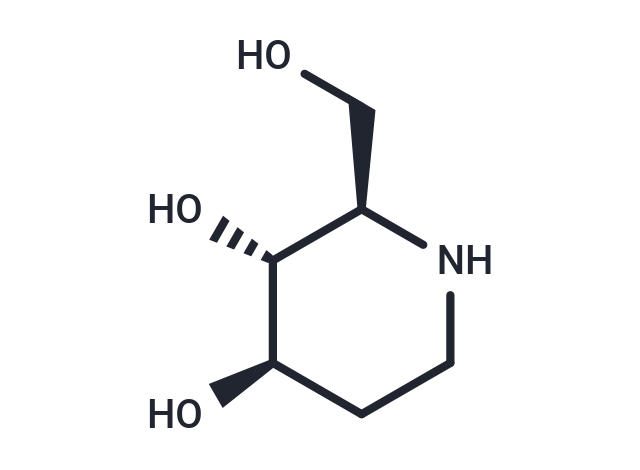
Synonyms: D-Fagomine
| Pack Size | Price | USA Stock | Global Stock | Quantity |
|---|---|---|---|---|
| 1 mg | $199 | 7-10 days | 7-10 days |
| Description | Fagomine (D-Fagomine) is a mild glycosidase inhibitor, an analog of 1-deoxynojirimycin (DNJ) with hypoglycemic activity, and Fagomine reduces intracellular reactive oxygen species (ROS) production and malondialdehyde (MDA) levels. |
| In vitro | Fagomine (D-fagomine), a subamino sugar, exhibits selective agglutination of Escherichia coli in vitro. It selectively aggregates flagellated E. coli, inhibiting their adherence to the intestinal mucosa. This effect may be attributed to its structural similarity with sugar moieties binding to lectins, such as mannose. Fagomine has the ability to alter the impact of a high-fat high-sucrose diet (HFHS) on the ratio of Enterobacteriaceae and Bacteroides in the gut[3]. |
| In vivo | Fagomine (D-fagomine), a natural subamino sugar, can counteract the short-term effects of a high-energy density diet on body weight, fasting blood glucose levels, and intestinal Enterobacteriaceae[3]. When compared to the standard group, rats fed a high-fat high-sucrose diet (HFHS) along with D-fagomine exhibited a significantly lower increase in body weight (15.3%), in contrast to rats fed only HFHS (20.9%)[2]. |
| Synonyms | D-Fagomine |
| Kinase Assay | Lysosomal enzyme activities in cell lysates are determined. Briefly, cells are scraped in ice-cold 0.1% Triton X-100 in water. After centrifugation (6000 rpm for 15 min at 4°C) to remove insoluble materials, protein concentrations are determined using Protein Assay Rapid Kit. The lysates are incubated at 37°C with the corresponding 4-methylumbelliferyl β-D-glycopyranoside solution in 0.1 M citrate buffer (pH 4). The liberated 4-methylumbelliferone is measured with a fluorescence plate reader (excitation 340 nm; emission 460 nm). For enzyme inhibition assay, cell lysates from normal skin fibroblasts are mixed with the 4-methylumbelliferyl β-D-glycopyranoside substrates in the absence or presence of increasing concentrations of Fagomine [1]. |
| Cell Research | Human skin fibroblasts from a healthy and three Gaucher disease patients (with N188S/G183W, V230G/R296X, and L444P/L444P mutations) are maintained in DMEM supplemented with 10% FBS as the culture medium. For enzyme activity enhancement assay, cells are cultured in the presence of different concentrations of Fagomine or DMSO alone (as a control) for 5 days and harvested by scraping. Cytotoxicity of Fagomine is monitored by measuring the lactate dehydrogenase activities in the cultured supernatants [1]. |
| Animal Research | Sprague-Dawley rats (male, 22 weeks old) are randomly assigned to one of the three dietary groups: the control group fed a standard diet (STD); a group fed HFHS (modified high-fat high-sucrose diet); a group fed HFHS supplemented with 0.065% Fagomine (HFHS+FG). The percentage of Fagomine is adjusted so that its ratio to sucrose is 2 mg/g, as defined before from the results of post-prandial tests. The modified diets are processed. Feed consumption is monitored every day throughout the experiment and body weight is measured before and at the end of the nutritional intervention. All animal manipulations are carried out in the morning to minimize the effects of circadian rhythms [3]. |
| Molecular Weight | 147.17 |
| Formula | C6H13NO3 |
| Cas No. | 53185-12-9 |
| Smiles | OC[C@H]1NCC[C@@H](O)[C@@H]1O |
| Relative Density. | 1.279 g/cm3 |
| Storage | Store at low temperature Powder: -20°C for 3 years | In solvent: -80°C for 1 year Shipping with blue ice/Shipping at ambient temperature. | |||||||||||||||||||||||||||||||||||
| Solubility Information | H2O: 30 mg/mL (203.85 mM), Sonication is recommended. | |||||||||||||||||||||||||||||||||||
Solution Preparation Table | ||||||||||||||||||||||||||||||||||||
H2O
Note : The dilution table applies only to solid products. For liquid products, please calculate the stock solution based on the stated concentration and/or density. | ||||||||||||||||||||||||||||||||||||
 For example, if the intended dosage is 10 mg/kg for animals weighing 20 g , with a dosing volume of 100 μL per animal, and a total of 10 animals are to be administered, using a formulation of
  10% DMSO+ 40% PEG300+ 5% Tween 80+ 45% Saline/PBS/ddH2O , the resulting working solution concentration would be 2 mg/mL.
Dissolve 2 mg of the compound in 100 μL DMSO to obtain a stock solution at a concentration of 20 mg/mL . If the required concentration exceeds the compound's known solubility, please contact us for technical support before proceeding.
1) Add 100 μL of the DMSO stock solution to 400 µL PEG300 and mix thoroughly until the solution becomes clear.
2) Add 50 µL Tween 80 and mix well until fully clarified.
3) Add 450 µL Saline,PBS or ddH2O and mix thoroughly until a homogeneous solution is obtained.
| Size | Quantity | Unit Price | Amount | Operation |
|---|
 Feedback
 Hello! How can I help you today?
Copyright © 2015-2026 TargetMol Chemicals Inc. All Rights Reserved.
