


Shopping Cart
Remove All Your shopping cart is currently empty

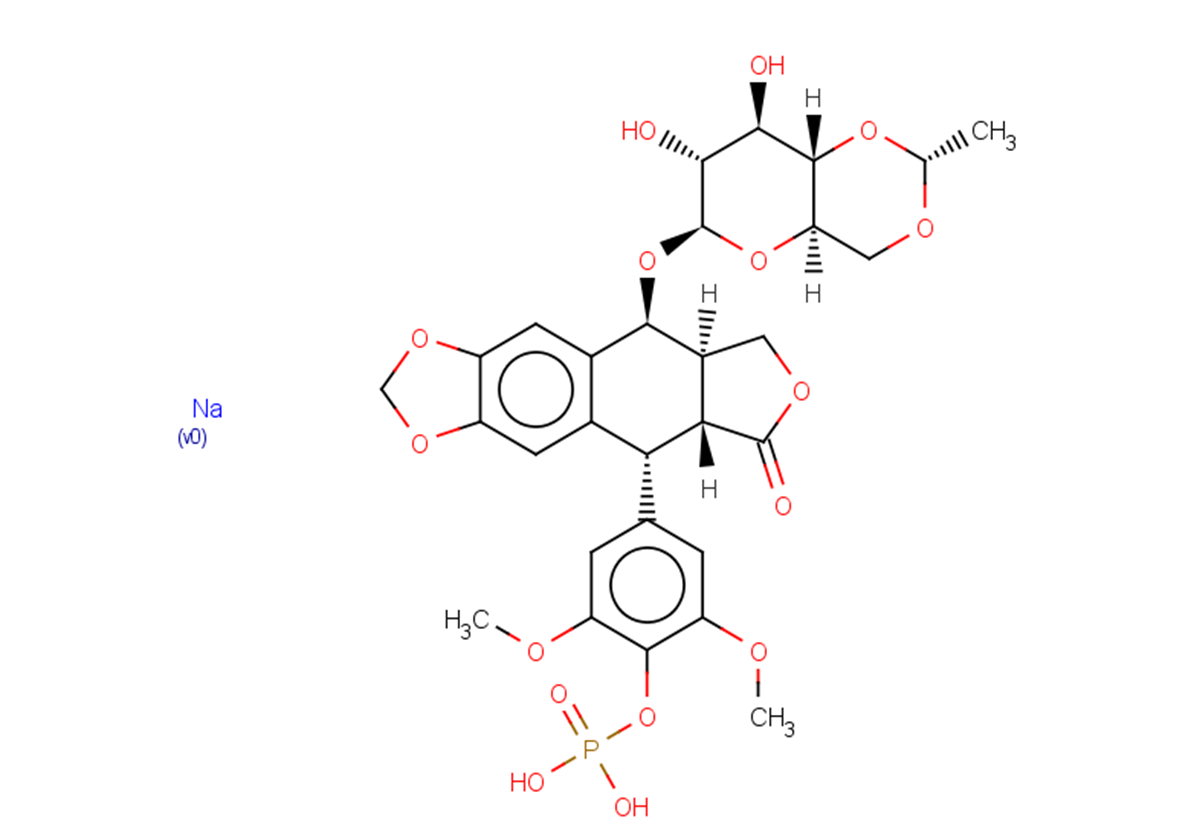
Synonyms: Etoposide phosphate disodium, BMY-40481 disodium
| Pack Size | Price | USA Stock | Global Stock | Quantity |
|---|---|---|---|---|
| 5 mg | $970 | Inquiry | Inquiry |
| Description | Etoposide phosphate disodium (BMY-40481 disodium), a phosphate ester prodrug of etoposide, is a potent chemotherapeutic agent that selectively inhibits topoisomerase II, hindering the re-ligation of DNA strands. Regarded as the active equivalent of etoposide, it effectively induces cell cycle arrest, apoptosis, and autophagy in cancer cells. |
| In vitro | Etoposide phosphate disodium, a water-soluble derivative and likely prodrug of etoposide, is distinguished by a phosphate group at position 4' on the E ring of the etoposide molecule[1]. It demonstrates dose-dependent inhibition of HCT116 FBXW7 +/+, FBXW7 -/-, and p53 -/- cells, with IC50 values being 0.945 μM, 0.375 μM, and 1.437 μM respectively, when administered at concentrations ranging from 0-1 μM over 72 hours[2]. At a concentration of 25 μM for 6 hours, etoposide phosphate disodium delays the recovery of p53 in cells deficient in FBXW7, where FBXW7 expression is absent in FBXW7 -/- cells[2]. Cell viability assays show that the compound inhibits the growth of HCT116 FBXW7 +/+, FBXW7 -/-, and p53 -/- cells in a concentration-dependent manner at varying concentrations up to 1 μM over 72 hours[2]. Additionally, Western Blot analysis reveals that at 25 μM concentration for 6 hours, there is a delayed recovery of p53 levels in HCT116 FBXW7 +/+ or FBXW7 -/- cells post DNA damage, mediated by FBXW7 presence[2]. |
| In vivo | Etoposide phosphate, administered as a single intravenous injection at dosages of 50, 100, or 150 mg/kg, induces prominent clinical symptoms in female CD-1 mice, including progressive ataxia, an impaired righting reflex, and splaying coupled with paresis of both fore- and hindlimbs by day 8. Similarly observed under light microscopy (LM) were degenerative changes in dorsal root ganglion cells and axonal degeneration in their distal and proximal processes affecting peripheral nerves, dorsal spinal roots, and dorsal funiculi of the spinal cord across all tested doses. |
| Synonyms | Etoposide phosphate disodium, BMY-40481 disodium |
| Molecular Weight | 712.5 |
| Formula | C29H31Na2O16P |
| Cas No. | 122405-33-8 |
| Smiles | [Na].[H][C@]12COC(=O)[C@]1([H])[C@H](c1cc(OC)c(OP(O)(O)=O)c(OC)c1)c1cc3OCOc3cc1[C@H]2O[C@@H]1O[C@]2([H])CO[C@@H](C)O[C@@]2([H])[C@H](O)[C@H]1OjcExt:v:0:0 |
| Relative Density. | no data available |
| Storage | Powder: -20°C for 3 years | In solvent: -80°C for 1 year Shipping with blue ice/Shipping at ambient temperature. |
 For example, if the intended dosage is 10 mg/kg for animals weighing 20 g , with a dosing volume of 100 μL per animal, and a total of 10 animals are to be administered, using a formulation of
  10% DMSO+ 40% PEG300+ 5% Tween 80+ 45% Saline/PBS/ddH2O , the resulting working solution concentration would be 2 mg/mL.
Dissolve 2 mg of the compound in 100 μL DMSO to obtain a stock solution at a concentration of 20 mg/mL . If the required concentration exceeds the compound's known solubility, please contact us for technical support before proceeding.
1) Add 100 μL of the DMSO stock solution to 400 µL PEG300 and mix thoroughly until the solution becomes clear.
2) Add 50 µL Tween 80 and mix well until fully clarified.
3) Add 450 µL Saline,PBS or ddH2O and mix thoroughly until a homogeneous solution is obtained.
| Size | Quantity | Unit Price | Amount | Operation |
|---|
 Feedback
 Hello! How can I help you today?
Copyright © 2015-2026 TargetMol Chemicals Inc. All Rights Reserved.
