


Shopping Cart
Remove All Your shopping cart is currently empty

Synonyms: Utidelone, UTD1, UTD 1, KOS862, KOS 862
| Pack Size | Price | USA Stock | Global Stock | Quantity |
|---|---|---|---|---|
| 1 mg | $50 | 6-8 weeks | 6-8 weeks | |
| 5 mg | Preferential | - | In Stock |
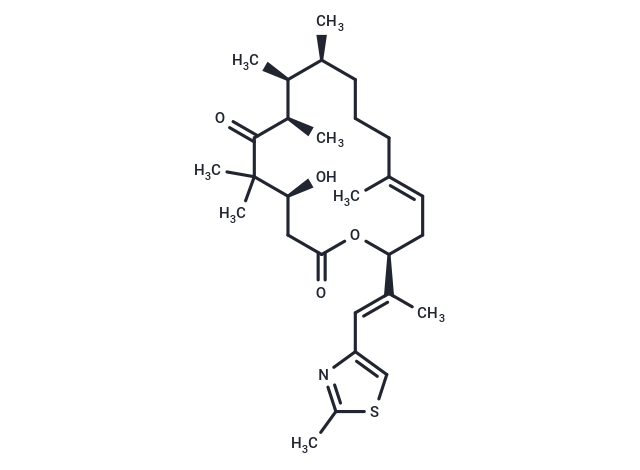
| Description | Epothilone D is a natural polyketide compound isolated from the myxobacterium Sorangium cellulosum that binds to tubulin and inhibits microtubule disassembly, thereby blocking mitosis, cellular proliferation, and cell motility, Epothilone D is extensively utilized in cancer research to study microtubule dynamics, mitotic arrest, and cytoskeleton-targeted anticancer mechanisms. |
| In vitro | Epothilone D is a more potent microtubule stabilizer in vitro than epothilone A or B. In vitro, Epothilone D has shown potent cytotoxicity in a panel of human tumor cell lines, with similar potency to paclitaxel. Epothilone D also shows a definite advantage over paclitaxel in drug-resistant cell lines and retained its cytotoxicity against a multidrug-resistant cell line over-expressing P-glycoprotein [1]. |
| In vivo | In a transgenic mouse model of Tauopathy (PS19 mice), which mimics features of Alzheimer's disease, intraperitoneal (i.p.) administration of Epothilone D (1 mg/kg or 3 mg/kg, weekly for 3 months) affected microtubule density and axonal integrity. These structural changes were associated with improvements in cognitive measures in the treated mice. At these dosages, the mice did not exhibit weight loss or neutropenia, indicating a tolerance profile distinct from higher chemotherapeutic doses [2]. |
| Synonyms | Utidelone, UTD1, UTD 1, KOS862, KOS 862 |
| Animal Research | Groups of mice (n=3) receive intraperitoneal (i.p.) injections of 3.7 mg/kg of Epothilone D (epoD) dissolved in 100% DMSO, followed by euthanization using approved at times ranging from 0.25 h to 24 h. In another study, groups of mice (n=3) receive injections of 3 mg/kg of epoD in 100% DMSO followed by euthanization 4, 6 and 10 days later. The Epothilone D (epoD) levels in the brain and blood samples are determined using LC-MS/MS protocols. Groups (n=10-13) of 3-month old PS19 tau Tg mice or 3-month old non-Tg littermates are administered weekly i.p. injections of 1 mg/kg epoD, 3 mg/kg of Epothilone D (epoD) or vehicle (DMSO), for a total of 3 months. Animals are monitored for signs of abnormal behavior or distress and are weighed weekly. After final dosing, the mice undergo motor function and cognitive testing. After euthanization, brains and optic nerve (ON) are recovered for immunohistochemical analyses. A subset of mice from each group also undergo necropsy evaluation with organ weights recorded [2]. |
| Molecular Weight | 489.72 |
| Formula | C28H43NO4S |
| Cas No. | 189453-10-9 |
| Smiles | CC(C)(C([C@@H]([C@H]([C@H](CCC/C(C)=C/C[C@H](O1)/C(C)=C/C2=CSC(C)=N2)C)C)C)=O)[C@H](CC1=O)O |
| Relative Density. | 1.084 g/cm3 (Predicted) |
| Storage | Store at low temperature Powder: -20°C for 3 years | In solvent: -80°C for 1 year Shipping with blue ice/Shipping at ambient temperature. | |||||||||||||||||||||||||||||||||||
| Solubility Information | DMSO: 80 mg/mL (163.36 mM), Sonication is recommended. | |||||||||||||||||||||||||||||||||||
| In Vivo Formulation | 10% DMSO+40% PEG300+5% Tween-80+45% Saline: 3.3 mg/mL (6.74 mM), Sonication is recommended. Please add the solvents sequentially, clarifying the solution as much as possible before adding the next one. Dissolve by heating and/or sonication if necessary. Working solution is recommended to be prepared and used immediately. The formulation provided above is for reference purposes only. In vivo formulations may vary and should be modified based on specific experimental conditions. | |||||||||||||||||||||||||||||||||||
Solution Preparation Table | ||||||||||||||||||||||||||||||||||||
DMSO
Note : The dilution table applies only to solid products. For liquid products, please calculate the stock solution based on the stated concentration and/or density. | ||||||||||||||||||||||||||||||||||||
 For example, if the intended dosage is 10 mg/kg for animals weighing 20 g , with a dosing volume of 100 μL per animal, and a total of 10 animals are to be administered, using a formulation of
  10% DMSO+ 40% PEG300+ 5% Tween 80+ 45% Saline/PBS/ddH2O , the resulting working solution concentration would be 2 mg/mL.
Dissolve 2 mg of the compound in 100 μL DMSO to obtain a stock solution at a concentration of 20 mg/mL . If the required concentration exceeds the compound's known solubility, please contact us for technical support before proceeding.
1) Add 100 μL of the DMSO stock solution to 400 µL PEG300 and mix thoroughly until the solution becomes clear.
2) Add 50 µL Tween 80 and mix well until fully clarified.
3) Add 450 µL Saline,PBS or ddH2O and mix thoroughly until a homogeneous solution is obtained.
| Size | Quantity | Unit Price | Amount | Operation |
|---|
 Feedback
 Hello! How can I help you today?
Copyright © 2015-2026 TargetMol Chemicals Inc. All Rights Reserved.
