


Shopping Cart
Remove All Your shopping cart is currently empty

Synonyms:
| Pack Size | Price | USA Stock | Global Stock | Quantity |
|---|---|---|---|---|
| 1 mg | $227 | - | In Stock | |
| 5 mg | $677 | - | In Stock | |
| 10 mg | $997 | - | In Stock | |
| 25 mg | $1,820 | - | In Stock | |
| 50 mg | $2,730 | - | In Stock | |
| 100 mg | $3,690 | - | In Stock |
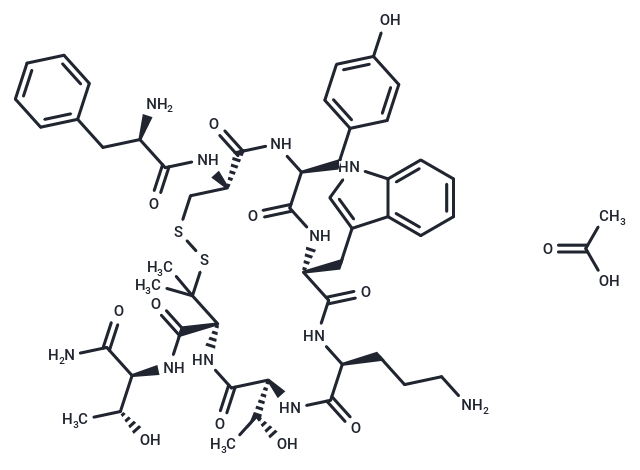
| Description | CTOP acetate is a somatostatin analogue and a μ-opioid receptor antagonist. |
| In vitro | CTOP acetate increased a K+ conductance with an EC50 of 560 nM. The K+ currents induced by high concentrations of CTOP acetate desensitized to 42% of the initial maximum after prolonged superfusion (t1/2 = 247 sec). In the presence of fully desensitized CTOP acetate responses, somatostatin (1 microM) still produced near-maximal K+ currents; i.e., there was no cross-desensitization, which suggests that CTOP acetate might act on a receptor distinct from somatostatin receptors. However, the converse did not apply; high concentrations of CTOP acetate (30 microM) did not produce any additional current in the presence of desensitized somatostatin responses[2]. |
| In vivo | Intracerebroventricular (i.c.v.) administration of CTOP acetate antagonized the analgesic effect of morphine in a dose-dependent manner, as measured by the heat-irradiant (tail-flick) method. CTOP acetate was more effective than naloxone in inhibiting analgesia on a molar basis. CTOP acetate also antagonized the acute morphine-induced hypermotility. CTOP acetate caused withdrawal hypothermia and a loss of body weight in morphine-dependent animals. After the development of morphine-induced chronic dependence, CTOP acetate administered i.c.v. caused a dose-dependent loss of body weight and hypothermia, and was about 10-400 times more potent than naloxone. CTOP acetate administered alone to drugnaive mice did not cause antinociception, changes in body weight or body temperature[1]. |
| Molecular Weight | 1122.32 |
| Formula | C52H71N11O13S2 |
| Smiles | O=C([C@H](N)CC1=CC=CC=C1)N[C@H](C(N[C@H](C(N[C@@H](C(N[C@H](C(N[C@H](C(N[C@@H]2C(N[C@H](C(N)=O)[C@@H](C)O)=O)=O)[C@@H](C)O)=O)CCCN)=O)CC3=CNC4=CC=CC=C43)=O)CC5=CC=C(O)C=C5)=O)CSSC2(C)C.CC(O)=O |
| Relative Density. | no data available |
| Sequence | Phe-Cys-Tyr-Trp-Orn-ξThr-Pen-ξThr (Disulfide bridge:Cys2-Pen7) |
| Sequence Short | FCYWXTXT |
| Storage | Store at low temperature,Keep away from moisture Powder: -20°C for 3 years | In solvent: -80°C for 1 year Shipping with blue ice/Shipping at ambient temperature. |
 For example, if the intended dosage is 10 mg/kg for animals weighing 20 g , with a dosing volume of 100 μL per animal, and a total of 10 animals are to be administered, using a formulation of
  10% DMSO+ 40% PEG300+ 5% Tween 80+ 45% Saline/PBS/ddH2O , the resulting working solution concentration would be 2 mg/mL.
Dissolve 2 mg of the compound in 100 μL DMSO to obtain a stock solution at a concentration of 20 mg/mL . If the required concentration exceeds the compound's known solubility, please contact us for technical support before proceeding.
1) Add 100 μL of the DMSO stock solution to 400 µL PEG300 and mix thoroughly until the solution becomes clear.
2) Add 50 µL Tween 80 and mix well until fully clarified.
3) Add 450 µL Saline,PBS or ddH2O and mix thoroughly until a homogeneous solution is obtained.
| Size | Quantity | Unit Price | Amount | Operation |
|---|
 Feedback
 Hello! How can I help you today?
Copyright © 2015-2026 TargetMol Chemicals Inc. All Rights Reserved.
