


Shopping Cart
Remove All Your shopping cart is currently empty

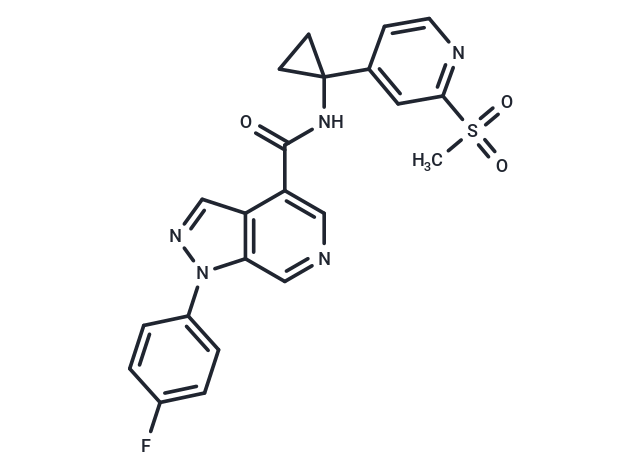
Synonyms: CCR1 antagonist8, CCR1 antagonist 8, BI639667

| Pack Size | Price | USA Stock | Global Stock | Quantity |
|---|---|---|---|---|
| 1 mg | $117 | - | In Stock | |
| 5 mg | $289 | - | In Stock | |
| 10 mg | $496 | - | In Stock | |
| 25 mg | $932 | - | In Stock | |
| 50 mg | $1,380 | - | In Stock | |
| 1 mL x 10 mM (in DMSO) | $318 | - | In Stock |
| Description | BI 639667, a compound belonging to the azaindazole class, functions as a potent inhibitor of CCR1 activity, a property quantitatively demonstrated by its half-maximal inhibitory concentration (IC50) of 1.8 nM in standardized calcium flux assays. |
| Targets & IC50 | CCR1:1.8 nM |
| In vitro | Methods: Venlafaxine and paroxetine, which are marketed for the treatment of depression, were selected as positive drugs for affinity comparison. Molecular docking studies were performed using IL1R1 (PDB ID: 4gaf) and CCR1 antagonist 8 (BI 639667) to evaluate their binding energy with IL1R1, and further visualization was achieved through docking simulation with ILIRI. Results: BI 639667 exhibited the lowest binding energy; the root mean square deviation (RMSD) Results showed that the fluctuation of the system was within 0.1 nm, indicating that the system had strong stability. The solvent accessible surface area (SASA) showed that the binding of BI 639667 had little effect on the structure of IL1R1. Further calculations of the hydrogen bond contacts between BI 639667 and IL1R1 were consistent with the docking Results, and the complex was able to form stable hydrogen bonds. [2] |
| Synonyms | CCR1 antagonist8, CCR1 antagonist 8, BI639667 |
| Molecular Weight | 451.47 |
| Formula | C22H18FN5O3S |
| Cas No. | 1295298-26-8 |
| Smiles | O=C(NC1(C=2C=CN=C(C2)S(=O)(=O)C)CC1)C3=CN=CC4=C3C=NN4C5=CC=C(F)C=C5 |
| Relative Density. | 1.51 g/cm3 (Predicted) |
| Storage | Store at low temperature Powder: -20°C for 3 years | In solvent: -80°C for 1 year Shipping with blue ice/Shipping at ambient temperature. | ||||||||||||||||||||
| Solubility Information | DMSO: 8 mg/mL (17.72 mM), Sonication is recommended. | ||||||||||||||||||||
| In Vivo Formulation | 10% DMSO+40% PEG300+5% Tween-80+45% Saline: 0.5 mg/mL (1.11 mM), Sonication is recommended. Please add the solvents sequentially, clarifying the solution as much as possible before adding the next one. Dissolve by heating and/or sonication if necessary. Working solution is recommended to be prepared and used immediately. The formulation provided above is for reference purposes only. In vivo formulations may vary and should be modified based on specific experimental conditions. | ||||||||||||||||||||
Solution Preparation Table | |||||||||||||||||||||
DMSO
Note : The dilution table applies only to solid products. For liquid products, please calculate the stock solution based on the stated concentration and/or density. | |||||||||||||||||||||
 For example, if the intended dosage is 10 mg/kg for animals weighing 20 g , with a dosing volume of 100 μL per animal, and a total of 10 animals are to be administered, using a formulation of
  10% DMSO+ 40% PEG300+ 5% Tween 80+ 45% Saline/PBS/ddH2O , the resulting working solution concentration would be 2 mg/mL.
Dissolve 2 mg of the compound in 100 μL DMSO to obtain a stock solution at a concentration of 20 mg/mL . If the required concentration exceeds the compound's known solubility, please contact us for technical support before proceeding.
1) Add 100 μL of the DMSO stock solution to 400 µL PEG300 and mix thoroughly until the solution becomes clear.
2) Add 50 µL Tween 80 and mix well until fully clarified.
3) Add 450 µL Saline,PBS or ddH2O and mix thoroughly until a homogeneous solution is obtained.
| Size | Quantity | Unit Price | Amount | Operation |
|---|
 Feedback
 Hello! How can I help you today?
Copyright © 2015-2026 TargetMol Chemicals Inc. All Rights Reserved.
