


Shopping Cart
Remove All Your shopping cart is currently empty

Synonyms:
| Pack Size | Price | USA Stock | Global Stock | Quantity |
|---|---|---|---|---|
| 25 mg | $1,520 | 6-8 weeks | 6-8 weeks | |
| 50 mg | $1,980 | 6-8 weeks | 6-8 weeks | |
| 100 mg | $2,500 | 6-8 weeks | 6-8 weeks |
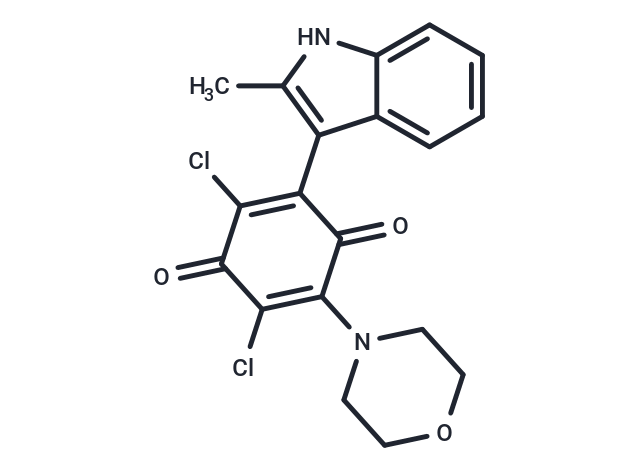
| Description | Anticancer agent 42 (compound 10d) is an orally active, potent anticancer agent with an IC50 of 0.07 μM against MDA-MB-231 cells. It exerts anticancer activity by activating apoptotic pathways and p53 expression. Anticancer agent 42 is a valuable tool for investigating metastatic breast cancer [1]. |
| In vitro | Anticancer agent 42 (compound 10d), ranging from concentrations of 0 to 20 μM and incubation periods up to 24 hours, demonstrates significant antitumor effects on MDA-MB-231 cells, evidenced by its potent activity and an IC 50 value of 0.07 μM. It effectively induces G2 and S phase cell cycle arrest, simultaneously decreasing the percentage of cells in the G1 phase dramatically from 74.44% to 16.48% and increasing those in the G2 phase from 8.95% to 55.05%. Furthermore, this compound triggers apoptosis, achieving an apoptotic rate of 31.69%, by altering the expression of apoptosis-related proteins and causing mitochondrial membrane depolarization, which reduces mitochondrial membrane potential. Additionally, it prompts cells to produce a substantial amount of reactive oxygen species (ROS) at concentrations between 0-1 μM. Western blot analyses further confirm its efficacy by showing an increase in the expression levels of pro-apoptotic proteins (caspase 9, caspase 3, cytochrome C, Bax) and a decrease in Bcl-2 expression, alongside heightened levels of human apoptosis-related proteins (pro-caspase 3, catalase, HTRA2/Omi, and p53) in MDA-MB-231 cells, underlining its mechanism of action in inducing cell apoptosis. |
| In vivo | Anticancer agent 42, also referred to as compound 10d, was evaluated for its safety and efficacy in various mouse models. When administered orally at a high dose of 5000 mg/kg to Kunming mice, it exhibited extremely low toxicity, with no fatalities observed. Intraperitoneal (IP) administration of doses ranging from 238 to 600 mg/kg showed no significant liver or kidney damage, identifying an LD50 of 374 mg/kg. However, at a lower dose of 25 mg/kg administered IP bi-daily, mild liver and kidney damage was reported, evidenced by slight increases in ALT, AST, and BUN levels. In a therapeutic context, compound 10d demonstrated a significant antitumor effect in BALB/c mice bearing 4T1 tumors, particularly when used in combination with Cyanoacrylates (CA). This combination not only inhibited breast cancer tumor growth more effectively but also showcased the ability of the compound to penetrate the skin and deliver its anticancer effects. The study underscores the potential of anticancer agent 42 as a viable candidate for cancer treatment, with an optimal safety profile at higher doses and enhanced therapeutic efficacy when used alongside CA. |
| Molecular Weight | 391.25 |
| Formula | C19H16Cl2N2O3 |
| Cas No. | 2687265-18-3 |
| Smiles | CC1=C(C=2C(N1)=CC=CC2)C=3C(=O)C(=C(Cl)C(=O)C3Cl)N4CCOCC4 |
| Storage | Powder: -20°C for 3 years | In solvent: -80°C for 1 year Shipping with blue ice/Shipping at ambient temperature. |
 For example, if the intended dosage is 10 mg/kg for animals weighing 20 g , with a dosing volume of 100 μL per animal, and a total of 10 animals are to be administered, using a formulation of
  10% DMSO+ 40% PEG300+ 5% Tween 80+ 45% Saline/PBS/ddH2O , the resulting working solution concentration would be 2 mg/mL.
Dissolve 2 mg of the compound in 100 μL DMSO to obtain a stock solution at a concentration of 20 mg/mL . If the required concentration exceeds the compound's known solubility, please contact us for technical support before proceeding.
1) Add 100 μL of the DMSO stock solution to 400 µL PEG300 and mix thoroughly until the solution becomes clear.
2) Add 50 µL Tween 80 and mix well until fully clarified.
3) Add 450 µL Saline,PBS or ddH2O and mix thoroughly until a homogeneous solution is obtained.
| Size | Quantity | Unit Price | Amount | Operation |
|---|
 Feedback
 Hello! How can I help you today?
Copyright © 2015-2026 TargetMol Chemicals Inc. All Rights Reserved.
