


Shopping Cart
Remove All Your shopping cart is currently empty

Synonyms: Adraxone

| Pack Size | Price | USA Stock | Global Stock | Quantity |
|---|---|---|---|---|
| 2 mg | $30 | - | In Stock | |
| 5 mg | $42 | - | In Stock | |
| 10 mg | $68 | - | In Stock | |
| 25 mg | $109 | - | In Stock | |
| 50 mg | $158 | - | In Stock | |
| 100 mg | $233 | - | In Stock |
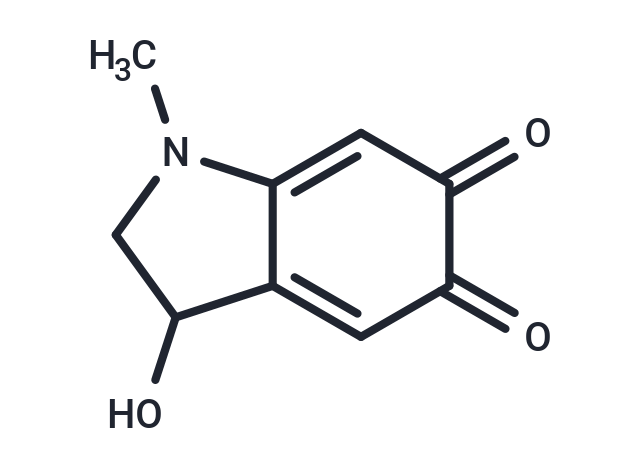
| Description | Adrenochrome (Adraxone) is a cytotoxic molecule that can be used to kill bacteria. Adrenochrome is an oxidized product of Epinephrine. Adrenochrome is a coronary systolic compound that acts on rat hearts and is associated with cardiotoxicity and can be used to determine superoxide dismutase activity. Adrenochrome is a potential psychotropic drug for the study of nervous system diseases. |
| In vitro | Microsomal calcium binding, calcium uptake, and Ca2+-stimulated Mg2+-dependent ATPase activities are reduced in the presence of Adrenochrome. The inhibitory impact of Adrenochrome on microsomal calcium uptake activity of the isolated membrane remains unaffected by various factors, including pH (ranging from 6.0 to 8.0), calcium concentrations (ranging from 10 to 200 μM), protein concentration (ranging from 0.02 to 0.10 mg/mL), temperature (ranging from 25 to 37 degrees C), and incubation time (ranging from 2 to 30 minutes). [1] |
| In vivo | In isolated rat hearts, the administration of Adrenochrome at concentrations ranging from 1 to 1000 ng/mL leads to a dose- and time-dependent elevation in coronary pressure. Moreover, the extent of constriction induced by Adrenochrome is influenced by the concentration of CaCl2 in the perfusion medium. [2] |
| Synonyms | Adraxone |
| Molecular Weight | 179.17 |
| Formula | C9H9NO3 |
| Cas No. | 54-06-8 |
| Smiles | OC1C=2C(N(C)C1)=CC(=O)C(=O)C2 |
| Relative Density. | 1.2822 g/cm3 (Estimated) |
| Storage | Store at low temperature Powder: -20°C for 3 years | In solvent: -80°C for 1 year Shipping with blue ice/Shipping at ambient temperature. | |||||||||||||||||||||||||||||||||||
| Solubility Information | DMSO: 90 mg/mL (502.32 mM), Sonication is recommended. | |||||||||||||||||||||||||||||||||||
Solution Preparation Table | ||||||||||||||||||||||||||||||||||||
DMSO
Note : The dilution table applies only to solid products. For liquid products, please calculate the stock solution based on the stated concentration and/or density. | ||||||||||||||||||||||||||||||||||||
 For example, if the intended dosage is 10 mg/kg for animals weighing 20 g , with a dosing volume of 100 μL per animal, and a total of 10 animals are to be administered, using a formulation of
  10% DMSO+ 40% PEG300+ 5% Tween 80+ 45% Saline/PBS/ddH2O , the resulting working solution concentration would be 2 mg/mL.
Dissolve 2 mg of the compound in 100 μL DMSO to obtain a stock solution at a concentration of 20 mg/mL . If the required concentration exceeds the compound's known solubility, please contact us for technical support before proceeding.
1) Add 100 μL of the DMSO stock solution to 400 µL PEG300 and mix thoroughly until the solution becomes clear.
2) Add 50 µL Tween 80 and mix well until fully clarified.
3) Add 450 µL Saline,PBS or ddH2O and mix thoroughly until a homogeneous solution is obtained.
| Size | Quantity | Unit Price | Amount | Operation |
|---|
 Feedback
 Hello! How can I help you today?
Copyright © 2015-2026 TargetMol Chemicals Inc. All Rights Reserved.
