


Shopping Cart
Remove All
  • TargetMol
    Your shopping cart is currently empty

Xanthine

Copy Product Info
🥰Excellent
Catalog No. T0665Cas No. 69-89-6
Alias Isoxanthine, 2,6-Dihydroxypurine

Xanthine (Isoxanthine) is a product on the pathway of purine degradation. Xanthine is subsequently converted to uric acid by the action of the Xanthine oxidase enzyme. Xanthine is found in most body tissues and fluids in various organisms. Biologically Xanthine is produced from guanine by cypin (guanine deaminase). Furthermore, Xanthines act as antagonists for adenosine receptors, with selectivity depending on whether there are substitution of alkyl groups.
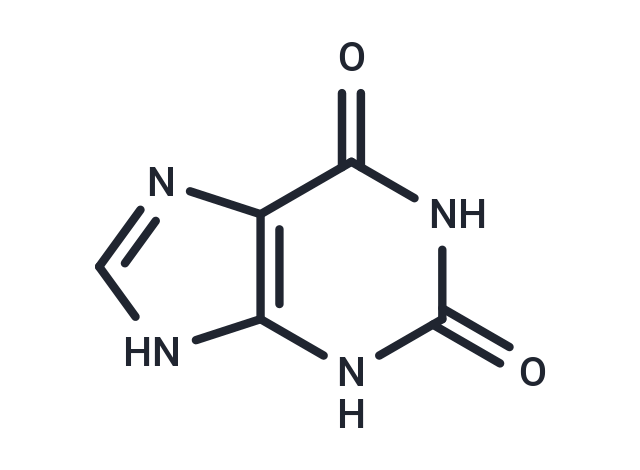
Xanthine

Xanthine

Copy Product Info
🥰Excellent
Purity: 99.36%
Catalog No. T0665Alias Isoxanthine, 2,6-DihydroxypurineCas No. 69-89-6
Xanthine (Isoxanthine) is a product on the pathway of purine degradation. Xanthine is subsequently converted to uric acid by the action of the Xanthine oxidase enzyme. Xanthine is found in most body tissues and fluids in various organisms. Biologically Xanthine is produced from guanine by cypin (guanine deaminase). Furthermore, Xanthines act as antagonists for adenosine receptors, with selectivity depending on whether there are substitution of alkyl groups.
Pack SizePriceUSA WarehouseGlobal WarehouseQuantity
100 mg$29In StockIn Stock
Add to Cart
Add to Quotation
In Stock Estimated shipping dateUSA Warehouse[1-2 days] Global Warehouse[5-7 days]
All TargetMol products are for research purposes only and cannot be used for human consumption. We do not provide products or services to individuals. Please comply with the intended use and do not use TargetMol products for any other purpose.
Questions
TargetMol
View More

Batch Information

Select Batch
Purity:99.36%
Appearance:Solid
Color:White to Yellow
Contact us for more batch information

Resource Download

Product Introduction

Xanthine AI Summary
Xanthine exhibits a range of bioactivities across various assays and biological systems. It demonstrates relaxant activity on guinea pig tracheal ring chains with an EC50 value greater than 100,000 nM, and shows a positive chronotropic effect on guinea pig right atrium with an EC15 value greater than 100 μM, coupled with low affinity towards the adenosine A1 receptor (Ki > 200,000 nM). The compound also inhibits cyclic AMP phosphodiesterase activity in guinea pig tracheal muscle (Ki > 200,000 nM) and has a broncho selectivity ratio of 1.0. In cellular assays, it inhibits adenosine-stimulated accumulation of cyclic AMP at the Adenosine A2 receptor in rat VA13 fibroblasts (Ki = 130,000 nM) and demonstrates inhibitory activity against Escherichia coli CTP synthetase. In enzyme inhibition studies, Xanthine inhibits Glucose-6-phosphate dehydrogenase (Ki = 1,960 nM), Plasmodium falciparum HGXPRT enzyme (Km = 189,000 nM at pH 7.4, Km = 420,000 nM at pH 8.5), and bovine xanthine oxidase (Km = 21,400 nM, Vmax = 2.768 μM/min), as well as human Acetylcholinesterase (IC50 = 9,000 nM). Additionally, Xanthine potentiates calcium release induced by cADRP in sea urchin egg homogenates at 2 mM concentration, showing a potentiation of 41.0%. It has an insulinotropic effect on rat pancreatic beta-cells, increasing insulin release to 7.72 ng/islet/h after PBS rinsing. The compound activates thyroid hormone receptor beta signaling in a qHTS assay with a potency of 50.1 nM. Xanthine exhibits substrate activity with ADH101 and ADH105 enzymes using NADH as a cofactor, with specific enzyme activities of 319.0 nmol/min/mg for ADH101, and 9.28 nmol/min/mg and 15.9 nmol/min/mg for ADH105 with and without hexane presence, respectively. Furthermore, it has a pKa value of 7.7, indicative of its dissociation properties under physiological conditions..
Note: Summary generated by AI. Data source: ChEMBL
Bioactivity
Description
Xanthine (Isoxanthine) is a product on the pathway of purine degradation. Xanthine is subsequently converted to uric acid by the action of the Xanthine oxidase enzyme. Xanthine is found in most body tissues and fluids in various organisms. Biologically Xanthine is produced from guanine by cypin (guanine deaminase). Furthermore, Xanthines act as antagonists for adenosine receptors, with selectivity depending on whether there are substitution of alkyl groups.
SynonymsIsoxanthine, 2,6-Dihydroxypurine
Chemical Properties
Molecular Weight152.11
FormulaC5H4N4O2
Cas No.69-89-6
SmilesO=C1NC2=C(N=CN2)C(=O)N1
Relative Density.1.5452 g/cm3 (Estimated)
Storage & Solubility Information
StorageIn solvent: -80°C for 1 year | Shipping with blue ice/Shipping at ambient temperature.
Solubility Information
DMSO: 1.53 mg/mL (10.06 mM), Sonication is recommended.

Ethanol: < 1 mg/mL (insoluble or slightly soluble)
H2O: < 1 mg/mL (insoluble or slightly soluble)
Solution Preparation Table
DMSO
1mg5mg10mg50mg
1 mM6.5742 mL32.8709 mL65.7419 mL328.7095 mL
5 mM1.3148 mL6.5742 mL13.1484 mL65.7419 mL
10 mM0.6574 mL3.2871 mL6.5742 mL32.8709 mL

Calculator

  • Molarity Calculator
  • Dilution Calculator
  • Reconstitution Calculator
  • Molecular Weight Calculator

In Vivo Formulation Calculator (Clear solution)

Please enter your animal experiment information in the following box and click Calculate to obtain the stock solution preparation method and in vivo formula preparation method:
TargetMol | Animal experiments For example, if the intended dosage is 10 mg/kg for animals weighing 20 g , with a dosing volume of 100 μL per animal, TargetMol | Animal experiments and a total of 10 animals are to be administered, using a formulation of TargetMol | reagent 10% DMSO+ 40% PEG300+ 5% Tween 80+ 45% Saline/PBS/ddH2O , the resulting working solution concentration would be 2 mg/mL.

Stock Solution Preparation:

Dissolve 2 mg of the compound in 100 μL DMSOTargetMol | reagent to obtain a stock solution at a concentration of 20 mg/mL . If the required concentration exceeds the compound's known solubility, please contact us for technical support before proceeding.

Preparation of the In Vivo Formulation:

1) Add 100 μL of the DMSOTargetMol | reagent stock solution to 400 μL PEG300TargetMol | reagent and mix thoroughly until the solution becomes clear.

2) Add 50 μL Tween 80 and mix well until fully clarified.

3) Add 450 μL Saline,PBS or ddH2OTargetMol | reagent and mix thoroughly until a homogeneous solution is obtained.

This example is provided solely to demonstrate the use of the In Vivo Formulation Calculator and does not constitute a recommended formulation for any specific compound. Please select an appropriate dissolution and formulation strategy based on your experimental model and route of administration.
All co-solvents required for this protocol, includingDMSO, PEG300/PEG400, Tween 80, SBE-β-CD, and Corn oil, are available for purchase on the TargetMol website.
1 Enter information below:
mg/kg
g
μL
2 Enter the in vivo formulation:
% DMSO
%
% Tween 80
% Saline/PBS/ddH2O

Dose Conversion

You can also refer to dose conversion for different animals. More Dose Conversion

Tech Support

Please see Inhibitor Handling Instructions for more frequently ask questions. Topics include: how to prepare stock solutions, how to store products, and cautions on cell-based assays & animal experiments, etc

Keywords

Related Tags: buy Xanthine | purchase Xanthine | Xanthine cost | order Xanthine | Xanthine chemical structure | Xanthine formula | Xanthine molecular weight





