


Shopping Cart
Remove All Your shopping cart is currently empty

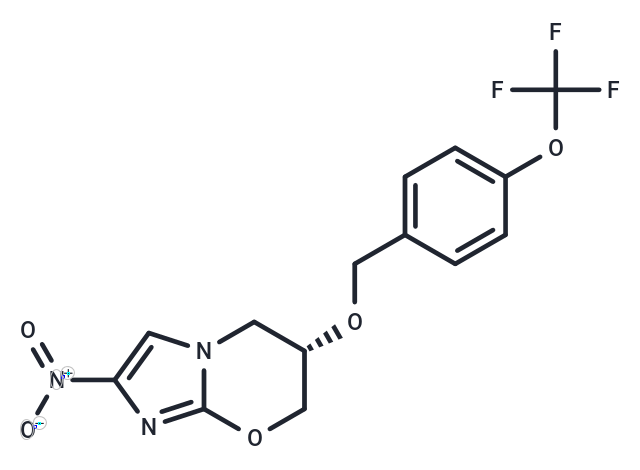
Pretomanid ((S)-PA 824) , a nitroimidazole, is used as an anti-tuberculosis drug for tuberculosis with MIC less than 2.8 μM.
| Pack Size | Price | USA Warehouse | Global Warehouse | Quantity |
|---|---|---|---|---|
| 5 mg | $41 | In Stock | In Stock | |
| 10 mg | $66 | In Stock | In Stock | |
| 25 mg | $95 | In Stock | In Stock | |
| 50 mg | $124 | In Stock | In Stock | |
| 100 mg | $191 | In Stock | In Stock | |
| 1 mL x 10 mM (in DMSO) | $45 | In Stock | In Stock |
| Description | Pretomanid ((S)-PA 824) , a nitroimidazole, is used as an anti-tuberculosis drug for tuberculosis with MIC less than 2.8 μM. |
| Targets&IC50 | MTB pan-sensitive and rifampin mono-resistant clinical isolates:0.015-0.25 ug/ml |
| In vitro | In vitro, PA-824 exhibits the high activity against multidrug-resistant Clinicalal isolates from Asia (India and South Korea) and from throughout the United States (MIC < 1 μg/ml) and is equally active against the drug-sensitive and multidrug-resistant isolates of M. tuberculosis (MICs range, 0.039 to 0.531 μg/ml). [1] A recent study shows that single-nucleotide polymorphisms of PA-824 resistance genes (fgd1 [Rv0407] and ddn [Rv3547]) don't significantly affect the PA-824 MICs (≤ 0.25 μg/ml). [2] |
| In vivo | In the rapid tuberculosis mouse model, PA-824 shows significant anti-microbial activity in a dose-dependent manner: at 50 mg/kg, PA-824 in MC produces a more than 1-log reduction of the CFU in the lungs; at 100 mg/kg it produces about a 2-log reduction, and at 300 mg/kg it produces a 3-log reduction. Furthermore, long-term treatment of PA-824 at 100 mg/kg in cyclodextrin/lecithin also leads to the reduction of the bacterial load below 500 CFU in the lungs and spleen. [1] PA-824 exhibits time-dependent anti-microbial activity in a murine model of tuberculosis with a maximal observed bactericidal effect of 0.1 log CFU/day over 24 days. [3] |
| Kinase Assay | Isolated kinase assays: The intracellular kinase domains of human EGFR and erbB2 are cloned and expressed in the baculovirus/Sf21 system. The inhibitory activity of AZD8931 is determined with ATP at Km concentrations (0.4 mM for erbB2 and 2 mM for EGFR) using the ELISA method. |
| Cell Research | A method is used to determine the MICs by a microdilution plate assay by using M. tuberculosis H37Rv. INH is dissolved in sterile, double-distilled water at a stock concentration of 500 μg/ml. PA-824 is dissolved in 100% dimethyl sulfoxide (DMSO) to a stock concentration of 100 μg/ml. A 1:2 dilution series of both compounds is made in a separate 96-well microtiter plate by using the same diluents. The interior 60 wells of a 96-well round-bottom microtiter assay plate are seeded with 98 μl of bacterial suspension. Two microliters of each drug is transferred to the assay plate wells containing bacteria. The final concentrations of INH in the wells range from 10.0 to 0.039 μg/mL; the final concentrations of PA-824 range from 2.0 μg/mL to 8.0 pg/mL. The assay plates are incubated at 37 °C for at least 21 days and are observed every 3 to 4 days to evaluate changes in growth. Inhibition of growth is determined both by visual examination and with a spectrophotometer at an OD600.(Only for Reference) |
| Synonyms | PA-824, (S)-PA 824 |
| Molecular Weight | 359.26 |
| Formula | C14H12F3N3O5 |
| Cas No. | 187235-37-6 |
| Smiles | [O-][N+](=O)c1cn2C[C@@H](COc2n1)OCc1ccc(OC(F)(F)F)cc1 |
| Relative Density. | 1.58g/cm3 |
| Storage | keep away from direct sunlight,keep away from moisture,store at low temperature | In solvent: -80°C for 1 year | Shipping with blue ice/Shipping at ambient temperature. | ||||||||||||||||||||||||||||||||||||||||
| Solubility Information | H2O: < 1 mg/mL (insoluble or slightly soluble) DMSO: 67 mg/mL (186.49 mM), Sonication is recommended. Ethanol: 13 mg/mL (36.19 mM), Sonication is recommended. | ||||||||||||||||||||||||||||||||||||||||
| In Vivo Formulation | 10% DMSO+40% PEG300+5% Tween 80+45% Saline: 2 mg/mL (5.57 mM), Sonication is recommended. Please add the solvents sequentially, clarifying the solution as much as possible before adding the next one. Dissolve by heating and/or sonication if necessary. Working solution is recommended to be prepared and used immediately. The formulation provided above is for reference purposes only. In vivo formulations may vary and should be modified based on specific experimental conditions. | ||||||||||||||||||||||||||||||||||||||||
Solution Preparation Table | |||||||||||||||||||||||||||||||||||||||||
Ethanol/DMSO
DMSO
| |||||||||||||||||||||||||||||||||||||||||
 For example, if the intended dosage is 10 mg/kg for animals weighing 20 g , with a dosing volume of 100 μL per animal, and a total of 10 animals are to be administered, using a formulation of
  10% DMSO+ 40% PEG300+ 5% Tween 80+ 45% Saline/PBS/ddH2O , the resulting working solution concentration would be 2 mg/mL.
Dissolve 2 mg of the compound in 100 μL DMSO to obtain a stock solution at a concentration of 20 mg/mL . If the required concentration exceeds the compound's known solubility, please contact us for technical support before proceeding.
1) Add 100 μL of the DMSO stock solution to 400 μL PEG300 and mix thoroughly until the solution becomes clear.
2) Add 50 μL Tween 80 and mix well until fully clarified.
3) Add 450 μL Saline,PBS or ddH2O and mix thoroughly until a homogeneous solution is obtained.

| Size | Quantity | Unit Price | Amount | Operation |
|---|
 Feedback
 Hello! How can I help you today?
Copyright © 2015-2026 TargetMol Chemicals Inc. All Rights Reserved.
