


Shopping Cart
Remove All Your shopping cart is currently empty

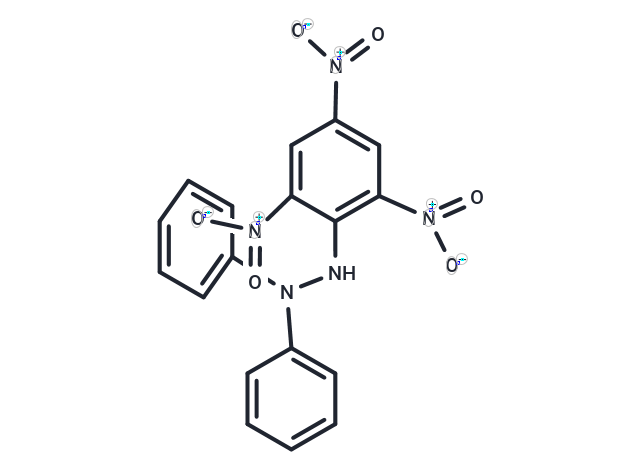
Synonyms: 2,2-Diphenyl-1-picrylhydrazyl

| Pack Size | Price | USA Stock | Global Stock | Quantity |
|---|---|---|---|---|
| 25 mg | $30 | In Stock | In Stock | |
| 50 mg | $40 | In Stock | In Stock | |
| 100 mg | $62 | In Stock | In Stock | |
| 500 mg | $150 | - | In Stock | |
| 1 mL x 10 mM (in DMSO) | $30 | In Stock | In Stock |
| Description | DPPH (2,2-Diphenyl-1-picrylhydrazyl) is a cell-permeable, stable free radical commonly used to evaluate the free radical scavenging ability, hydrogen donation capacity of compounds, and to measure the antioxidant activity of tissue extracts. |
| Targets & IC50 | PNT2 cells:1400 µM |
| In vitro | DPPH shows a strong absorption band at 517 nm due to its odd electron number, resulting in a dark purple solution that loses color as electron pairs detach, with decoloration stoichiometrically depending on the absorbed electrons. In alcohol solutions of 0.5 mM, it adheres to the Lambert-Beer law within the effective absorption range. DPPH is a fast, simple, and cost-effective method to evaluate the free radical scavenging or hydrogen-donating ability of compounds and the antioxidant activity of foods. It can quantify antioxidants in complex biological systems and solid or liquid samples. This method effectively determines the total antioxidant capacity and free radical scavenging activity in fruit and vegetable juices, wheat grains and bran, vegetables, conjugated linoleic acid, herbal medicine, edible seed oil, and flour in various solvents (ethanol, acetone, methanol, ethanol, and benzene). It also assesses antioxidant properties in cysteine, glutathione, ascorbic acid, tocopherol, and polyhydroxyaromatic compounds in olive oil, fruits, fruit juices, and wines. |
| In vivo | METHODS: To study the hepatotoxic effects, DPPH (100 mg/kg) was administered intraperitoneally to ICR mice to induce acute liver injury, and the mice were killed 12, 24, 48 and 72 h after treatment to obtain serum and liver. RESULTS: DPPH increased aminotransferase activity, MDA and NO levels, and significantly decreased GSH levels and SOD, CAT and GPx activities.The livers of DPPH-treated mice showed significant histopathological changes characterized by hepatocyte swelling and vacuolar degeneration.The mRNA levels of proinflammatory cytokines were elevated in the DPPH-treated group. The above results suggest that DPPH induces acute hepatotoxicity in mice. [3] |
| Synonyms | 2,2-Diphenyl-1-picrylhydrazyl |
| Molecular Weight | 394.32 |
| Formula | C18H12N5O6 |
| Cas No. | 1898-66-4 |
| Smiles | [O-][N+](=O)c1cc(c(NN(c2ccccc2)c2ccccc2)c(c1)[N+]([O-])=O)[N+]([O-])=O |
| Relative Density. | 1.484 g/cm3 |
| Storage | Store at low temperature,Keep away from moisture Powder: -20°C for 3 years | In solvent: -80°C for 1 year Shipping with blue ice/Shipping at ambient temperature. | ||||||||||||||||||||||||||||||
| Solubility Information | DMSO: 24 mg/mL (60.86 mM), Sonication is recommended. | ||||||||||||||||||||||||||||||
| In Vivo Formulation | 10% DMSO+40% PEG300+5% Tween 80+45% Saline: 2 mg/mL (5.07 mM), Sonication is recommended. Please add the solvents sequentially, clarifying the solution as much as possible before adding the next one. Dissolve by heating and/or sonication if necessary. Working solution is recommended to be prepared and used immediately. The formulation provided above is for reference purposes only. In vivo formulations may vary and should be modified based on specific experimental conditions. | ||||||||||||||||||||||||||||||
Solution Preparation Table | |||||||||||||||||||||||||||||||
DMSO
Note : The dilution table applies only to solid products. For liquid products, please calculate the stock solution based on the stated concentration and/or density. | |||||||||||||||||||||||||||||||
 For example, if the intended dosage is 10 mg/kg for animals weighing 20 g , with a dosing volume of 100 μL per animal, and a total of 10 animals are to be administered, using a formulation of
  10% DMSO+ 40% PEG300+ 5% Tween 80+ 45% Saline/PBS/ddH2O , the resulting working solution concentration would be 2 mg/mL.
Dissolve 2 mg of the compound in 100 μL DMSO to obtain a stock solution at a concentration of 20 mg/mL . If the required concentration exceeds the compound's known solubility, please contact us for technical support before proceeding.
1) Add 100 μL of the DMSO stock solution to 400 µL PEG300 and mix thoroughly until the solution becomes clear.
2) Add 50 µL Tween 80 and mix well until fully clarified.
3) Add 450 µL Saline,PBS or ddH2O and mix thoroughly until a homogeneous solution is obtained.
| Size | Quantity | Unit Price | Amount | Operation |
|---|
 Feedback
 Hello! How can I help you today?
Copyright © 2015-2026 TargetMol Chemicals Inc. All Rights Reserved.
