Shopping Cart
Remove All
  • TargetMol
    Your shopping cart is currently empty

3-Acetylcoumarin

Copy Product Info
😃Good
Catalog No. Fr12596Cas No. 3949-36-8

3-Acetylcoumarin as a practical ligand for copper-catalyzed CN coupling reactions at room temperature. It has neuroprotective and acaricidal properties.

3-Acetylcoumarin

3-Acetylcoumarin

Copy Product Info
😃Good
Purity: 99.31%
Catalog No. Fr12596Cas No. 3949-36-8
3-Acetylcoumarin as a practical ligand for copper-catalyzed CN coupling reactions at room temperature. It has neuroprotective and acaricidal properties.
Pack SizePriceUSA WarehouseGlobal WarehouseQuantity
500 mg$29-In Stock
1 mL x 10 mM (in DMSO)$29In StockIn Stock
Add to Cart
Add to Quotation
In Stock Estimated shipping dateUSA Warehouse[1-2 days] Global Warehouse[5-7 days]
All TargetMol products are for research purposes only and cannot be used for human consumption. We do not provide products or services to individuals. Please comply with the intended use and do not use TargetMol products for any other purpose.
Questions
TargetMol
View More

Batch Information

Select Batch
Purity:99.31%
Appearance:solid
Color:Yellow
Contact us for more batch information

Resource Download

Product Introduction

3-Acetylcoumarin AI Summary
3-Acetylcoumarin demonstrates a variety of bioactivities across multiple biological systems. It induces NAD(P)H quinone reductase activity in Hepa 1c1c7 murine hepatoma cells at a concentration of 200.0 µM, suggesting antioxidant properties. The compound exhibits DPPH radical scavenging activity of 0.83% at 25 µg/mL after 30 minutes and shows ABTS free radical inhibition by 63.58%. Moreover, it inhibits rat intestinal alpha-glucosidase by 53.19% at 100 µg/mL and displays inhibitory activity against Human Jumonji Domain Containing 2E (JMJD2E) with a potency of 10,000.0 nM. Additionally, 3-Acetylcoumarin acts in a cytochrome panel assay with an AC50 of 199.53 nM and inhibits human recombinant MAO-B with an IC50 value of 14,450.0 nM, showing selectivity over MAO-A. In cancer research, it inhibits growth in various human tumor cell lines with GI50 values between 36,224.3 nM and 100,000.0 nM across different cancer types such as breast, melanoma, lung, prostate, colon, leukemia, central nervous system, ovarian, and renal cells. The compound also protects against pesticide-induced gastric lesions in Swiss albino mice, reducing lesions by 66.0% at a dose of 20 mg/kg orally. It shows moderate inhibitory activity against human CA9 with a Ki value of 151.8 nM and strong inhibitory activity against human CA12 with a Ki value of 7.8 nM. 3-Acetylcoumarin also inhibits the aggregation of HFIP-induced amyloid beta (1-42 residues), with inhibition rates between 40.0% to 59.0%, as measured by ThT fluorescence and turbidity assays. It demonstrates cytotoxicity against human SH-SY5Y cells with an IC50 of 75,000.0 nM and neuroprotective effects against amyloid beta-induced toxicity in the same cells with an activity level of 77.0%. Additionally, the compound shows antiviral activity against SARS-CoV-2 in VERO-6 cells, although with an IC50 value greater than 20,000.0 nM, it may not be highly potent in this assay..
Note: Summary generated by AI. Data source: ChEMBL
Bioactivity
Description
3-Acetylcoumarin as a practical ligand for copper-catalyzed CN coupling reactions at room temperature. It has neuroprotective and acaricidal properties.
Chemical Properties
Molecular Weight188.18
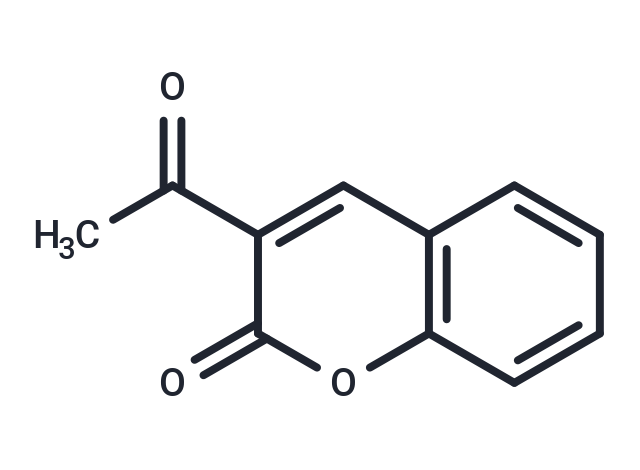
FormulaC11H8O3
Cas No.3949-36-8
SmilesCC(=O)c1cc2ccccc2oc1=O
Relative Density.1.285g/cm3
Storage & Solubility Information
StoragePowder: -20°C for 3 years | In solvent: -80°C for 1 year | Shipping with blue ice/Shipping at ambient temperature.
Solubility Information
DMSO: 25 mg/mL (132.85 mM), Sonication is recommended.

Solution Preparation Table
DMSO
1mg5mg10mg50mg
1 mM5.3141 mL26.5703 mL53.1406 mL265.7031 mL
5 mM1.0628 mL5.3141 mL10.6281 mL53.1406 mL
10 mM0.5314 mL2.6570 mL5.3141 mL26.5703 mL
20 mM0.2657 mL1.3285 mL2.6570 mL13.2852 mL
50 mM0.1063 mL0.5314 mL1.0628 mL5.3141 mL
100 mM0.0531 mL0.2657 mL0.5314 mL2.6570 mL

Calculator

  • Molarity Calculator
  • Dilution Calculator
  • Reconstitution Calculator
  • Molecular Weight Calculator

In Vivo Formulation Calculator (Clear solution)

Please enter your animal experiment information in the following box and click Calculate to obtain the stock solution preparation method and in vivo formula preparation method:
TargetMol | Animal experiments For example, if the intended dosage is 10 mg/kg for animals weighing 20 g , with a dosing volume of 100 μL per animal, TargetMol | Animal experiments and a total of 10 animals are to be administered, using a formulation of TargetMol | reagent 10% DMSO+ 40% PEG300+ 5% Tween 80+ 45% Saline/PBS/ddH2O , the resulting working solution concentration would be 2 mg/mL.

Stock Solution Preparation:

Dissolve 2 mg of the compound in 100 μL DMSOTargetMol | reagent to obtain a stock solution at a concentration of 20 mg/mL . If the required concentration exceeds the compound's known solubility, please contact us for technical support before proceeding.

Preparation of the In Vivo Formulation:

1) Add 100 μL of the DMSOTargetMol | reagent stock solution to 400 μL PEG300TargetMol | reagent and mix thoroughly until the solution becomes clear.

2) Add 50 μL Tween 80 and mix well until fully clarified.

3) Add 450 μL Saline,PBS or ddH2OTargetMol | reagent and mix thoroughly until a homogeneous solution is obtained.

This example is provided solely to demonstrate the use of the In Vivo Formulation Calculator and does not constitute a recommended formulation for any specific compound. Please select an appropriate dissolution and formulation strategy based on your experimental model and route of administration.
All co-solvents required for this protocol, includingDMSO, PEG300/PEG400, Tween 80, SBE-β-CD, and Corn oil, are available for purchase on the TargetMol website.
1 Enter information below:
mg/kg
g
μL
2 Enter the in vivo formulation:
% DMSO
%
% Tween 80
% Saline/PBS/ddH2O

Dose Conversion

You can also refer to dose conversion for different animals. More Dose Conversion

Tech Support

Please see Inhibitor Handling Instructions for more frequently ask questions. Topics include: how to prepare stock solutions, how to store products, and cautions on cell-based assays & animal experiments, etc

Keywords

Related Tags: buy 3-Acetylcoumarin | purchase 3-Acetylcoumarin | 3-Acetylcoumarin cost | order 3-Acetylcoumarin | 3-Acetylcoumarin chemical structure | 3-Acetylcoumarin formula | 3-Acetylcoumarin molecular weight