


Shopping Cart
Remove All Your shopping cart is currently empty

Synonyms:
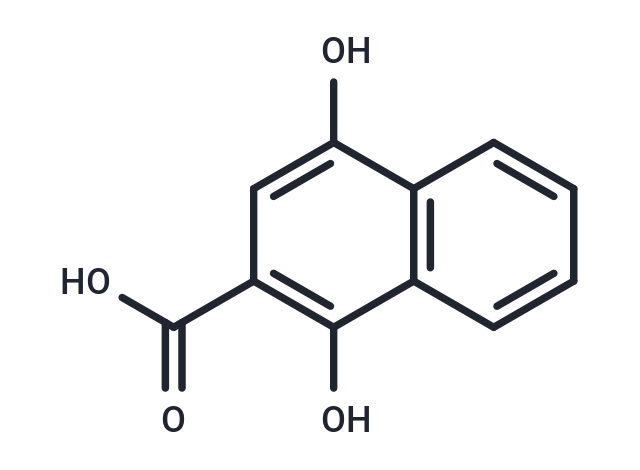
| Pack Size | Price | USA Stock | Global Stock | Quantity |
|---|---|---|---|---|
| 200 mg | $29 | - | In Stock | |
| 1 mL x 10 mM (in DMSO) | $29 | - | In Stock |
| Description | 1,4-Dihydroxy-2-naphthoic acid is a bacterially derived metabolite that functions as an aryl hydrocarbon receptor (AhR) agonist and has been reported to possess anti-inflammatory activity. The ability of 1,4-Dihydroxy-2-naphthoic acid to modulate AhR signaling pathways supports the use of 1,4-Dihydroxy-2-naphthoic acid in investigations of host–microbiome interactions, inflammatory signaling networks, immune regulation, and receptor-mediated cellular responses. |
| In vitro | Method: Young adult mouse colonic cells and human Caco-2 colon cancer cells were treated with 1,4-dihydroxy-2-naphthoic acid, and CYP1A1 and CYP1B1 mRNA levels were measured as aryl hydrocarbon receptor-responsive endpoints. Rresult: 1,4-Dihydroxy-2-naphthoic acid was the most potent compound among the tested hydroxyl- and carboxyl-substituted naphthalene derivatives and induced CYP1A1 and CYP1B1 responses comparable in magnitude to those induced by TCDD.[2] Method: RAW264.7 macrophages and bone marrow-derived macrophages obtained from IL-10-deficient mice were pretreated with 1,4-dihydroxy-2-naphthoic acid before endotoxin stimulation, and proinflammatory cytokine mRNA levels were measured. Rresult: 1,4-Dihydroxy-2-naphthoic acid significantly suppressed endotoxin-induced expression of proinflammatory cytokine mRNAs, including IL-6 and IL-23p19.[3] Method: The antiproliferative activity of 1,4-dihydroxy-2-naphthoic acid against HaCaT human keratinocytes was evaluated after 72 h of treatment using a sulforhodamine B assay. Rresult: 1,4-Dihydroxy-2-naphthoic acid inhibited HaCaT cell proliferation with an IC50 of 38.9 μg/mL.[4] |
| In vivo | Method: Female C57BL/6 mice were subjected to unpredictable chronic mild stress. In the preventive group, mice received 1,4-dihydroxy-2-naphthoic acid orally at 20 mg/kg daily for 3 weeks before stress exposure; in the reversal group, treatment was initiated after 2 weeks of stress. Rresult: 1,4-Dihydroxy-2-naphthoic acid prevented and reversed the stress-induced reduction in sucrose preference, indicating prevention and reversal of anhedonia-like behavior.[1] Method: Male C57BL/6 mice received 1,4-dihydroxy-2-naphthoic acid orally at 20 mg/kg daily for 3 weeks before administration of 80 mg/kg MPTP; motor function was evaluated 4 weeks later. Rresult: 1,4-Dihydroxy-2-naphthoic acid prevented MPTP-induced deficits in the motor-pole and adhesive-removal tests, improved balance-beam performance and completely prevented the MPTP-induced reduction in stride length.[5] |
| Molecular Weight | 204.18 |
| Formula | C11H8O4 |
| Cas No. | 31519-22-9 |
| Smiles | O=C(O)C=1C=C(O)C=2C=CC=CC2C1O |
| Storage | Keep away from moisture, Powder: -20°C for 3 years | In solvent: -80°C for 1 year Shipping with blue ice/Shipping at ambient temperature. | |||||||||||||||||||||||||||||||||||
| Solubility Information | DMSO: 140 mg/mL (685.67 mM), Sonication is recommended. | |||||||||||||||||||||||||||||||||||
Solution Preparation Table | ||||||||||||||||||||||||||||||||||||
DMSO
Note : The dilution table applies only to solid products. For liquid products, please calculate the stock solution based on the stated concentration and/or density. | ||||||||||||||||||||||||||||||||||||
 For example, if the intended dosage is 10 mg/kg for animals weighing 20 g , with a dosing volume of 100 μL per animal, and a total of 10 animals are to be administered, using a formulation of
  10% DMSO+ 40% PEG300+ 5% Tween 80+ 45% Saline/PBS/ddH2O , the resulting working solution concentration would be 2 mg/mL.
Dissolve 2 mg of the compound in 100 μL DMSO to obtain a stock solution at a concentration of 20 mg/mL . If the required concentration exceeds the compound's known solubility, please contact us for technical support before proceeding.
1) Add 100 μL of the DMSO stock solution to 400 µL PEG300 and mix thoroughly until the solution becomes clear.
2) Add 50 µL Tween 80 and mix well until fully clarified.
3) Add 450 µL Saline,PBS or ddH2O and mix thoroughly until a homogeneous solution is obtained.
| Size | Quantity | Unit Price | Amount | Operation |
|---|
 Feedback
 Hello! How can I help you today?
Copyright © 2015-2026 TargetMol Chemicals Inc. All Rights Reserved.
