


Shopping Cart
Remove All Your shopping cart is currently empty


Synonyms:
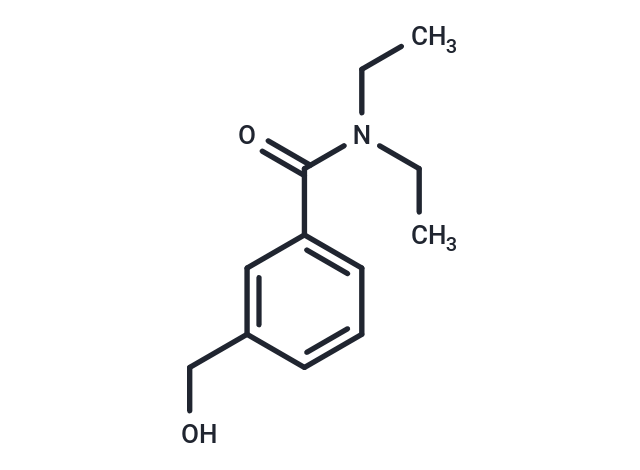

| Description | ω-Hydroxy-DEET, a significant metabolite of the insect repellent N-N-diethyl-meta-toluamide (DEET), exhibits anti-proliferative properties. DEET, renowned for being a spatial repellent and irritant, is frequently employed to deter mosquito contact. |
| In vitro | Studies on hepatoma cells demonstrate that treatment with ω-Hydroxy-DEET (DHMB; at concentrations ranging from 0.1 to 10 μg/mL for durations of 48 to 72 hours) leads to decreased cellular proliferation [1]. |
| In vivo | Following both intravenous and topical administration of DEET in rats, the metabolite ω-Hydroxy-DEET (DHMB) showed extensive distribution, with ω-Hydroxy-DEET emerging as DEET's principal metabolite. Notably, repeated daily topical applications over a 30-day period resulted in elevated ω-Hydroxy-DEET concentrations in the liver[1]. |
| Molecular Weight | 207.27 |
| Formula | C12H17NO2 |
| Cas No. | 72236-22-7 |
| Smiles | CCN(CC)C(=O)c1cccc(CO)c1 |
| Storage | Powder: -20°C for 3 years | In solvent: -80°C for 1 year Shipping with blue ice/Shipping at ambient temperature. |
 For example, if the intended dosage is 10 mg/kg for animals weighing 20 g , with a dosing volume of 100 μL per animal, and a total of 10 animals are to be administered, using a formulation of
  10% DMSO+ 40% PEG300+ 5% Tween 80+ 45% Saline/PBS/ddH2O , the resulting working solution concentration would be 2 mg/mL.
Dissolve 2 mg of the compound in 100 μL DMSO to obtain a stock solution at a concentration of 20 mg/mL . If the required concentration exceeds the compound's known solubility, please contact us for technical support before proceeding.
1) Add 100 μL of the DMSO stock solution to 400 µL PEG300 and mix thoroughly until the solution becomes clear.
2) Add 50 µL Tween 80 and mix well until fully clarified.
3) Add 450 µL Saline,PBS or ddH2O and mix thoroughly until a homogeneous solution is obtained.
| Size | Quantity | Unit Price | Amount | Operation |
|---|
 Feedback
 Hello! How can I help you today?
Copyright © 2015-2026 TargetMol Chemicals Inc. All Rights Reserved.
