


Shopping Cart
Remove All Your shopping cart is currently empty

Synonyms: PSC 833

| Pack Size | Price | USA Stock | Global Stock | Quantity |
|---|---|---|---|---|
| 1 mg | $212 | In Stock | In Stock | |
| 5 mg | $639 | In Stock | In Stock | |
| 10 mg | $987 | - | In Stock | |
| 25 mg | Inquiry | - | In Stock | |
| 50 mg | Inquiry | - | In Stock | |
| 1 mL x 10 mM (in DMSO) | $1,370 | - | In Stock |
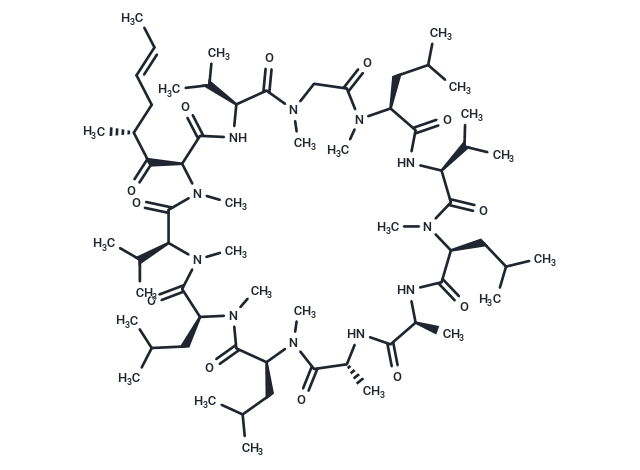
| Description | Valspodar (PSC 833) is a small-molecule inhibitor and a P-glycoprotein (P-gp) inhibitor with high selectivity and chemosensitizing properties. This compound can effectively reverse P-gp-mediated multidrug resistance (MDR) and is used in experimental research on drug-resistant tumors such as advanced epithelial ovarian cancer. |
| Targets & IC50 | SW620 cells:0.1 μM, MDR cells:0.4 μM, L929 cells:> 100 μM |
| In vitro | Methods: A Caco-2 cell monolayer model was used. Bidirectional transport experiments were performed with 4 μM Valspodar co-incubated with ticagrelor for 3 hours. Results: Valspodar significantly reduced the basolateral-to-apical apparent permeability coefficient of ticagrelor (from 1.60×10⁻⁵ to 1.13×10⁻⁵ cm/s), with the efflux ratio decreasing from 2.71 to 1.59 and an inhibition rate of approximately 70%, confirming that Valspodar can effectively inhibit P-gp-mediated ticagrelor efflux. [1] Methods: P-glycoprotein (P-gp)-overexpressing human breast cancer MCF-7 TX400 cells were used. Valspodar at 3 μg/mL was co-incubated with photosensitizers for 1 hour, and detection was performed by extraction method and flow cytometry. Results: Valspodar increased intracellular accumulation of BPD and rose bengal, suggesting that both are P-gp substrates; Results for ropurpurin were inconsistent, while other photosensitizers such as temoporfin showed no significant effect. [2] |
| In vivo | Methods: An NMRI nu/nu mouse model was used. Valspodar was administered orally by gavage at a dose of 50 mg/kg (dissolved in DMSO/PEG/water) as a single dose 4 hours before paclitaxel injection. Results: Valspodar increased brain concentrations of paclitaxel by 6–8 fold, but also significantly increased paclitaxel levels in liver, kidney, and plasma, with a relatively low brain/plasma ratio.[3] Methods:Sprague Dawley rats were used. Valspodar was administered by constant-rate infusion via femoral vein at doses of 0.09–8 mg/hr/kg for 4.5 hours, dissolved in Cremophor EL:ethanol:normal saline. Results: At doses ≥0.9 mg/hr/kg, the brain/plasma ratio of P-gp substrates such as loperamide and quinidine no longer increased with dose, indicating that this dose can completely inhibit P-gp-mediated efflux at the blood-brain barrier.[4] |
| Synonyms | PSC 833 |
| Molecular Weight | 1214.62 |
| Formula | C63H111N11O12 |
| Cas No. | 121584-18-7 |
| Smiles | C\C=C\C[C@@H](C)C(=O)[C@@H]1N(C)C(=O)[C@H](C(C)C)N(C)C(=O)[C@H](CC(C)C)N(C)C(=O)[C@H](CC(C)C)N(C)C(=O)[C@@H](C)NC(=O)[C@H](C)NC(=O)[C@H](CC(C)C)N(C)C(=O)[C@@H](NC(=O)[C@H](CC(C)C)N(C)C(=O)CN(C)C(=O)[C@@H](NC1=O)C(C)C)C(C)C |
| Relative Density. | 1.015 g/cm3 (Predicted) |
| Storage | Store at low temperature,Keep away from moisture Store at -20°C Shipping with blue ice/Shipping at ambient temperature. | ||||||||||||||||||||||||||||||
| Solubility Information | DMSO: 90 mg/mL (74.1 mM), Sonication is recommended. | ||||||||||||||||||||||||||||||
| In Vivo Formulation | 10% DMSO+90% Corn Oil: 3.3 mg/mL (2.72 mM), Sonication is recommended. Please add the solvents sequentially, clarifying the solution as much as possible before adding the next one. Dissolve by heating and/or sonication if necessary. Working solution is recommended to be prepared and used immediately. The formulation provided above is for reference purposes only. In vivo formulations may vary and should be modified based on specific experimental conditions. | ||||||||||||||||||||||||||||||
Solution Preparation Table | |||||||||||||||||||||||||||||||
DMSO
Note : The dilution table applies only to solid products. For liquid products, please calculate the stock solution based on the stated concentration and/or density. | |||||||||||||||||||||||||||||||
 For example, if the intended dosage is 10 mg/kg for animals weighing 20 g , with a dosing volume of 100 μL per animal, and a total of 10 animals are to be administered, using a formulation of
  10% DMSO+ 40% PEG300+ 5% Tween 80+ 45% Saline/PBS/ddH2O , the resulting working solution concentration would be 2 mg/mL.
Dissolve 2 mg of the compound in 100 μL DMSO to obtain a stock solution at a concentration of 20 mg/mL . If the required concentration exceeds the compound's known solubility, please contact us for technical support before proceeding.
1) Add 100 μL of the DMSO stock solution to 400 µL PEG300 and mix thoroughly until the solution becomes clear.
2) Add 50 µL Tween 80 and mix well until fully clarified.
3) Add 450 µL Saline,PBS or ddH2O and mix thoroughly until a homogeneous solution is obtained.
| Size | Quantity | Unit Price | Amount | Operation |
|---|
 Feedback
 Hello! How can I help you today?
Copyright © 2015-2026 TargetMol Chemicals Inc. All Rights Reserved.
