


Shopping Cart
Remove All Your shopping cart is currently empty

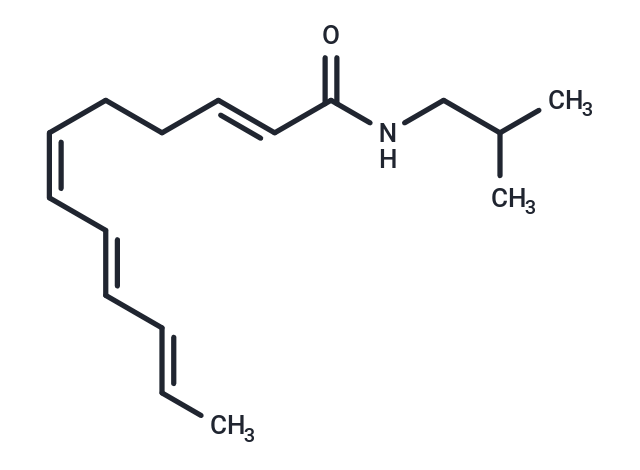
Synonyms: Sanshool, Neoherculin, Echinacein, (2E,6Z,8E,10E)-N-(2-methylpropyl)dodeca-2,6,8,10-tetraenamide

| Pack Size | Price | USA Stock | Global Stock | Quantity |
|---|---|---|---|---|
| 5 mg | $56 | Inquiry | Inquiry | |
| 10 mg | $83 | Inquiry | Inquiry | |
| 25 mg | $141 | Inquiry | Inquiry | |
| 50 mg | $211 | Inquiry | Inquiry | |
| 100 mg | $317 | Inquiry | Inquiry | |
| 500 mg | $589 | Inquiry | Inquiry |
| Description | α-Sanshool (Neoherculin) is a natural product isolated from Zanthoxylum bungeanum. Sanshool can ameliorate UVB-induced skin photodamage by targeting JAK2/STAT3-dependent autophagy. |
| In vitro | Method: Human dermal fibroblasts (HDFs) were pretreated with α-Sanshool (10–40 μM) and then exposed to UVB irradiation (40 mJ/cm²). After 24 h, cell viability was assessed by CCK-8 assay, MMP-1 and MMP-3 expression was detected by ELISA and Western blot, and ROS levels were measured using DCF-DA probe combined with flow cytometry. Result: α-Sanshool dose-dependently increased the cell viability of UVB-irradiated HDFs, significantly inhibited UVB-induced secretion and protein expression of MMP-1 and MMP-3, and reduced ROS production [1]. Method: HDFs were treated with α-Sanshool (40 μM) for 24 h, or treated with Sanshool following UVB irradiation. The expression of JAK2, p-JAK2, STAT3, p-STAT3, AKT, and p-AKT was detected by Western blot. In some experiments, cells were pretreated with the JAK2 inhibitor AZD1480 to observe changes in autophagic flux and cell viability. Result: UVB irradiation upregulated the phosphorylation levels of JAK2, STAT3, and AKT in HDFs, while α-Sanshool treatment significantly inhibited this phosphorylation activation. AZD1480 pretreatment further enhanced α-Sanshool-induced autophagy and improved cell viability, suggesting that α-Sanshool exerts its protective effects through inhibition of the JAK2/STAT3 pathway [1]. |
| In vivo | Method: Six-week-old female nude mice were topically applied with α-Sanshool (20 mg/kg) on the dorsal skin. After 30 min, the mice were exposed to UVB irradiation (300 mJ/cm²) three times per week for 2 weeks. Erythema scores were evaluated, and skin sections were subjected to H&E staining, Verhoeff elastic fiber staining, LC3 immunofluorescence staining, and immunohistochemical staining for JAK2, STAT3, and AKT. Result: Topical application of α-Sanshool significantly alleviated erythema, scaling, and dryness on the dorsal skin of UVB-irradiated mice. H&E staining revealed reduced epidermal thickening and inflammatory infiltration, while Verhoeff staining showed increased elastic fibers and improved collagen density. Immunofluorescence staining demonstrated an increase in LC3-positive punctate structures, and immunohistochemistry showed decreased expression of JAK2, STAT3, and AKT, consistent with the in vitro results [1]. |
| Synonyms | Sanshool, Neoherculin, Echinacein, (2E,6Z,8E,10E)-N-(2-methylpropyl)dodeca-2,6,8,10-tetraenamide |
| Molecular Weight | 247.38 |
| Formula | C16H25NO |
| Cas No. | 504-97-2 |
| Smiles | C(=C/CC/C=C\C=C\C=C\C)\C(NCC(C)C)=O |
| Relative Density. | 0.904g/cm3 |
| Storage | Powder: -20°C for 3 years | In solvent: -80°C for 1 year Shipping with blue ice/Shipping at ambient temperature. |
 For example, if the intended dosage is 10 mg/kg for animals weighing 20 g , with a dosing volume of 100 μL per animal, and a total of 10 animals are to be administered, using a formulation of
  10% DMSO+ 40% PEG300+ 5% Tween 80+ 45% Saline/PBS/ddH2O , the resulting working solution concentration would be 2 mg/mL.
Dissolve 2 mg of the compound in 100 μL DMSO to obtain a stock solution at a concentration of 20 mg/mL . If the required concentration exceeds the compound's known solubility, please contact us for technical support before proceeding.
1) Add 100 μL of the DMSO stock solution to 400 µL PEG300 and mix thoroughly until the solution becomes clear.
2) Add 50 µL Tween 80 and mix well until fully clarified.
3) Add 450 µL Saline,PBS or ddH2O and mix thoroughly until a homogeneous solution is obtained.
| Size | Quantity | Unit Price | Amount | Operation |
|---|
 Feedback
 Hello! How can I help you today?
Copyright © 2015-2026 TargetMol Chemicals Inc. All Rights Reserved.
