


Shopping Cart
Remove All Your shopping cart is currently empty


Synonyms: MK-8669, Deforolimus, AP23573
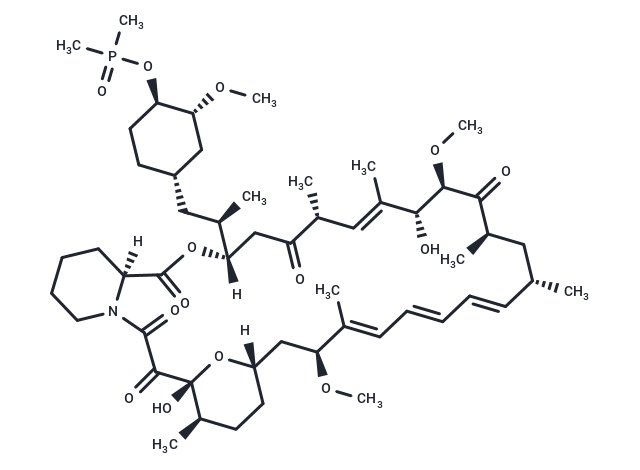
| Pack Size | Price | USA Stock | Global Stock | Quantity |
|---|---|---|---|---|
| 5 mg | $51 | In Stock | In Stock | |
| 10 mg | $81 | In Stock | In Stock | |
| 25 mg | $165 | In Stock | In Stock | |
| 50 mg | $297 | In Stock | In Stock |
| Description | Ridaforolimus (AP23573) is a small molecule and non-prodrug analogue of the lipophilic macrolide antibiotic rapamycin with potential antitumor activity. Ridaforolimus binds to and inhibits the mammalian target of rapamycin (mTOR), which may result in cell cycle arrest and, consequently, the inhibition of tumor cell growth and proliferation. Upregulated in some tumors, mTOR is a serine/threonine kinase involved in regulating cellular proliferation, motility, and survival that is located downstream of the PI3K/Akt signaling pathway. |
| Targets & IC50 | mTOR (HT-1080 cells):0.2 nM |
| In vitro | Deforolimus exhibits significant antitumor activity in a dose-dependent manner in mice bearing xenografts of PC-3 (prostate), HCT-116 (colon), MCF7 (breast), PANC-1 (pancreas), or A549 (lung) cancers. It inhibits the mTOR signaling pathway in the SK-LMS-1 xenograft model associated with the inhibition of tumor growth. |
| In vivo | Deforolimus exhibits dose-dependent inhibition of S6 and 4E-BP1 phosphorylation in HT-1080 cells, with IC50 values of 0.2 nM and 5.6 nM, respectively, and EC50 values of 0.2 nM and 1.0 nM, respectively. It leads to a reduction in cell size, an increase in G1 phase cells, and inhibition of glucose uptake, with an EC50 range of 0.1-1 nM. Demonstrating significant antiproliferative activity across a spectrum of cell lines, Deforolimus has EC50 values ranging from 0.2 to 2.3 nM. It effectively and selectively inhibits VEGF production in a dose-dependent manner, with an EC50 of ~0.1 nM. When combined with MEK inhibitors CI-1040 or PD0325901 on human lung cancer cell lines, Deforolimus synergizes, leading to a dose-dependent reduction in cell proliferation rather than an increase in cell apoptosis. This combination, after a 24-hour treatment, results in a 40% inhibition of ribosomal synthesis and a decrease in the ratio of polysomes to monosomes. Notably, Deforolimus significantly inhibits the growth of human NSCLC cell lines (except for H157 cells) with IC30 values between 2.45-8.83 nM, but its effect on H157 cells shows an IC30 >20 nM. Treating A549, H1703, and H157 cells (excluding H1666 cells with mTORC1-resistant mutations) with 2.8-5.9 nM Deforolimus results in dephosphorylation of p70S6KThr389 and increased phosphorylation levels of pAKTser473 and pAKTThr308 in A549 and H1703 cells. |
| Synonyms | MK-8669, Deforolimus, AP23573 |
| Kinase Assay | HT-1080 cells are treated with increasing concentrations of Deforolimus (0-100 nM) for 2 hours, prior to harvest. Cellular lysates are extracted in denaturing lysis buffer, resolved on SDS-PAGE and transferred to PVDF membranes. After blocking, membranes are incubated with primary antibodies for 1 hour, followed by appropriate HRPconjugated secondary antibodies for 1 hour at room temperature. Immunoreactive proteins are detected using enhanced chemiluminescence and autoradiography performed by exposure to X-ray film. IC50 is determined by the inhibition of levels of phosphorylated ribosomal protein S6 (p-S6) and 4E-BP1 (p-4E-BP1). |
| Cell Research | Cell lines: Colo205,H1755,H1395,H1666,A549,H157,and H1703 cells. Concentrations: Dissolved in ethanol,final concentrations ~ 1 μM. Method: Cells are seeded at 2-3 ×10⁴/mL,and serial dilutions of Deforolimus are added after 2 hours,for at least three cell doublings (72-120 hours).Deforolimus effects are measured by the CellTiter 96 Aqueous nonradioactive cell proliferation assay and Sulforhodamine B assays. |
| Animal Research | Animal Models: Male and female athymic NCr-nu mice with xenografts established by subcutaneous implantation of PC-3,A549,HCT-116,MCF7,PANC-1 and SK-LMS-1 tumors. Formulation: Dissolved in ethanol,and diluted in a vehicle of 4% ethanol,5% Tween 80,and 5% propylene glycol. Dosages: ~10 mg/kg. Administration: Intraperitoneally injection |
| Molecular Weight | 990.21 |
| Formula | C53H84NO14P |
| Cas No. | 572924-54-0 |
| Smiles | [H][C@@]12CC[C@@H](C)[C@@](O)(O1)C(=O)C(=O)N1CCCC[C@@]1([H])C(=O)O[C@@]([H])(CC(=O)[C@H](C)\C=C(C)\[C@@H](O)[C@@H](OC)C(=O)[C@H](C)C[C@H](C)\C=C\C=C\C=C(C)\[C@H](C2)OC)[C@H](C)C[C@@H]1CC[C@@H](OP(C)(C)=O)[C@@H](C1)OC |
| Relative Density. | 1.18 g/cm3 |
| Storage | Powder: -20°C for 3 years Shipping with blue ice/Shipping at ambient temperature. | |||||||||||||||||||||||||||||||||||
| Solubility Information | H2O: < 1 mg/mL (insoluble or slightly soluble) Ethanol: < 1 mg/mL (insoluble or slightly soluble) DMSO: 160 mg/mL (161.58 mM), Sonication is recommended.  | |||||||||||||||||||||||||||||||||||
| In Vivo Formulation | 10% DMSO+40% PEG300+5% Tween 80+45% Saline: 10 mg/mL (10.1 mM), Solution. 10% DMSO+90% Saline: < 10 mg/mL (10.1 mM), Lower concentrations may be soluble, but exact solubility limit is unknown. Please add the solvents sequentially, clarifying the solution as much as possible before adding the next one. Dissolve by heating and/or sonication if necessary. Working solution is recommended to be prepared and used immediately. The formulation provided above is for reference purposes only. In vivo formulations may vary and should be modified based on specific experimental conditions. | |||||||||||||||||||||||||||||||||||
Solution Preparation Table | ||||||||||||||||||||||||||||||||||||
DMSO
Note : The dilution table applies only to solid products. For liquid products, please calculate the stock solution based on the stated concentration and/or density. | ||||||||||||||||||||||||||||||||||||
 For example, if the intended dosage is 10 mg/kg for animals weighing 20 g , with a dosing volume of 100 μL per animal, and a total of 10 animals are to be administered, using a formulation of
  10% DMSO+ 40% PEG300+ 5% Tween 80+ 45% Saline/PBS/ddH2O , the resulting working solution concentration would be 2 mg/mL.
Dissolve 2 mg of the compound in 100 μL DMSO to obtain a stock solution at a concentration of 20 mg/mL . If the required concentration exceeds the compound's known solubility, please contact us for technical support before proceeding.
1) Add 100 μL of the DMSO stock solution to 400 µL PEG300 and mix thoroughly until the solution becomes clear.
2) Add 50 µL Tween 80 and mix well until fully clarified.
3) Add 450 µL Saline,PBS or ddH2O and mix thoroughly until a homogeneous solution is obtained.
| Size | Quantity | Unit Price | Amount | Operation |
|---|
 Feedback
 Hello! How can I help you today?
Copyright © 2015-2026 TargetMol Chemicals Inc. All Rights Reserved.
