


Shopping Cart
Remove All Your shopping cart is currently empty

Synonyms: LY3437943
| Pack Size | Price | USA Stock | Global Stock | Quantity |
|---|---|---|---|---|
| 1 mg | $235 | - | In Stock | |
| 5 mg | $591 | In Stock | In Stock |
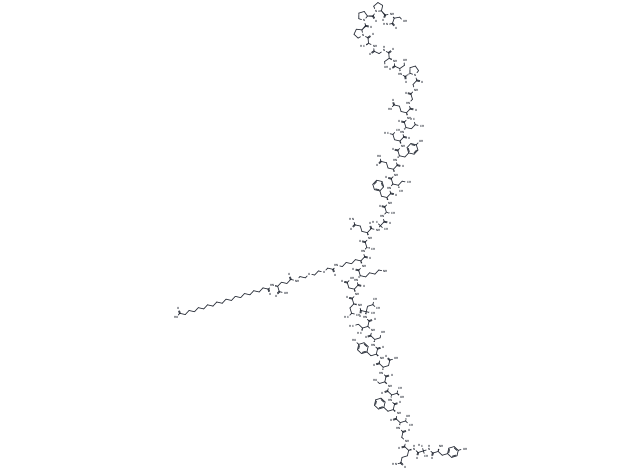
| Description | Retatrutide is a triple receptor agonist targeting the glucagon-like peptide-1 receptor (GLP-1R), glucose-dependent insulinotropic polypeptide receptor (GIPR), and glucagon receptor (GCGR), with FDA approval for the indication of obesity.Retatrutide may be used in studies of obesity, type 2 diabetes, and non-alcoholic steatohepatitis. |
| Targets & IC50 | GCGR:5.79 nM (EC50, human), GLP1 receptor:0.775 nM (EC50, human), GCGR:73 nM (Ki, mouse), GIPR:0.0643 nM (EC50, human), GLP1 receptor:7.2 nM (Ki, human), GIPR:0.057 nM (Ki, human), GIPR:0.191 nM (EC50, mouse), GIPR:2.8 nM (Ki, mouse), GCGR:5.6 nM (Ki, human), GLP1 receptor:0.794 nM (EC50, mouse), GLP1 receptor:1.3 nM (Ki, mouse), GCGR:2.32 nM (EC50, mouse) |
| In vitro | Methods: HEK-293 cells expressing human/mouse GCGR, GIPR, and GLP-1R were used to assess Retatrutide’s cAMP production and receptor-binding capacity, and to evaluate its in vitro agonist activity. Results: Retatrutide is a full agonist at all three receptors, exhibiting stronger activity at the GIPR and balanced activity at the GCGR and GLP-1R.[2] |
| In vivo | Methods: C57BL/6N mice were divided into 4 groups and fed for 31 days. Control group: standard diet + tap water; Western diet group: Western diet + tap water; Western diet + sugar water group: Western diet + drinking water containing fructose/sucrose; Western diet + sugar water + terminal fructose gavage group: same as above, with a single fructose gavage (10 mg/g body weight) administered 6 hours prior to sacrifice on day 31. Subcutaneous administration of Retatrutide (30 nmol/kg) began during the final 2 weeks of the model (i.e., days 18–31), with a frequency of once every 3 days during the penultimate week and once every 2 days during the final week, for a total of 7 injections. Results: In female mice, compared with the solvent control group, Retatrutide intervention significantly reduced body weight, lowered ALT levels, decreased hepatic triglycerides and cholesterol, reduced hepatic inflammatory markers, and improved MASH pathological features. [1] Methods: Diet-induced obese (DIO) mice were administered subcutaneous injections of 0.3, 1, 3, 15, or 30 nmol/kg Retatrutide (once every 3 days for 21 consecutive days), and body weight, food intake, body composition, and glucose metabolism parameters were continuously monitored. Results: Retatrutide dose-dependently reduced body weight, decreased food intake, and lowered fat mass in mice, while significantly improving blood glucose levels and insulin sensitivity. [2] Methods: Rhesus monkeys were administered subcutaneous injections of 0.05, 0.15, or 0.5 mg/kg of Retatrutide weekly for 6 consecutive months to evaluate long-term cardiovascular safety. Results: Long-term administration of Retatrutide caused a sustained increase in heart rate, which was reversible during the recovery period following discontinuation of the drug and did not result in irreversible cardiovascular damage. [2] Methods: 8-week-old db/db diabetic nephropathy mice were administered 10 nmol/kg of Retatrutide via intraperitoneal injection for 10 consecutive weeks. Blood glucose, body weight, blood lipids, renal function, markers of renal inflammation and fibrosis, and intestinal butyrate levels were measured. Results: Retatrutide effectively reduced body weight, improved renal function, suppressed renal inflammation (TNF-α, caspase-1, NLRP3) and fibrosis (fibronectin, α-SMA, type I collagen), and increased intestinal butyrate levels. [3] |
| Synonyms | LY3437943 |
| Molecular Weight | 4732.09 |
| Formula | C221H342N46O68 |
| Cas No. | 2381089-83-2 |
| Smiles | CC[C@H](C)C(C(=O)N[C@@H](CCC(=O)O)C(=O)N[C@@H](CC1=CC=C(C=C1)O)C(=O)N[C@@H](CC(C)C)C(=O)N[C@@H](CC(C)C)C(=O)N[C@@H](CCC(=O)O)C(=O)NCC(=O)NCC(=O)N2CCC[C@H]2C(=O)N[C@@H](CO)C(=O)N[C@@H](CO)C(=O)NCC(=O)N[C@@H](C)C(=O)N3CCC[C@H]3C(=O)N4CCC[C@H]4C(=O)N5CCC[C@H]5C(=O)N[C@@H](CO)C(=O)N)NC(=O)[C@H](CC6=CC=CC=C6)NC(=O)[C@H](C)NC(=O)C(C)(C)NC(=O)[C@H](CCC(=O)N)NC(=O)[C@H](C)NC(=O)[C@H](CCCCNC(=O)COCCOCCNC(=O)CC[C@@H](C(=O)O)NC(=O)CCCCCCCCCCCCCCCCCCC(=O)O)NC(=O)[C@H](CCCCN)NC(=O)[C@H](CC(=O)O)NC(=O)[C@H](CC(C)C)NC(=O)[C@@](C)(CC(C)C)NC(=O)C([C@@H](C)CC)NC(=O)[C@H](CO)NC(=O)[C@H](CC7=CC=C(C=C7)O)NC(=O)[C@H](CC(=O)O)NC(=O)[C@H](CO)NC(=O)[C@H]([C@@H](C)O)NC(=O)[C@H](CC8=CC=CC=C8)NC(=O)[C@H]([C@@H](C)O)NC(=O)CNC(=O)[C@H](CCC(=O)N)NC(=O)C(C)(C)NC(=O)[C@H](CC9=CC=C(C=C9)O)N |
| Sequence | Tyr-{Aib}-Gln-Gly-Thr-Phe-Thr-Ser-Asp-Tyr-Ser-Ile-{(αMe)Leu}-Leu-Asp-Lys-{Lys(AEEA-AEEA-γGlu-C20 diacid)}-Ala-Gln-{Aib}-Ala-Phe-Ile-Glu-Tyr-Leu-Leu-Glu-Gly-Gly-Pro-Ser-Ser-Gly-Ala-Pro-Pro-Pro-Ser-NH₂ |
| Sequence Short | YXQGTFTSDYSILLDKKAQXAFIEYLLEGGPSSGAPPPS |
| Storage | Store at low temperature,Keep away from moisture Powder: -20°C for 3 years | In solvent: -80°C for 1 year Shipping with blue ice/Shipping at ambient temperature. | |||||||||||||||
| Solubility Information | H2O: 30 mg/mL (6.34 mM), when pH is adjusted to 7 with NaOH. Sonication is recommended. DMSO: 30 mg/mL (6.34 mM), Sonication is recommended. | |||||||||||||||
Solution Preparation Table | ||||||||||||||||
H2O/DMSO
Note : The dilution table applies only to solid products. For liquid products, please calculate the stock solution based on the stated concentration and/or density. | ||||||||||||||||
 For example, if the intended dosage is 10 mg/kg for animals weighing 20 g , with a dosing volume of 100 μL per animal, and a total of 10 animals are to be administered, using a formulation of
  10% DMSO+ 40% PEG300+ 5% Tween 80+ 45% Saline/PBS/ddH2O , the resulting working solution concentration would be 2 mg/mL.
Dissolve 2 mg of the compound in 100 μL DMSO to obtain a stock solution at a concentration of 20 mg/mL . If the required concentration exceeds the compound's known solubility, please contact us for technical support before proceeding.
1) Add 100 μL of the DMSO stock solution to 400 µL PEG300 and mix thoroughly until the solution becomes clear.
2) Add 50 µL Tween 80 and mix well until fully clarified.
3) Add 450 µL Saline,PBS or ddH2O and mix thoroughly until a homogeneous solution is obtained.
| Size | Quantity | Unit Price | Amount | Operation |
|---|
 Feedback
 Hello! How can I help you today?
Copyright © 2015-2026 TargetMol Chemicals Inc. All Rights Reserved.
