


Shopping Cart
Remove All Your shopping cart is currently empty

Synonyms: Prodigiosine hydrochloride
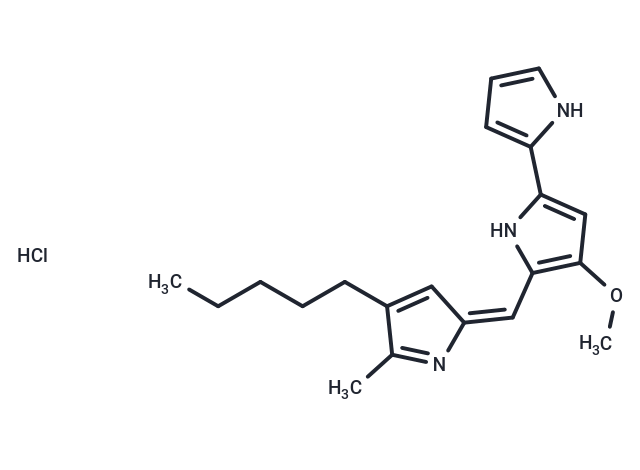
| Pack Size | Price | USA Stock | Global Stock | Quantity |
|---|---|---|---|---|
| 25 mg | $6,329 | Inquiry | Inquiry |
| Description | Prodigiosin hydrochloride, a red pigment, is a bioactive secondary metabolite produced by bacteria. It exhibits potent proapoptotic activity and functions as an inhibitor of the Wnt/β-catenin pathway. Additionally, this compound possesses antibacterial, antifungal, antiprotozoal, antimalarial, immunosuppressive, and anticancer properties. |
| In vitro | Treatment with Prodigiosin (25-500 nM) for 24 hours significantly reduces the viability and proliferation of breast cancer cells, specifically demonstrating IC50 values of 62.52 nM in MDA-MB-231 cells and 261.2 nM in MDA-MB-468 cells after 48 hours. Furthermore, this treatment markedly diminishes the levels of crucial components in the Wnt signaling pathway, namely phosphorylated LRP6, DVL2, active and total β-catenin in cell line studies, while also enhancing GSK3β activity through reduced phosphorylation at Ser9 in HEK293T cells. These effects suggest a potent inhibition of cell proliferation and induction of apoptosis in breast cancer cells, as well as a dose-dependent blockage of Wnt signaling stimulated by various Wnt factors in transfected HEK293T cells. Additionally, Prodigiosin exhibits significant antifungal activity against chytrid fungi, Batrachochytrium dendrobatidis, and B. salamandrivorans, with MIC values of 10 μM and 50 μM, respectively. These findings underscore Prodigiosin's broad biological activity, including its ability to inhibit Wnt signaling and its potential therapeutic applications in cancer and fungal infections. |
| In vivo | Prodigiosin (5 mg/kg; intraperitoneal injection; twice weekly; for 3 weeks) significantly inhibits tumor growth by reducing tumor cell density and decreasing Ki-67 expression in female BALB/c nude mice injected with MDA-MB-231 cells[1], resulting in marked tumor growth inhibition. |
| Synonyms | Prodigiosine hydrochloride |
| Molecular Weight | 359.9 |
| Formula | C20H26ClN3O |
| Cas No. | 56144-17-3 |
| Smiles | Cl.CCCCCC1=C\C(=C/c2[nH]c(cc2OC)-c2ccc[nH]2)N=C1C |
| Relative Density. | no data available |
| Storage | Powder: -20°C for 3 years | In solvent: -80°C for 1 year Shipping with blue ice/Shipping at ambient temperature. |
 For example, if the intended dosage is 10 mg/kg for animals weighing 20 g , with a dosing volume of 100 μL per animal, and a total of 10 animals are to be administered, using a formulation of
  10% DMSO+ 40% PEG300+ 5% Tween 80+ 45% Saline/PBS/ddH2O , the resulting working solution concentration would be 2 mg/mL.
Dissolve 2 mg of the compound in 100 μL DMSO to obtain a stock solution at a concentration of 20 mg/mL . If the required concentration exceeds the compound's known solubility, please contact us for technical support before proceeding.
1) Add 100 μL of the DMSO stock solution to 400 µL PEG300 and mix thoroughly until the solution becomes clear.
2) Add 50 µL Tween 80 and mix well until fully clarified.
3) Add 450 µL Saline,PBS or ddH2O and mix thoroughly until a homogeneous solution is obtained.
| Size | Quantity | Unit Price | Amount | Operation |
|---|
 Feedback
 Hello! How can I help you today?
Copyright © 2015-2026 TargetMol Chemicals Inc. All Rights Reserved.
