


Shopping Cart
Remove All Your shopping cart is currently empty

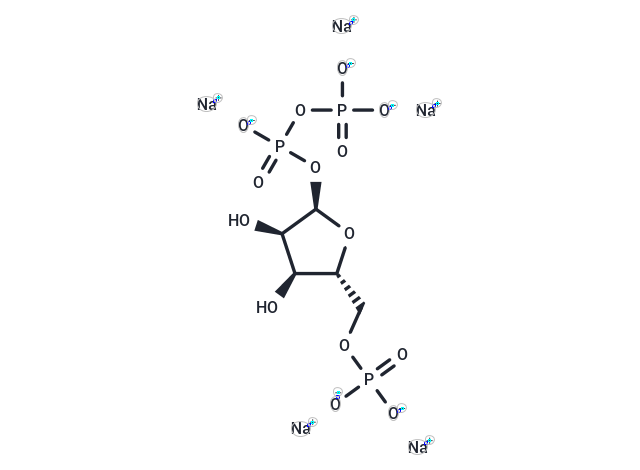
Synonyms: PRPPpentasodium, PRPP pentasodium
| Pack Size | Price | USA Stock | Global Stock | Quantity |
|---|---|---|---|---|
| 1 mg | $54 | - | In Stock | |
| 5 mg | Preferential | 7-10 days | 7-10 days |
| Description | Phosphoribosyl pyrophosphate pentasodium is the sodium salt form of PRPP. PRPP is a phosphoribosyl donor for AMP and GMP synthesis in reactions catalysed by adenine phosphoribosyltransferase and hypoxanthine/guanine phosphoribosyltransferase. PRPP is synthesized from ribose-5-phosphate and ATP by PRPP synthetase (EC 2.7.6.1). |
| In vitro | Phosphoribosyl diphosphate (PRPP) pentasodium serves as a crucial intermediate in cellular metabolism, synthesized via the action of PRPP synthase from ribose 5-phosphate and ATP, yielding PRPP and AMP. PRPP, ubiquitous in living organisms, participates in substitution reactions leading to glycosidic bond formation. It plays a pivotal role in the biosynthesis of purine and pyrimidine nucleotides, amino acids like histidine and tryptophan, cofactors such as NAD and tetrahydromethanopterin, arabinosyl monophosphodecaprenol, and some aminoglycoside antibiotics. Additionally, as a common substrate for adenine phosphoribosyltransferase and hypoxanthine-guanine phosphoribosyltransferase, PRPP pentasodium accumulates in human erythrocytes deficient in hypoxanthine-guanine phosphoribosyltransferase. The addition of 5-Phosphoribosyl-1-pyrophosphate to purified adenine phosphoribosyltransferase has been shown to enhance its stability against heat inactivation. |
| Synonyms | PRPPpentasodium, PRPP pentasodium |
| Molecular Weight | 499.98 |
| Formula | C5H8Na5O14P3 |
| Cas No. | 108321-05-7 |
| Smiles | O=P([O-])([O-])OP(O[C@H]1O[C@@H]([C@H]([C@H]1O)O)COP([O-])([O-])=O)([O-])=O.[Na+].[Na+].[Na+].[Na+].[Na+] |
| Storage | Keep away from moisture,Store at low temperature Powder: -20°C for 3 years | In solvent: -80°C for 1 year Shipping with blue ice/Shipping at ambient temperature. | ||||||||||||||||||||||||||||||
| Solubility Information | H2O: 40 mg/mL (80 mM), Sonication is recommended. | ||||||||||||||||||||||||||||||
Solution Preparation Table | |||||||||||||||||||||||||||||||
H2O
Note : The dilution table applies only to solid products. For liquid products, please calculate the stock solution based on the stated concentration and/or density. | |||||||||||||||||||||||||||||||
 For example, if the intended dosage is 10 mg/kg for animals weighing 20 g , with a dosing volume of 100 μL per animal, and a total of 10 animals are to be administered, using a formulation of
  10% DMSO+ 40% PEG300+ 5% Tween 80+ 45% Saline/PBS/ddH2O , the resulting working solution concentration would be 2 mg/mL.
Dissolve 2 mg of the compound in 100 μL DMSO to obtain a stock solution at a concentration of 20 mg/mL . If the required concentration exceeds the compound's known solubility, please contact us for technical support before proceeding.
1) Add 100 μL of the DMSO stock solution to 400 µL PEG300 and mix thoroughly until the solution becomes clear.
2) Add 50 µL Tween 80 and mix well until fully clarified.
3) Add 450 µL Saline,PBS or ddH2O and mix thoroughly until a homogeneous solution is obtained.
| Size | Quantity | Unit Price | Amount | Operation |
|---|
 Feedback
 Hello! How can I help you today?
Copyright © 2015-2026 TargetMol Chemicals Inc. All Rights Reserved.
